

by Rinki Pandey December 2, 2025
In rental housing, compliance with assistance-animal regulations has become one of the most sensitive and complex parts of property management. Over the past decade, emotional support animals (ESAs) and service animals have become increasingly common in residential communities, and with that shift has come confusion, conflict, and legal risk. Many landlords want to protect their property from damage or nuisance concerns, while residents with disabilities need equal access to housing and reasonable accommodations that allow them to live independently.
Navigating these expectations responsibly requires clarity, structure, and a deep understanding of the regulatory landscape surrounding ESA verification compliance.
Unlike pet-related rules, which vary widely by property and policy, assistance-animal regulations are grounded in federal protections tied directly to civil rights law. In other words, the subject is not simply about pets; it is about disability accommodation, and therefore must be handled with accuracy, consistency, and respect. When verification is conducted improperly whether through skepticism, discrimination, or accidental misuse of documentation property managers can face legal complaints, compliance penalties, and damaged reputations. On the other hand, a well-built ESA verification workflow supports transparency, protects fair housing rights, minimizes conflict, and reduces fraud from illegitimate documentation. In today’s housing environment, compliance is no longer optional; it is a professional standard.
To manage this effectively, property managers must understand three connected areas: the legal distinctions between pets, service animals, and ESAs; the rules governing documentation and verification; and the systems and processes that ensure consistent, fair, repeatable decisions. This article explores those concepts in depth and guides on building an ESA verification compliance framework that is both lawful and practical for modern residential settings.
Understanding the Legal Difference Between Service Animals and ESAs

One of the most significant sources of confusion in residential housing is the belief that all support animals are treated the same. They do not. Service animals and ESAs are legally defined differently, protected differently, and cannot be processed identically when evaluating accommodation requests. To remain compliant, property managers must clearly recognize the distinctions.
Service animals are trained to perform specific tasks directly related to a person’s disability such as guiding individuals who are visually impaired, alerting to seizures, reminding someone to take medication, or responding to panic attacks. Because they provide task-based assistance, they fall under a different legal category and are protected with much stronger regulatory boundaries. Service animals are not considered pets; therefore, policies such as pet deposits, breed restrictions, or weight limits cannot be applied to them, regardless of the property’s preference.
Emotional support animals, by contrast, do not perform trained tasks but provide therapeutic emotional or psychological support to individuals experiencing disabilities such as anxiety, PTSD, chronic depression, or panic disorders. ESAs are protected within residential settings as part of fair housing disability accommodation. Still, this protection does not automatically extend to public spaces in the same way that service animal rules do. Because ESAs do not require specialized training, verification focuses on documenting the disability-related need rather than proving specific animal skills.
Confusing the two categories can lead to legal exposure and conflict with tenants who feel misunderstood or disrespected. By creating thoughtful policies grounded in fair housing principles, property managers help ensure compliance while maintaining trust and transparency.
The Regulatory Foundation Behind ESA Verification Compliance

ESA accommodation requests must be processed in accordance with housing compliance standards that prohibit discrimination and require an individualized evaluation of each request. Because assistance-animal rules fall under disability rights, the focus must always remain on fairness, consistency, and confidentiality.
When a resident requests an accommodation, the property manager’s responsibility is not to judge the legitimacy of the disability itself, but to verify the need appropriately and confirm the documentation is accurate.
In many cases, property managers may request reliable supporting documentation if a disability or related need is not apparent. This documentation typically comes from a qualified licensed healthcare practitioner who has a legitimate doctor-patient relationship with the resident requesting the accommodation. Proper verification is designed to prevent abuse of ESA status while ensuring residents with valid needs are supported without unnecessary barriers.
One area where many housing providers struggle is the rise of fraudulent ESA documentation mills that generate letters without evaluation or a clinical relationship.
Properties aren’t required to accept documentation that appears to be commercially generated, lacks appropriate licensing information, or shows no legitimate connection to a care provider. However, rejecting documentation without a clear verification protocol can still lead to conflict or compliance challenges. That’s why structured, consistent workflows are essential, not reactive decisions.
When verification is handled thoughtfully, property managers can balance legal compliance in property management with property protection. The process becomes predictable, transparent, and equitable reducing emotional tension and protecting everyone involved.
Why Clear Processes Reduce Conflict and Legal Risk
Requests involving assistance animals are often emotionally charged because they involve personal health, disability identity, safety concerns, and community standards. Conflicts arise when policies are vague, inconsistently enforced, or appear subjective. Residents expect fairness. Property managers require clarity. Legal authorities evaluate repeatability and documentation.
A clearly defined ESA verification process protects both residents and housing professionals by eliminating guesswork. When every request is handled through the same workflow with consistent timelines, documentation standards, and communication style, individuals feel respected and informed instead of dismissed or challenged. This reduces complaints, misinterpretations, and allegations of discriminatory treatment.
Beyond legal risk, unclear processes create operational strain. Staff members may offer conflicting information, decisions may vary by manager, and outcomes may be questioned. But when compliance standards are written, distributed, and trained across the team, property management becomes more confident, predictable, and defensible. Firm policy is not just about avoiding fines or lawsuits; it is about building a professionally run housing environment grounded in fairness and structure.
In today’s rental environment, compliance is not measured solely by final decisions but also by transparency, documentation, and the consistency of processes.
Evaluating Documentation and Preventing Verification Abuse

The growing prevalence of online ESA letters and certification services has created an entirely new challenge for verification compliance. Many of the documents circulating online are purchased through commercial platforms rather than provided by licensed clinicians working directly with a patient. Because of this, property managers must learn to evaluate documentation appropriately without crossing into invasive or illegal questioning.
In a compliant verification process, the goal is to confirm that the documentation is reliable and issued by a legitimate practitioner. It is not appropriate to request details about diagnosis, medical history, or specific symptoms. Instead, the focus is on confirming professional credentials, relationship to the resident, identifiable licensing information, and a reasonable statement explaining how the animal supports the disability-related need.
Without structured evaluation standards, housing providers face a flood of questionable documentation that undermines legitimate accommodation needs, frustrates staff, and creates tension between residents. But when verification methods are consistent, fair, and well-communicated, most conflicts resolve quickly and respectfully. Fraud decreases, misunderstandings fade, and approval decisions become clean and administrative rather than personal or confrontational.
In the next section, we will explore the importance of aligning policies across property teams and standardizing internal training to support long-term compliance and risk reduction.
Creating Internal Consistency Through Team Training and Written Policies

Even the best compliance strategy fails when only one person understands it. Assistance-animal request handling must never rely solely on personal judgment. When decisions depend on who answers the phone, which manager is on duty, or how stressed someone feels that day, compliance breaks down, and residents lose trust. That’s why internal training is one of the most crucial aspects of ESA verification compliance. Every member of the leasing office, management team, and communication staff must understand what can and cannot legally be asked, what the verification process includes, and how to speak respectfully with applicants.
Training is not just about protecting against legal complaints; it builds consistency. When residents receive the same answer from every team member, they feel respected and reassured that the process is fair. Staff feel more confident, less anxious, and better equipped to respond professionally rather than react emotionally. Written policy documents, step-by-step procedures, internal scripts, and role-play conversations can be incredibly helpful. Instead of improvising, your team follows documented standards that support stable outcomes.
Moreover, clearly defining internal timelines protects both the resident and the business. For example, properties may set a standard review window after receiving documentation, or a specific way to communicate delays or requests for clarification.
When everything is structured, the conversation becomes administrative rather than personal. The more predictable the process, the less likely it is that conflict will arise. Compliance thrives on clarity, documentation, and repetition — and training is the foundation that supports all three.
Aligning Property Rules With Fair Housing Expectations
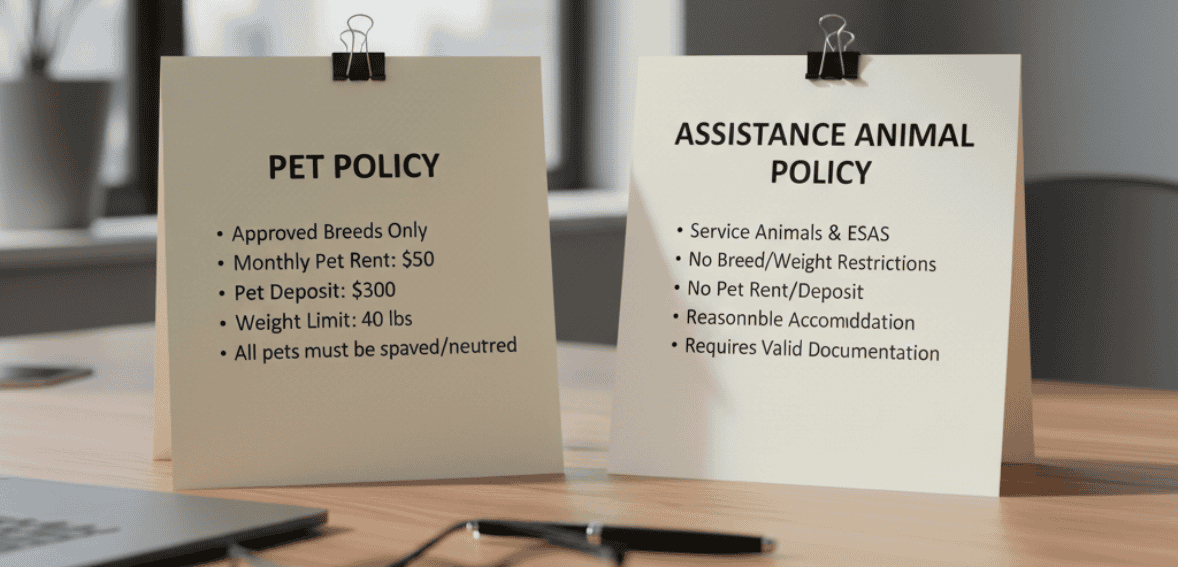
To truly support ESA verification compliance, properties must ensure that general pet policies and assistance-animal rules remain clearly separated. Many disputes arise from accidentally mixing the two categories applying pet rules or penalties to an assistance-animal request. Assistance animals are not pets, which means rules like pet rent, pet deposits, breed restrictions, or weight limitations cannot be applied to them. It can be tempting to blur these boundaries when property damage or neighbor concerns arise, but attempting to enforce pet-style restrictions against a lawful accommodation can lead to serious compliance issues.
Proper alignment means reviewing all lease agreements, addenda, community guidelines, and notice templates to ensure language is precise. Some properties successfully separate their documentation so residents clearly see the distinction for example, a standard pet addendum for pet-owning residents, and a separate assistance-animal accommodation agreement outlining responsibilities such as cleaning up after the animal, maintaining control in shared areas, and preventing unreasonable disturbances. These behavioral responsibilities apply to all animals, including ESAs and service animals, because they relate to safety and peaceful living not fees or restrictions.
Clarifying what applies and what does not prevents resentment on both sides. Pet owners should understand why rules differ. ESA households feel respected rather than singled out. And property teams become confident in managing requests without guessing or debating. Substantial compliance means clean, organized differentiation and a philosophy built on fairness rather than confrontation.
Managing Community Concerns and Communication Challenges

Even when policies are legally correct, community members may express frustrations or misunderstandings about assistance animals such as noise concerns, allergies, fear of certain breeds, or perceived unfairness. In those moments, property managers must act as mediators, balancing individual accommodation needs with community well-being. Handling these situations thoughtfully requires calm communication and education rather than abrupt enforcement or defensiveness.
When residents voice concerns, listening is crucial. Acknowledging feelings builds trust even before solutions appear. Then, managers can explain that assistance animals are permitted under federal accommodation rules and are not categorized as pets. When residents understand the legal foundation, conflict often decreases.
Beyond education, setting realistic behavioral expectations for all animals in the building reinforces fairness. If an assistance animal is causing genuine disturbances, excessive noise, aggressive behavior, or damage, managers are allowed to respond just as they would with any other issue that interferes with peaceful living.
Compliance protects disability rights, but it does not require tolerating unsafe or disruptive environments.
Transparent communication also reduces gossip or resentment. When policies are structured, posted clearly, and communicated neutrally, communities adapt more easily. Silence, inconsistency, or secrecy, on the other hand, create distrust and tension. In a well-run residential setting, structure and transparency stabilize the environment, protect vulnerable populations, and reassure everyone that rules are grounded in fairness.
Building a Modern System for ESA Verification Compliance

Housing environments are changing rapidly, and residents expect streamlined, professional processes rather than outdated paper systems or improvised responses. Modern workflows rely on structured, organized, and auditable verification methods that protect both the property and residents. Many organizations now use centralized documentation collection, electronic tracking, secure record retention, and standardized communication templates. Digitizing the process reduces lost paperwork, conflicting information, and memory-based decisions that lead to inconsistent treatment.
Centralized systems also help track timelines, record decisions, and securely store documents. When disputes arise, properties have clear evidence that decisions followed policy, respected fairness, and complied with requirements. In a world where complaints and conflicts can cause costly legal reviews, documentation is protection.
Technology also helps detect patterns such as repeated fraudulent submissions, documentation that shares identical characteristics, or recurring misunderstanding areas that require clearer education. Compliance is not a single action; it is a system of ongoing review and refinement. Structured digital processes transform ESA verification from a stressful confrontation into an administrative workflow supported by predictable structure.
Modernized systems reduce errors, increase transparency, and support respectful collaboration between residents and management teams. They make compliance easier, more defensible, and far more professional.
Conclusion
Regulatory compliance around service animals and emotional support animals is not simply about rules; it is about respect, fairness, and professionalism. Properties that approach ESA verification with structure and clarity not only protect themselves legally but also build trust and stability within their communities. When policies are written clearly, enforced consistently, communicated respectfully, and supported by organized systems, conflict decreases dramatically. Fraud becomes easier to identify without bias, and residents with legitimate needs feel safe and respected. ESA verification compliance is no longer an optional best practice; it is a modern housing requirement and a measure of operational maturity.
FAQs
Can a property deny an ESA request if documentation seems questionable?
Yes, if documentation appears unreliable, incomplete, or commercially generated without a clinical relationship, properties can request clarification or additional verification. The goal is not to reject valid needs, but to confirm legitimacy through a fair, consistent process.
Can a landlord ask what a resident’s disability is when reviewing an ESA request?
No. It is never appropriate to ask about a diagnosis or medical details. Verification focuses only on confirming disability-related needs through proper professional documentation, not on personal health information.
Can service animals or ESAs be restricted from housing?
Only in rare cases where behavior poses a genuine safety threat, causes significant property damage, or cannot be controlled appropriately. Restrictions can’t be based on breed, size, or personal preference only documented behavior issues.
Can properties require pet rent, deposits, or insurance for assistance animals?
No. Assistance animals are not pets and cannot be charged pet-related fees. Property managers may charge for actual damages if they occur, just as they would with any resident.
Why is consistent documentation so necessary in ESA verification compliance?
Consistency protects both residents and property owners by eliminating bias and ensuring defensible decisions. Documented workflows demonstrate fairness, reduce complaints, and support compliance accuracy.