

From Manager to Leader: Building a High-Performing Property Management Team
by Christopher Hayes February 19, 2026
Property management today looks very different from what it did even a few years ago. It is no longer limited to collecting rent on time, fixing occasional maintenance issues, or filling empty units as quickly as possible. Expectations have grown on every side. Property owners want stronger and more consistent returns while residents expect faster responses, better communication, and a living experience that feels smooth and dependable. At the same time, market conditions continue to shift, bringing new challenges and new pressures. In this kind of environment, simply managing daily tasks is not enough. What truly makes meaningful and lasting results is leadership, the ability to guide people with clarity, shape a positive and accountable culture, and build a team that can perform steadily even when situations become demanding or unpredictable.
A high-performing property management team does far more than just keep a building running. It protects the long-term value of the asset, strengthens relationships with residents, reduces costly turnover, and helps create a community where people actually want to stay. None of this happens by chance; it begins when a manager grows into a leader, someone who does not just assign responsibilities but inspires ownership, encourages accountability, and earns genuine trust from the team. A true leader aligns everyone toward shared goals, making sure each person understands not only what they need to do, but why their role matters. The sections that follow explore how this shift from managing to leading can be made, and how it can gradually shape a property management team that performs with greater consistency, confidence, and purpose every single day.
Understanding the Shift: Manager vs. Leader
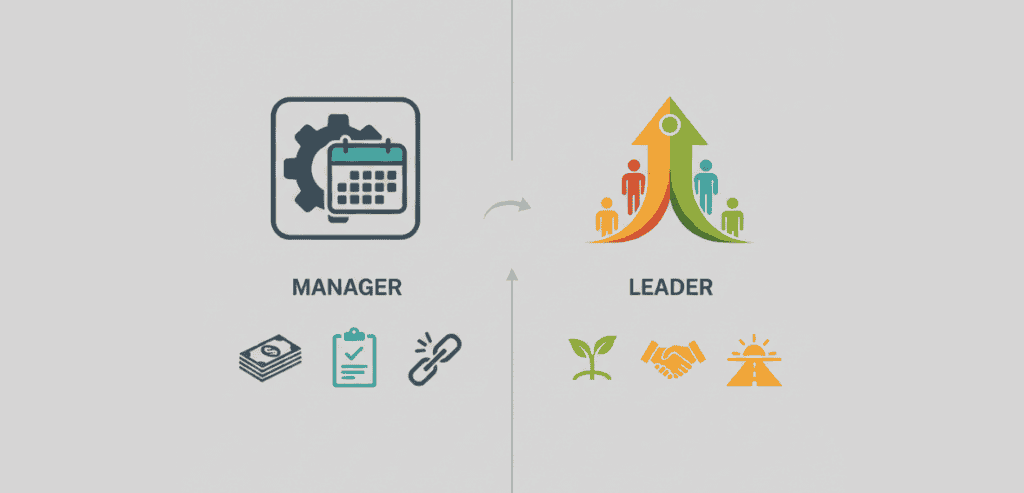
A manager is concerned with the system, schedules, and day-to-day activities. A leader is concerned with people, direction, and long-term results. While both roles are important, one is the key to the other.
Property management activities commonly involve managing work orders, rent payments, policies, and problems for the team. Leadership activities for the team include team development, a service-first culture, personal responsibility, and preparation for growth and change.
For example, a manager could pressure leasing employees to meet monthly targets. Leaders help employees realize the importance of keeping spaces occupied, improve their closing skills with added training, and support them during slow periods. One individual manages tasks. The other individual manages performance.
Build a Clear Vision for the Team
A great team starts with clarity. Without vision, even talented employees lose focus.
As a property leader, determine the kind of service experience that is desired from residents, the response of the team to challenges, and the definition of success beyond the numbers.
For example, rather than stating the need to increase resident retention, a strong leader could state our goal of “building a community in which residents feel heard, feel respected, and feel comfortable staying with us year after year.”
Such clarity of understanding affects behavior. Response to maintenance is quicker, communications in leasing arrangements are better, and the front office becomes more solution based. Performance improves when there is clarity of purpose.
Hire for Attitude, Train for Skill

Technical skills are important, but mindsets are more important. In property management, everything can be taught software, procedures, compliance, and so on. It’s much more difficult to teach ownership, understanding, and accountability.
A high-performance team is created through hiring people who can communicate well, who remain cool under pressure, who care about the job of service, and who take ownership. This means the leasing agent with better people skills can outperform someone with extensive experience but a bad attitude. Moreover, the maintenance technician with better communication skills can outperform colleagues who only repair things quietly.
Once the right people are in place, structured training enables potential to be converted to performance.
Create a Culture of Accountability Without Fear
Accountability is not about pressure. It is about ownership.
Well-structured property teams have clear expectations, defined roles, quantified goals, and regular feedback. Instead of asking employees to improve their response times, establish that all service requests to residents should be acknowledged within two hours and be completed within twenty-four hours, unless parts of them are overdue.
Clarity dissolves confusion, and consistency creates trust, but accountability must come with support as well. When employees feel safe asking for support, they perform better and make fewer costly mistakes.
Strengthen Communication Across the Property Management Team
Poor communication is the root cause of most operational problems faced in property management. As a leader, implement this by providing structured communication channels that include daily or weekly team check-ins, clear handover notes between shifts, transparent reporting regarding occupancy and renewals, and an open door for all property management team concerns.
When leasing and maintenance teams are in good communication, unit turnovers happen quickly and with ease. That directly impacts revenue and resident satisfaction. Great leaders do not assume communication is happening; they design systems to ensure it does.
Invest in Training and Continuous Growth
A dormant property management team cannot produce good outcomes. The markets are changing; the residents are changing; and technology keeps changing.
Leaders of high-performing teams typically invest in leasing and closing skills, customer service development, maintenance efficiency, and practices, as well as conflict resolution. A good example is the consideration of the following case: assume that an improved technique for responding to objections by leasing agents can be learned by the team. This will result in major outcomes due to multiplying small improvements.
Growth also boosts morale. Employees who feel they are learning tend to stay longer and perform better.
Lead by Example
Culture starts at the top. Teams mirror their leader’s behavior more than their words.
If leader stays calm in crisis, is respectful with residents, remains organized and responsible, and offers support to team members during challenging times, the same standards get assimilated into the team automatically. If the leadership is reactive, inconsistent, or unavailable, the performance spirals downwards fast. Leadership is not about the title; it’s about what happens daily.
Use Data to Drive Smarter Decisions
Strong leadership requires effective human relations combined with performance data. To be effective, these individuals should have data on occupancy rates, renewal percentages, work order completion rates, satisfaction levels, and turnover duration.
The numbers tell us a story: a decline in renewals indicates a degradation in service quality, an increase in time to process work orders suggests a staffing or process issue, and information helps us prevent problems before they become real crises downstream.
Empower the Team Instead of Controlling Them
Micromanagement leads to a decrease in performance and confidence. Empowered teams move into action, and confidence grows with their ownership. Give your staff the power to handle the common problems residents encounter, clarity about the decisions you need to make, and the confidence to handle opportunities.
It can also help to avoid conflicts if the leasing agent is given some power to approve some goodwill gestures in genuine circumstances. When people feel trusted, they act with greater responsibility.
Recognize Effort and Celebrate Wins

People perform better when valued. Recognition need not be complicated: a simple thank-you at the end of a busy week, public recognition of solid leasing performance, celebration of occupancy milestones, and recognition of maintenance excellence-all help build morale and teams.
High-performing property teams are not just efficient, they are motivated.
Handle Conflict with Calm and Fairness
In the case of property management, conflict is inevitable, and it can be between the residents and the management or the management and the residents. Leaders must listen before acting, remain neutral, and be solution-oriented rather than placing blame.
Conflict is managed properly to build trust if it is done in a fair manner, while it increases if it is not managed at all. Leaders are tested in difficult situations.
Conclusion
It is not about having authority as a property leader but about having influence. It means changing from task management to group development, from short-term solutions to long-term results, and from management to empowerment.
It takes not accidents, but solid vision, strong communication, clear accountability, and real investment in people to create a high-performance property management team. By establishing strong leadership, teams will thrive, residents will be more comfortable in their communities, and properties will succeed as natural byproducts.
As stated, in the current competitive market, properties that have strong leadership are identified not by the fact that they have avoided challenges, but rather because they have a team that is ready to face such challenges collectively, in an efficient way, and in a professional manner.
Frequently Asked Questions
-
What is the difference between a property manager and a property leader?
A property manager focuses on daily operations and tasks, while a leader focuses on team development, culture, and long-term performance.
-
How can I improve my property team’s performance quickly?
Start with clear expectations, improve communication, track performance metrics, and provide targeted training where gaps exist.
-
What is the most important quality of a strong property leader?
Consistency. Teams perform best when leadership is steady, fair, and clear in expectations.
-
How do I reduce employee turnover in property management?
Invest in training, recognize effort, create growth opportunities, and build a supportive work environment.
-
Why is communication so important in property management teams
Poor communication leads to delays, errors, and resident dissatisfaction. Strong communication improves coordination, efficiency, and service quality.