
by Christopher Hayes September 17, 2026
Imagine a former tenant files a Fair Housing complaint a year and a half after they’ve moved out, claiming you denied their request for an assigned parking space at the building entrance. You recall the request and are sure it was granted, but the investigator asks for evidence. You have a faint memory and an email to maintenance that failed to include the word “disability.” It’s in these types of gaps that cases are won and lost.
A request for a reasonable accommodation can be one of the trickiest and most sensitive parts of the entire property management process. It involves a disability and private, protected information and touches on federal law. Your best defense is a clear, documented, and time-stamped request and response. This guide will explain how to create that, the value of strong documentation, and how it will benefit your residents and serve your business.
What Is a Reasonable Accommodation Request in Property Management?
A reasonable accommodation is a change to a rule, policy, practice, or service that lets a person with a disability fully use and enjoy their home. The Fair Housing Act requires housing providers to grant these changes unless doing so would create an undue financial or administrative burden or fundamentally alter operations. Common examples include allowing an assistance animal despite a no-pet policy, assigning an accessible parking space, or letting a resident pay rent on a different day tied to when disability benefits arrive.
It’s useful to clarify definitions for two commonly confused terms. A reasonable accommodation typically refers to a modified policy. A reasonable modification refers to a change in the environment, such as adding a ramp or installing grab bars. While both are covered under the Fair Housing Act, there are different provisions on cost and what must be documented. Once either one is requested, the time limitation to respond is triggered and the obligation to document the request.
It is important to note that requests for reasonable accommodations or modifications need not be formal. The requestor does not need to submit a request using specific terminology or a specific request form. A statement such as “I need my dog because of my anxiety” is a request. Because of that informality, it is important to have a documented request for a reasonable accommodation or modification. If you only document requests that are submitted on formal request posted in a specific location, you will not capture requests that are submitted electronically or posted in informal locations such as a conversation in the hallway.
Why Audit Trails Matter for Fair Housing Compliance
Fair Housing compliance is not just about doing the right thing. It is about being able to prove you did the right thing. Denial of a reasonable accommodation is one of the most frequent sources of complaints handled by the U.S. Department of Housing and Urban Development (HUD) and the Department of Justice. When a complaint lands, the investigator does not care about your intentions. They care about your records.
There are financial consequences. Federal law allows an administrative law judge to impose a fine of $26,262 for a first offense of the Fair Housing Act, with greater amounts for subsequent violations. Those amounts are in addition to any damages and legal fees. If the Justice Department gets involved, those amounts are considerably greater. If there is no documentation, an enforceable decision becomes a costly settlement.
The request audit trail for reasonable accommodation requests reverses the situation. In this case, you provide an organized record that is time-stamped for each request with your response and the reasoning. This record illustrates your good-faith effort and the reason for your response and is the two major components that a fair housing investigation would be analyzing. Internally, you’re also protected, because due to staff turnover, the request may be addressed by someone who is no longer with the company.
What a Strong Reasonable Accommodation Audit Trail Includes
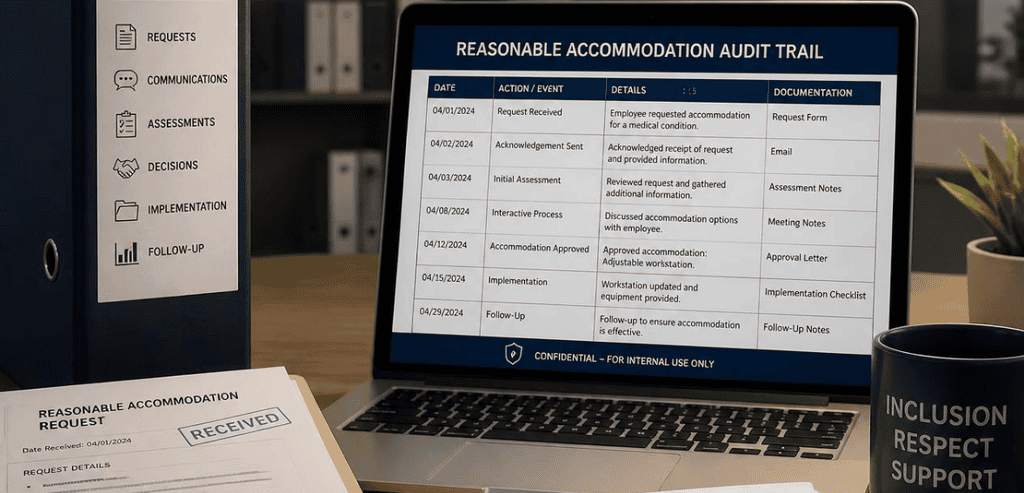
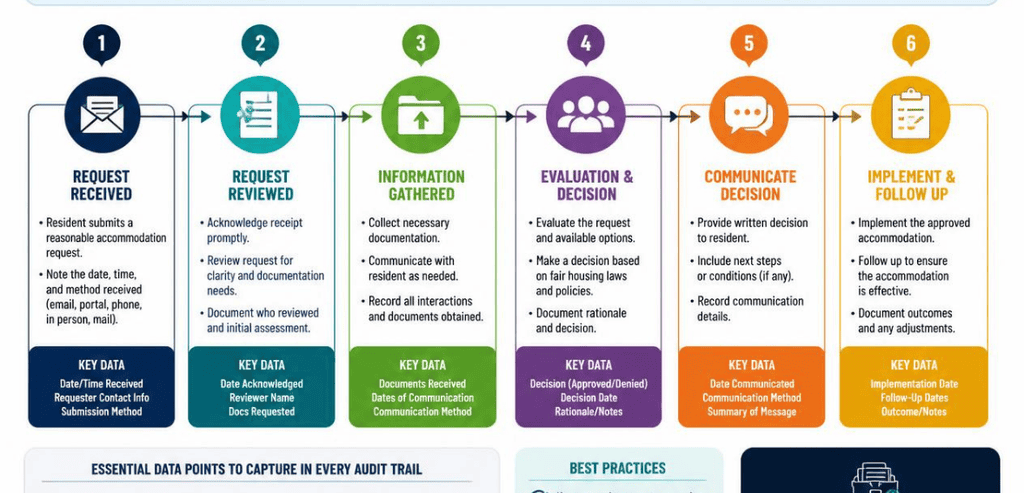
A complete audit trail is not one document. It is a connected chain of records that tells the full story from the first contact to the outcome. The strongest chains capture three distinct phases.
Capturing the Initial Request
A request from a resident marks the beginning of the trail. Log the date and time of the request, who it was presented to, how it was submitted, and what the resident requested in their own words. Note if the disability and related need were apparent or not. The answer to this question will determine if you can ask for further information. If the request was made verbally, follow up with a written communication, if only to create a record of the communication for date and time. This will also create a record of the date the request was made and when your obligation to respond began, which is usually the date a dispute will be centered on.
Documenting the Interactive Process
Fair housing law strongly encourages an interactive process, a back-and-forth conversation where the provider and resident discuss the disability-related need and any workable alternatives. Every step of that dialogue belongs in the file. Save the emails, summarize the phone calls with dates, and record any verification you requested and received. If the disability is not visible, you may ask for reliable documentation confirming the disability and the connection to the requested change, but you cannot demand medical records or a diagnosis. Documenting this exchange shows you engaged in good faith rather than stonewalling, which is precisely the behavior investigators look for.
Recording the Final Decision
Your decision letter is the most singularly important document in the decision-making process because it closes the loop. State the action you approve and the date you approve it if you grant the request. If you deny the request, explain the legally defensible reason, be it fundamental alteration, undue hardship, or no disability-related need, and provide the option you proffered. A denial without a reason appears to be discriminatory, even if it is not. Including the final letter, proof of delivery, and any correspondence from the resident will ensure that the decision is not called into question.
Building a Compliant Workflow Step by Step
Good documentation occurs as part of a good process and not as an add-on at the end of the procedure. To start, you need to give every request a single contact point. This can include a dedicated email address, a form in a portal, or a contact at the front desk who has been properly trained so nothing slips through the cracks. After a request is received, you need to respond, let the requestor know that their request has been received, and then review the request; respond to the requestor to clarify details if needed, and after all the necessary information has been collected, respond to the requestor with a decision. The purpose of this procedure is to respond to requests promptly, with 30 days as a common benchmark. Responses that take longer can be interpreted as a constructive denial.
This procedure works best if it is consistent. If the same process is followed for each request, it will be documented that similar requests were handled in similar ways. This usually means requests that were received from different requestors will be treated in the same way, which is the best defense against a claim of discrimination. This procedure should be combined with frequent self-audits. Monthly reviews of accommodation files can help detect missing letters or requests that were ignored. This will help prevent outside investigations.
How Long Should You Keep Accommodation Records?
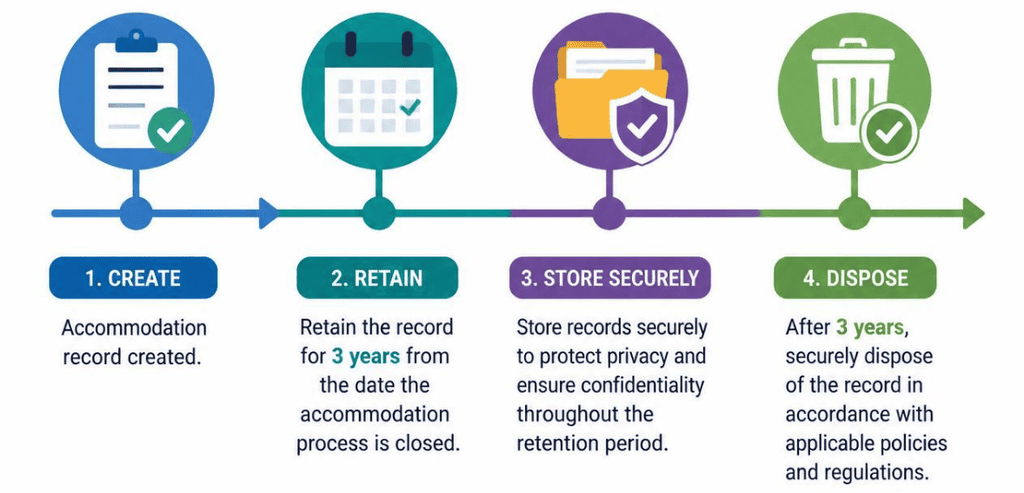
Retention is where many otherwise careful managers slip. Because Fair Housing complaints can be filed up to a year after an incident with HUD and lawsuits can follow for two years in federal court, records need to outlive the tenancy by a wide margin. A practical baseline used across the industry is to keep accommodation requests, the evaluation, and the decision for several years after a resident moves out, with many attorneys recommending you align these files with your longest applicable claim window rather than your shortest.
Confidentiality goes hand-in-hand with retention. Records of accommodations should contain sensitive information regarding someone’s disability. Therefore, they should be stored separately from the general tenant files and be accessible only to the staff who truly require access. Digital storage can offer a secure record and controlled access to its contents. Compare that to an unlocked storage folder. The objective is to be able to provide a record quickly if you are asked, but without revealing private information to anyone who happens to open the file.
Tools That Help Property Managers Track Requests
You can maintain a solid audit trail with a shared spreadsheet and disciplined email habits, but purpose-built software makes the timestamps automatic and the storage centralized. Property management platforms increasingly build documentation and audit-log features directly into their workflows, which removes the human error that manual tracking invites.
AppFolio
AppFolio consolidates tenant communications and records, maintenance requests, and document storage in one property management platform. AppFolio’s recordkeeping communication logs provide time-stamped records of accommodation-related interactions for compliance between property management and residents.
Yardi
Yardi’s software aids management and accounting for residential and affordable housing. It has features for document management and compliance, which help large clients to standardize the recording of requests and decisions across many properties. Standardization across multiple entities can be a critical component of a legal defense strategy.
The software may have great capabilities, but its effectiveness is highly dependent on the processes that have been put in place. A system can record and time-stamp a conversation, but a system cannot log a difficult hallway conversation or draft a formal response. That remains the responsibility of the organization.
Common Mistakes That Break the Audit Trail
The failures that cause trouble are rarely dramatic. They are small and quiet. Managers forget to document verbal requests, treat an accommodation like a routine maintenance ticket, or deny a request without writing down the reason. Others let requests sit unanswered while they “think about it,” not realizing that silence can be read as refusal. Some store accommodation records in the general tenant file, mixing sensitive disability information with everyday paperwork and creating a privacy problem on top of a compliance one.
The same methodical approach solves every one of these. Document it, timestamp it, and secure it. If you handle every request the same way, you create a record (audit trail) of a request for a reasonable accommodation that isn’t bureaucratic for bureaucracy’s sake. It demonstrates that you provided a resident with a disability an appropriate accommodation, and it is why the complaint is closed with no judgment-related costs.
Conclusion
Reasonable accommodation requests will always be part of property management, and they will always carry legal weight. The managers who handle them well are not necessarily the ones with the best intentions. They are the ones who can prove their intentions with a clean, connected record. Build a single intake point, document the request, capture the interactive process, write a clear decision, store it securely, and keep it long enough to outlast any claim. Do that consistently and your audit trail becomes both a shield against liability and a genuine service to the residents who depend on those accommodations to call your property home.
Frequently Asked Questions (FAQs)
Do residents have to submit a reasonable accommodation request in writing?
No. The Fair Housing Act does not require a specific form or written request, and verbal requests are legally valid. Because verbal requests are harder to prove later, property managers should confirm them in writing to create a timestamped record while never requiring a written request as a condition of approval.
How quickly does a property manager have to respond to an accommodation request?
There is no single federal deadline, but responses are expected to be prompt and reasonable, and many state agencies point to roughly 30 days as a benchmark. An unreasonable delay can itself be treated as a denial, so acknowledging the request quickly and documenting each step is essential.
Can a property manager ask for medical records to verify a disability?
Not directly. When a disability and its connection to the request are not obvious, you may ask for reliable documentation confirming the person has a disability and needs the accommodation. You cannot demand a specific diagnosis, detailed medical history, or access to medical records.
How long should accommodation request records be kept?
Keep them well beyond the tenancy. Because complaints and lawsuits can be filed months or years after an incident, a common practice is to retain the request, evaluation, and decision for several years after move-out, stored securely and separately from general tenant files. Confirm the exact timeline with legal counsel based on your state’s rules.