
by Christopher Hayes August 21, 2026
Choosing the wrong software can quietly cost you money. A missed rent escalation. An unbilled expense. A lease renewal that slips past its deadline. These mistakes add up fast. And they usually happen when a property manager forces one type of software to do a job it was never built for.
That is the essence of the commercial lease software vs. property management software debate. Both solutions claim to organize your portfolio. Both address rent and tenants, and both address reporting. However, they address different issues. One focuses on the tricky math behind office and retail buildings. The other focuses on apartments, single-family homes, and the beat of the day-to-day leasing of residential property.
This guide breaks down the differences of commercial lease software vs residential property management and helps potential users see what each system addresses best, what companies are top players, and how to match your software to your property. First, let’s explain the fundamental difference.
What Is the Real Difference Between Commercial Lease Software vs Residential Property Management Software?
The short answer comes down to lease complexity. Residential leases are fairly standard. A tenant pays a fixed monthly rent. The term usually runs 12 months. The landlord covers most expenses. There are only so many variables to track.
Commercial leases are unlike any others. A single building may house five tenants, with five distinct lease types. One tenant may be on a triple-net (NNN) lease. Another may be on a lease with a clause that adjusts rent based on a percentage of sales. A third may be on a lease that is tied to annual price adjustments based on the CPI. Additionally, each tenant is responsible for a proportionate share of common area maintenance (CAM) costs.
These factors create a great deal of complexity for both tenants and landlords. For this reason, there are specific types of software for managing commercial leases. Compared to software for managing residential leases, these types of software are designed to make more sophisticated computations. Managing a commercial portfolio with a residential tool would quickly highlight the shortcomings of the tool.
Understanding Commercial Lease Software
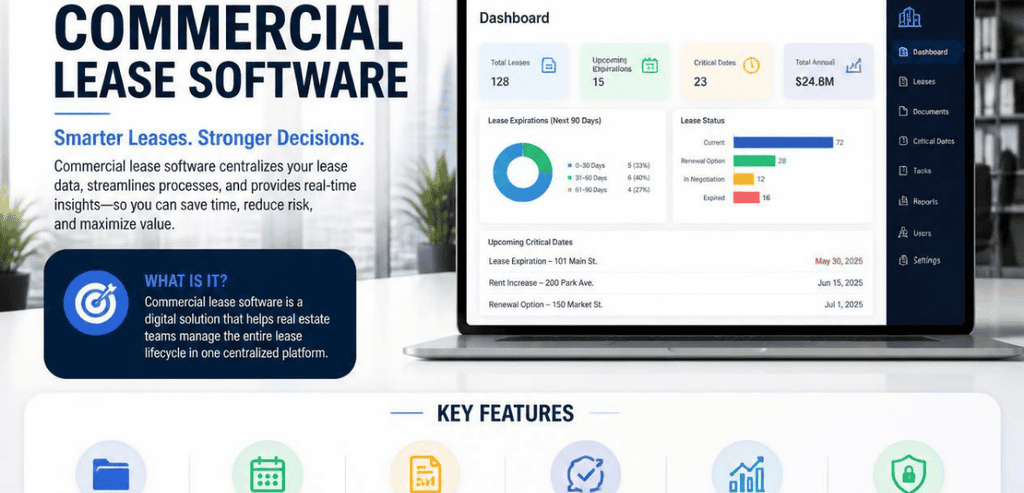
Commercial lease software, sometimes called commercial real estate lease management software, is a specialized platform for nonresidential property. Think office buildings, retail plazas, industrial warehouses, and mixed-use campuses.
It consolidates and offers visibility into lease data. It captures and recognizes lease milestones, key dates, obligations, and tenant-specific language. More importantly, it dynamically calculates notoriously manual and time-consuming spreadsheet tasks.
The most impressive functionality is Automated CAM Reconciliation. This is the annual process of evaluating and reconciling the tenant estimate for operating costs versus actual costs incurred by the landlord. Failing to perform this reconciliation results in a loss of net operating income. Failure to perform a single reconciliation can result in a landlord losing tens of thousands of dollars in unrecovered costs. Best-in-class CAM Reconciliation software performs the math for the tenant’s pro rata share and prepares a clean and easy-to-understand report for the tenants.
Commercial software solutions have the capability to automate and manage renewals, escalations, co-tenancy, and abstractions. Many of the newer solutions offer artificial intelligence (AI) to read leases and determine important dates/clauses with little to no human assistance.
The solution also provides compliance in cases where portfolios or companies are large enough to fall under the regulations set by the FASB for ASC 842. Commercial software is built to automate tasks in compliance with the FASB’s ASC 842 standard.
Yardi
Yardi has been a fixture in real estate software since 1984. Its Voyager platform serves large commercial and mixed-use portfolios that need deep analytics, detailed lease tracking, and enterprise-grade reporting. It is powerful, though it carries a learning curve and custom pricing that fits established firms more than small operators.
MRI Software
MRI Software covers large and complex real estate portfolios. It offers flexible lease administration and strong reporting for office, retail, and industrial real estate. Firms with numerous properties spanning several asset classes regularly select MRI because of its breadth and the ability to integrate other enterprise systems.
STRATAFOLIO
STRATAFOLIO fills a more specific niche. It focuses heavily on CAM reconciliation and financial oversight, and it syncs directly with QuickBooks. Owners who want accurate NNN reconciliations without duplicate data entry find it useful. It suits small and mid-sized commercial operators who need sharper expense recovery without moving to a full enterprise suite.
Understanding Residential Property Management Software
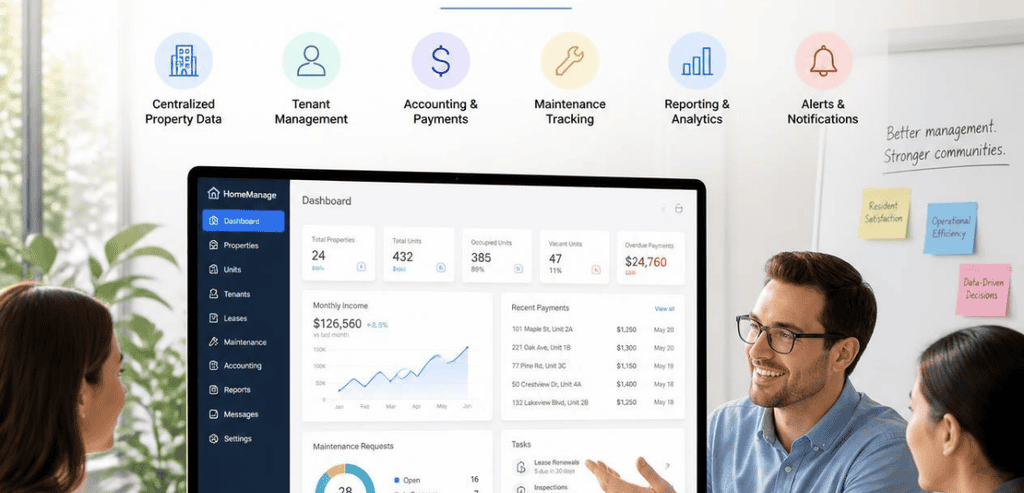
Residential property management software automates the everyday tasks of running rental homes. That means apartments, single-family rentals, small multifamily buildings, and student housing.
The design philosophy is speed and simplicity. Most landlords do not need complexity like percentage rent formulas. They need to be able to fill vacancies, screen tenants, collect rent, and handle maintenance requests. They do not need to be overwhelmed by paperwork.
Because of that, these companies start with lead-to-lease tools. Features allow you to post a listing, receive online applications, run background and credit checks, and sign an accepted lease with an e-signature. Once completed, the software will manage rent collection by ACH or card payments for you, send automatic reminders for payments, store data for you for future tax purposes, and even generate a Schedule E for you. According to the U.S. Census Bureau, there are over 11 million individual landlords, and nearly all of those landlords would benefit from automation at this level.
Automation of maintenance requests is a highlight as well. Tenants enter a request in a portal, and the system creates a work order, and this request is assigned to a vendor. The system manages the request until the task is completed. More advanced systems utilize AI to further automate the system by prioritising and sending appropriate responses to the request.
AppFolio
AppFolio is one of the most widely used platforms among professional residential managers. It bundles tenant screening, digital lease management, online rent collection, and maintenance routing into one interface. It has also pushed hard into AI, with a leasing assistant that qualifies leads and schedules tours. It scales well for growing portfolios, though it is less suited to true commercial work.
Buildium
Buildium is designed for small- to medium-sized teams managing residential or mixed portfolios. It integrates maintenance, leasing, accounting, and operational processes within the same system. It has online application forms, screening, e-signatures, and 1099 eFiling. These features make Buildium a good choice for property managers who are looking for the core features in a system without added complexity.
DoorLoop
DoorLoop is designed for speed and growth. It automates rent collection, screening, accounting, and maintenance in one place. Notably, it stretches into small- to mid-sized commercial and mixed-use work too, including basic CAM tracking. That makes it a flexible bridge for landlords who own a mix of residential and light commercial property.
Commercial Lease Software vs. Residential Property Management: Feature Comparison
Now let’s put the two head-to-head across the areas that matter most.
Lease Structures and Rent Calculations
Residential leases have flat, consistent rent. Commercial leases (NNN, gross, and modified gross) are very different. They contain features like trackers for CPI escalations and percentage rent at the suite level. If your lease does any of that, you can’t use residential tools.
Financial Reporting and Compliance
Residential platforms cater to rent, occupancy, owner statements, and tax-ready accounting. This satisfies most landlord requests. Commercial platforms take more of an enterprise-level approach. They produce reports on the property level and the portfolio level and track CAM caps and exclusions, as well as supporting ASC 842. This level of transparency allows managers to evaluate the performance of an entire portfolio.
Tenant Management and Communication
Residential tenants want easy rent payment and quick maintenance responses. The portals reflect that. Commercial tenant relationships are more contractual. Software must track lease obligations, expense responsibilities, and critical dates for each business tenant. The stakes on a single commercial dispute are usually far higher, so transparency in billing becomes essential.
How to Choose the Right Software for Your Property Type
Start with your portfolio, not the feature list.
Think about what you supervise today and what you think you’ll supervise in the future. Do you run a business that involves renting apartments or single-family properties? A platform designed to manage residential properties will give you everything you need while also saving you money. There’s no sense in wasting your budget on features that you won’t even use.
Automating CAM (common area maintenance) and taking control of your leases should be your biggest focus if your portfolio consists of office, retail, or industrial space. These will protect your net operating income (NOI). A tool designed for residential properties may seem like a cheaper option in the short term, but will become a long-term money pit due to manual errors and unrecovered costs.
Bear in mind everything I’ve discussed, including integrations, onboarding, and the pricing of the tools. The best software will be the most adopted. A complex platform that isn’t used correctly is worse than a simple tool that is used effectively.
Can One Platform Handle Both Commercial and Residential?
Yes, but with caveats.
Vertical mixed-use development projects often include apartments above retail spaces. In the past, owners of these projects have utilized separate property management systems for each of their residential and commercial components. However, many property management systems (PMS) are starting to merge these offerings under the same umbrella, drastically reducing the time and cost involved in managing their assets. MRI Living, Rent Manager, and DoorLoop are some of the more recent entrants into this vertical that combine all components of a mixed-use development under the same PMS.
While systems like these have their advantages, they aren’t always the best fit or follow best practices. Some technologies excel in the commercial domain but not in the residential domain. Misalignment in residential systems often makes it cumbersome to manage complex commercial leases. Misalignment in the reverse creates a similar dilemma. Consider the complexity of your leases and the overall systems you need.
Conclusion
The choice between commercial lease software vs. residential property management is not about which product is better. It is about which product fits your property type. Residential software wins on speed, simplicity, and cost for standard rentals. Commercial lease software wins on the complex financial math that office, retail, and industrial portfolios demand.
Match the tool to the work. A residential landlord does not need CAM reconciliation. A commercial owner cannot survive without it. Evaluate your leases, your reporting needs, and your growth plans first. Then pick the platform built for that reality. Get this decision right, and your software stops being a cost center and starts protecting your bottom line.
Frequently Asked Questions
What Is the Main Difference Between Commercial Lease Software and Residential Property Management Software?
The main difference is lease complexity. Commercial lease software handles NNN leases, CAM reconciliation, percentage rent, and CPI escalations across multi-tenant properties. Residential property management software focuses on standard leases, rent collection, tenant screening, and maintenance for apartments and single-family homes.
Can I Use Residential Property Management Software for Commercial Properties?
You can, but it usually falls short. Residential tools lack CAM automation, lease abstraction, and the complex rent calculations commercial leases require. For a small mixed-use portfolio, it may work temporarily. For any serious commercial operation, a purpose-built platform protects your net operating income far better.
Is Commercial Lease Software More Expensive Than Residential Software?
Generally, yes. Commercial platforms carry more advanced features and often use custom pricing. Residential software frequently offers low per-unit rates or even free tiers for small landlords. The right question is not which is cheaper, but which prevents costly errors for your specific property type.
What Software Supports Both Commercial and Residential Portfolios?
Several platforms serve both, including DoorLoop, Rent Manager, and MRI Living. These suit mixed-use owners who want one system. Just confirm the platform offers deep enough commercial lease management, since some hybrid tools provide only basic commercial features alongside strong residential ones.