

by Rinki Pandey November 25, 2026
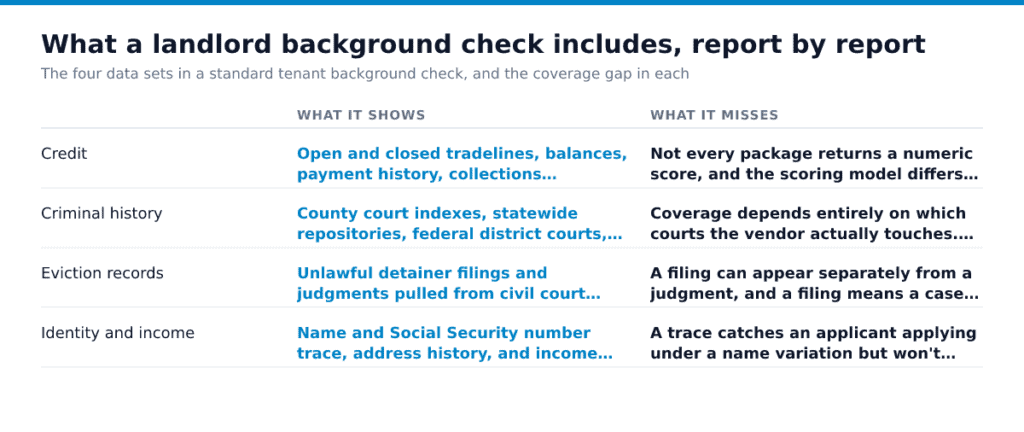
A landlord background check bundles four separate reports—credit, criminal history, eviction records, and identity/income—each pulled from different sources with its own coverage gaps.
What a landlord background check includes, report by report
Landlord Credit Background Check: What It Pulls Each data set comes from a different source, on a different schedule, with its own blind spots. A vendor sells them as one package and returns one PDF, which makes it easy to forget that a clean criminal section might mean the applicant has no record or might mean the vendor never searched the county where the record lives.
Read the package as four reports stapled together.
| Report | What it shows | What it misses |
|---|---|---|
| Credit | Open and closed tradelines, balances, payment history, collections accounts, and public records. Most packages add a score or a screening-specific recommendation such as accept or accept with conditions. | Not every package returns a numeric score, and the scoring model differs by provider, so two vendors can rate the same applicant differently. Rent paid on time to a small landlord usually isn’t reported at all. Older negative items drop off under FCRA reporting time limits. |
| Criminal history | County court indexes, statewide repositories, federal district courts, and sex offender registries, depending on the search the vendor runs. | Coverage depends entirely on which courts the vendor actually touches. Many county indexes aren’t digitized or searchable remotely, and records sealed or expunged under state law shouldn’t surface. |
| Eviction records | Unlawful detainer filings and judgments pulled from civil court indexes, usually with the filing date, the court, and the parties. | A filing can appear separately from a judgment, and a filing means a case was opened, not that the applicant lost or was ever removed. Several states seal or restrict eviction records. |
| Identity and income | Name and Social Security number trace, address history, and income confirmed through pay stubs, bank-linked verification, or a call to the employer. | A trace catches an applicant applying under a name variation but won’t flag a stolen identity by itself. Income typed into an application form is a claim, not verification. |
Anything a screening company sells you is a consumer report under the Fair Credit Reporting Act. That single fact is what creates every obligation that follows: The FCRA requires landlords to have a permissible purpose before ordering the report and to send an adverse action notice if the report leads to denial. Unlike employment checks, the law doesn’t require a signed authorization for tenant screening, but almost every screening company does.
Consent, disclosure, and who pays the screening fee
Get the applicant’s signed authorization before you order anything; your screening company will require it. The screening company will also make you certify that you have a permissible purpose for the report, which for a landlord means evaluating a rental application from that person, and they’ll ask you to confirm you’ll follow the FCRA’s notice rules if the report costs the applicant the unit. That certification isn’t a formality. It’s the basis on which the bureau released someone’s file to you.
Keep the signed authorization in the application file, with the date. If the applicant later tells the bureau the pull was unauthorized, the signature is what ends the dispute. A scanned copy stored with the application record is enough; a verbal yes from a showing is not.
The applicant normally pays the screening fee, charged at the time of application, and you should state the exact dollar amount before anyone fills out a form. Check whether your state caps screening fees before you set the number; where a cap exists, it’s set by statute, not by the market.
Two practices reliably generate consumer-protection complaints. Charging a fee and never running the check is the first. Collecting fees from fifteen applicants for one unit you’ll fill from the first three is the second. Separately, anyone denied because of a report can get a free copy of it from the screening company.
Write your screening criteria before the first application arrives
A written criteria sheet, dated and saved before you list the unit, is the one control that makes every later decision explainable. Same thresholds, every applicant, no adjusting the bar after you’ve seen a name or met someone at a showing. The Fair Housing Act applies to the screening process itself, including the criteria you choose and any tool you use to apply them.
Most workable criteria sheets set four things: a gross income multiple of rent, a minimum credit threshold, no unpaid judgments owed to a prior landlord, and a verified rental history length. Pick the numbers that fit your market and your rent, write them down, and hold them.
Reading the credit report is where discipline pays. The rent-relevant items are landlord collections, utility collections, and 60- or 90-day delinquencies in the last couple of years. A medical collection tells you almost nothing about whether rent arrives on the first, and a thin file tells you the applicant is young or pays cash, not that they’re risky. A 620 with clean housing-related history is usually a better bet than a 700 carrying a collection from a prior landlord.
Eviction output needs the same care. Find out whether the record is a filing, a dismissal, a stipulated agreement, or a money judgment, then check the date and the county, because a dismissed filing from six years ago in a county your applicant has never lived in is a name-only match. Confirm at least two identifiers before any criminal or eviction hit changes your decision.
Conditional approval works if the condition is written down in advance for everyone who trips that threshold: a larger deposit, a cosigner, or a shorter initial term. Screening standards keep shifting, and our guide to fair housing and modern tenant screening tracks what’s changing.
Running a tenant background check inside your application workflow
The sequence starts before the listing goes live. Post the unit with your screening criteria and the exact screening fee stated in the ad, so nobody pays to learn they were never eligible. Pre-qualify the inquiry on stated income and move-in date first. Charging a fee you already know you’ll reject is how complaints start.
- Send the full application with the screening authorization attached, not buried in the lease packet.
- Collect the signed authorization and the fee before you order reports.
- Verify identity first. If the name, date of birth, or SSN doesn’t match, stop and resolve it before reading credit or criminal results.
- Score against your written criteria line by line, not against your impression of the applicant.
- Verify income and call the current and prior landlord yourself. No report does this.
- Write the decision and its date on the application file, then send the required notice for any denial or conditional approval.
Done looks like two applicants, same order, same documents, same day count. Inconsistent sequencing is hard to defend if a decision is ever challenged, and our guide to online applications and screening workflows covers running the same steps for every applicant.
The FCRA adverse action notice: what you send when the report costs someone the unit
Any decision that leaves an applicant worse off because of a consumer report triggers the notice. Outright denial counts. So does a doubled deposit, a cosigner requirement, a shorter lease term, or approval conditioned on prepaid rent. Federal law attaches the duty to adverse action taken “in whole or in part” on the report, which means the report only has to be a factor, not the reason.
The notice has to name the consumer reporting agency that supplied the file, with its address and phone number (toll-free if it’s a nationwide agency), and state plainly that the agency did not make the decision and can’t explain why you made it. It must also tell the applicant two things they own as rights: a free copy of the report from that agency if they request it within 60 days, and the ability to dispute any item they believe is inaccurate or incomplete.
Oral, written, or electronic delivery all satisfy the statute. Send it in writing anyway and keep the copy, because what you’ll need later is proof of the date, not a recollection of a phone call. If you used a credit score in the decision, the notice must also disclose that score and the key factors behind it. Send a notice to every rejected applicant whose report was a factor, not only the ones who call and ask.
If you turned an applicant down because of something a former landlord or employer told you, rather than a report, the FTC’s guidance for landlords describes a separate disclosure to make. Check it, along with your state’s rules.
File the application, the written criteria in effect that day, the report, your decision note, and the notice together, and keep them as long as your state’s statute of limitations runs. Our fair housing guide covers the discrimination side of the same file.
Set up your application form and screening step inside Cloud Rental Manager’s free property management software, and store every decision record in the same place you collected it.
Frequently Asked Questions
Does running a tenant background check hurt the applicant’s credit score?
It can. Some screening services pull credit as a hard inquiry, which can lower the applicant’s score slightly; others use a soft pull that doesn’t. Ask your screening vendor which they use before you sign, and tell applicants when they ask. A hard inquiry carries far less weight than a missed payment, but an applicant shopping several units in one week has a fair reason to care.
Can I deny an applicant for a low credit score alone?
Generally, yes, if the cutoff is written down before applications arrive and applied the same way to every applicant. If the score played any part in a denial, the FCRA notice must include the score, the range of possible scores, the key factors that hurt it, and the date it was created. A cutoff can still raise fair housing questions if it screens out one group of applicants more than others, so tie the number to the rent you’re charging and let applicants below it offer a guarantor, a larger deposit where state law allows, or proof of on-time rent payments.