
by Christopher Hayes August 11, 2026
A resident knocks on your leasing office door. She is a survivor of domestic violence. She fears for her safety in her current unit. She wants to move now. What you do in the next few minutes matters. It also matters six months later, when a HUD reviewer asks to see your files.
This is where records for a VAWA Emergency Transfer Request come into play. They help keep survivors safe. They help protect your organization. For any covered housing provider, proper and complete records are not just paperwork. They are documented proof that the covered housing provider complies with federal law.
This guide explains what these records are, why they are important, and how to maintain them properly.
What Is a VAWA Emergency Transfer?
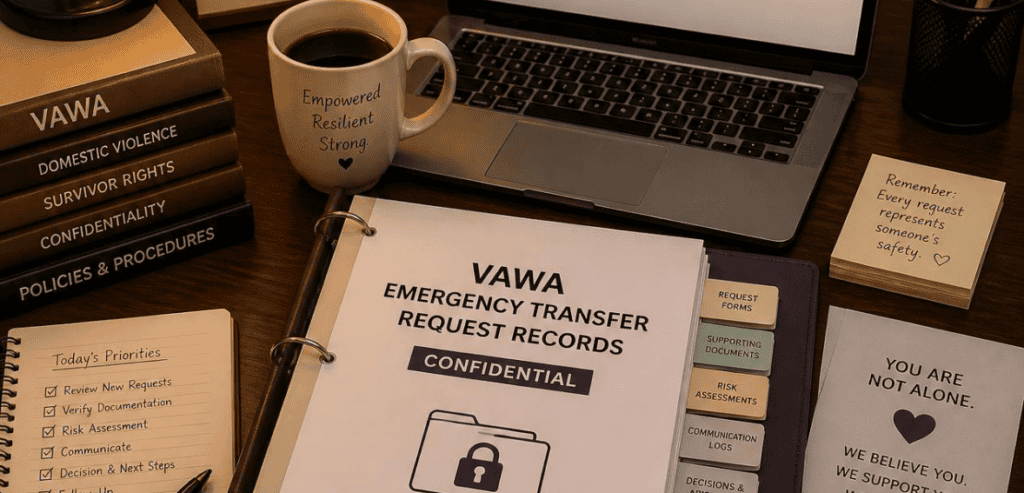
The Violence Against Women Act (VAWA) protects tenants who are victims of domestic violence, dating violence, sexual assault, or stalking. Despite the name, these protections apply to survivors of all genders.
If a tenant is at risk, they can use an emergency transfer to move to a safer unit. A tenant can file a request if they believe staying in their unit poses an imminent threat of harm. A request is also acceptable if sexual assault occurred on the property in the last 90 days.
There are internal and external transfers. An internal transfer relocates the tenant to another unit within the same provider’s units. An external transfer places the tenant in a different property, where the tenant is a new applicant to that property. It is also required that Section 8 voucher holders are allowed to transfer to a new unit with full Housing Choice Voucher assistance.
Why Emergency Transfer Records Matter for Housing Providers
Records are the backbone of VAWA compliance. When a survivor asks for help, your response creates a paper trail. That trail shows whether you followed the rules.
Effective documentation serves three purposes: it shows you responded in a timely, survivor-centered manner; it fulfills your annual reporting requirement to HUD; and it protects you during an audit, a fair housing complaint, or litigation.
The stakes have been raised. As of October 1, 2022, HUD’s enforcement powers expanded to cover the 2022 VAWA reauthorization. In several enforcement actions, providers were found to violate the law for requesting inappropriate or overly burdensome documentation from survivors. Sound recordkeeping is your best defense against this type of action.
The Core VAWA Forms You Need to Track
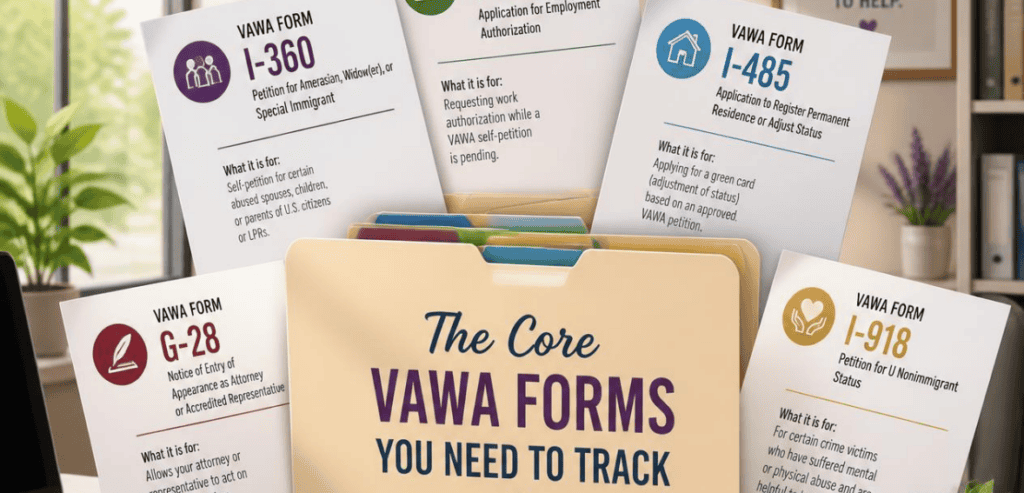
HUD publishes a set of model forms that anchor the entire process. Each one produces a record you may need later.
The Notice of Occupancy Rights (Form HUD-5380) explains VAWA rights to applicants and tenants. The Model Emergency Transfer Plan (Form HUD-5381) provides the framework for your written plan. The Certification form (Form HUD-5382) allows the survivor to self-certify. The Emergency Transfer Request (Form HUD-5383) is the written request a tenant is allowed to supply. The Emergency Transfer Data Collection form (Form HUD-5384) provides the data HUD wants in the format they want.
U.S. Department of Housing and Urban Development (HUD)
All of these requirements originate from HUD, the federal agency in charge. It specifies the requirements in 24 CFR part 5, subpart L. HUD also recently published the complete set of model forms with a new expiration date of January 31, 2028. Providers should always access the latest version of these forms from HUD. Forms can be accessed on the HUD VAWA resource page, which contains all forms and available translations.
A tenant is not required to use Form HUD-5383 for the process to be triggered. You must accept an oral request or any other form of written request. Regardless of the request form, it should be recorded in your log.
Building a Compliant VAWA Emergency Transfer Plan for Housing
Every covered housing provider must develop and implement a written VAWA emergency transfer plan. Housing programs under HUD were required to have these plans in place by June 14, 2017. Simply adopting HUD’s model plan word for word is not enough. You must tailor it to your program and its specific rules.
A compliant plan outlines the eligibility criteria for transfers and the required documentation. It describes the transfer process and how requests for transfer are prioritized. It describes the internal and external transfer processes, and it describes the situation where a safe unit is not available. It describes the confidentiality it assures throughout the process.
Your plan describes the standard of recordkeeping and reporting for your staff. In other words, your plan describes how records of transfers will be documented and how transfer records will be maintained. That plan-to-records connection is essential to being compliant. To create or amend your plan, the starting point should be the HUD Model Emergency Transfer Plan (Form HUD-5381).
There is one important limit that protects survivors. If you decide to have a policy that requires documentation of VAWA status, your plan must provide the tenant with a minimum of 14 business days to present the required documentation. The request for the documentation must also be made in writing.
What Records to Keep and How to Handle Documentation
Think of the record for each request as a small, complete file. It should trace the request from the day it arrived to the day it was resolved.
Begin with the request, whether written, oral, or on Form HUD-5383. Be sure to capture the date the request was received. You should explain how you managed the documentation. You may need to obtain written confirmation of abuse against the tenant or a member of the household covered by VAWA. That request may be satisfied by the submission of the self-certification form (Form HUD-5382). You may not request additional documentation if you do not have evidence that contradicts the abuse.
A survivor may opt to provide additional documentation. This may be a signed statement from a professional, or police, administrative, or court-related documentation such as a protective order. Whatever documentation the tenant provides should be retained in the file.
Lastly, describe the outcome. HUD has a clear definition of the outcomes. The outcome is approved if the tenant is found to be eligible. The outcome is denied when the incident is found not to be covered under VAWA. The outcome is incomplete if the review could not be completed, most of the time due to insufficient documentation. The date and the reason for each of the outcomes have to be provided in order to show that you were efficient in performing your duties.
Confidentiality Rules for Transfer Records
Confidentiality is not optional. It sits at the heart of every VAWA emergency transfer record.
You must keep strict confidentiality about a tenant’s status as a survivor. You cannot share information about the abuse with the person who committed or threatened it. You also cannot enter that information into any shared or public database without the tenant’s written consent.
Store these records apart from routine tenant files. Limit access to staff who truly need it. Train your team so they understand that a careless email or an open file on a desk can cause real harm. A breach does more than expose you to liability. It can put a survivor’s safety at risk.
Annual Reporting and Form HUD-5384
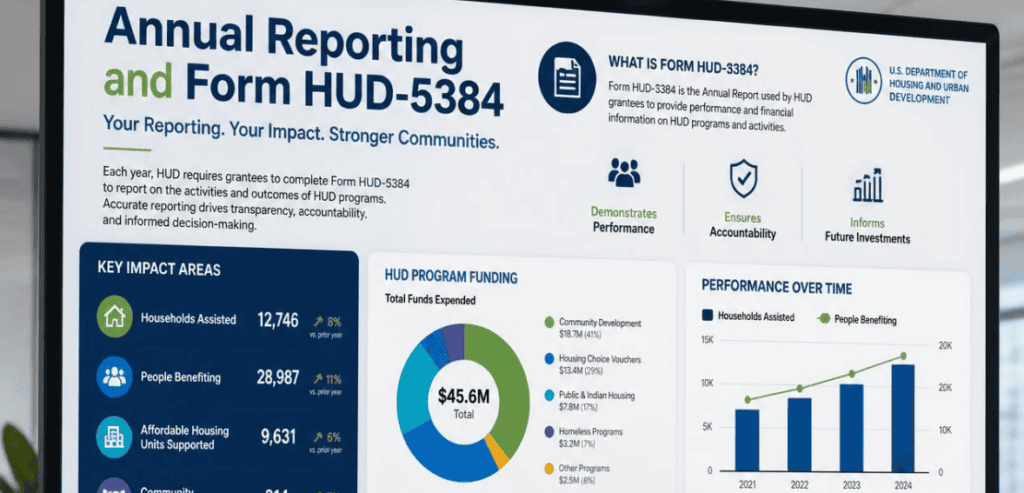
HUD wants to know how emergency transfers are working across the country. So covered housing providers must report requests and their outcomes to HUD on an annual basis.
Form HUD-5384 (VAWA Emergency Transfer Data Collection)
This is the format for that reporting. It includes fields for the total number of emergency transfer requests, how many requests resulted in internal and external transfers, how long the transfers took to process, and the reasons for the transfer requests that were denied.
There is a thoughtful design for privacy. Form HUD-5384 creates a way to report the aggregate data and not the data for every single survivor. HUD did that intentionally. Reporting aggregate numbers allows HUD to learn if the system is functioning, while maintaining the privacy of individual tenants and lessening the workload for the service providers.
Information can be collected through email, DocuSign, Microsoft Forms or other surveys, and can be embedded in a checklist. HUD can customize the questions for this program area. You have to fill out the form based on the timelines and instructions that HUD provides. You can find and review the HUD Emergency Transfer Data Collection form (Form HUD-5384) that has been published.
Your annual report is based on the case records you maintain; therefore, unorganized case records will prohibit accurate reporting. Organized case records will yield accurate reporting.
Common Compliance Mistakes to Avoid
Some patterns of noncompliance get repeated, yet they shouldn’t. Many service providers request more documentation from survivors than the law requires. Some refuse to accept verbal or non-form requests as legitimate. Others will completely bypass the request for documentation or give less than 14 business days for a response.
Another issue that is very common is a lack of training. The staff member who receives the very first request may or may not be aware of the plan. It is essential that every member of the team who may potentially receive a request is familiar with the VAWA emergency transfer plan and the surrounding rules of confidentiality. Most of the compliance issues that appear later on are a result of the response to the request in this first conversation.
Conclusion
VAWA emergency transfer request records sit at the meeting point of safety and compliance. They document that you treated a survivor with care and speed. They also prove to HUD that you followed federal law.
The path forward is clear. Build a tailored written plan. Use the current HUD forms. Keep a complete, confidential file for every request. Then roll those files into your annual report. Do this well, and you protect the people who need protection most. You also protect your organization from real legal and reputational risk.
Review your VAWA emergency transfer plan today. Check that your records match what HUD now expects. A short review now can spare you a painful audit later.
Frequently Asked Questions (FAQs)
What records should a housing provider keep for each VAWA emergency transfer request?
Keep the original request, the date it was received, any documentation the tenant submitted, all written communications, and the outcome with its date and reason. Together, these show a clear, timely, and survivor-centered response.
Can we require documentation before approving an emergency transfer?
Yes, but with limits. You must request it in writing and give the tenant at least 14 business days to respond. A survivor can satisfy the request with the self-certification form (Form HUD-5382). You cannot demand more proof unless you have conflicting information about the abuse.
How do confidentiality rules affect our recordkeeping?
You must keep a survivor’s status strictly confidential. Never disclose it to the abuser, and never enter it into a shared or public database without written consent. Store VAWA records separately and limit staff access to those who truly need it.
Does every housing provider have to report emergency transfers to HUD?
Covered housing providers must report emergency transfer requests and outcomes to HUD annually, typically through Form HUD-5384. The form collects aggregate numbers rather than individual survivor details, which protects confidentiality while still measuring how well the process works.