
by Christopher Hayes September 16, 2026
Imagine a long-time resident sitting across from your leasing staff at her annual recertification. She sold a small piece of land last year. On paper, her net family assets now cross a federal line. Do you terminate her assistance? Or do you have a documented, defensible reason to keep her housed? That single moment is where HOTMA asset limitation exceptions stop being theory and start becoming paperwork. And that paperwork is your exception file.
If you run or manage a HUD Multifamily property, you will experience this part of HOTMA in your interactions with your tenants. This guide explains HOTMA asset limitation exception files, their contents, and how to create a compliance workflow that is likely to survive a Management and Occupancy Review (MOR).
What Are HOTMA Asset Limitation Exceptions?
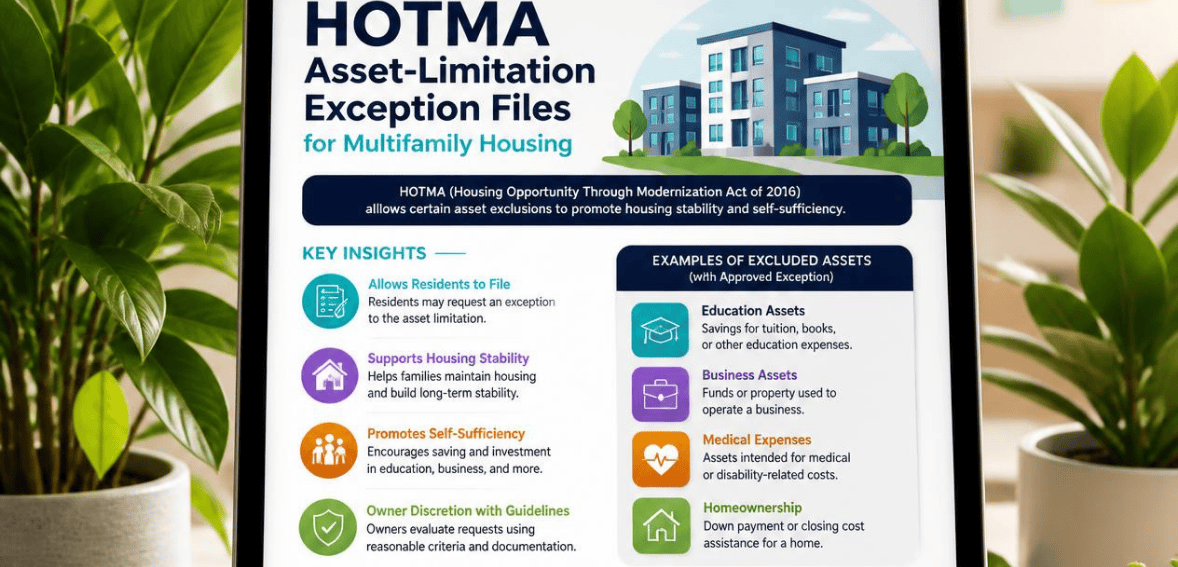
Housing Opportunity Through Modernization Act (HOTMA) of 2016 established new asset limits for Section 8 Project-Based Rental Assistance and Section 202/8 properties. In simple terms, asset limits determine eligibility for housing assistance.
HUD does not require property owners to enforce these limits. Property owners maintain discretion for both annual and interim reexaminations. Exceptions to the HOTMA asset limits are the written policies an owner implements to avoid automatically penalizing households for exceeding asset limits. Exceptions have to be defined in the policy before the owner is permitted to apply them to the resident.
There are two important things to note in this situation. The first is that the exception is not a favor. It is a policy decision. The second, and most important, is that the exception has to be documented, and the documentation is referred to as the HOTMA asset-limit exception file.
U.S. Department of Housing and Urban Development (HUD)
HUD is the federal agency that finalized the HOTMA rule and issues the implementation notices owners rely on. The core playbook is Notice H 2023-10. HUD has published resident fact sheets, model policy language, and repeated deadline updates through this notice series. Because HUD controls the forms, the software standards, and the review process, its guidance is the ceiling and the floor for how exceptions get documented.
The Two Asset Triggers Under HOTMA Section 104
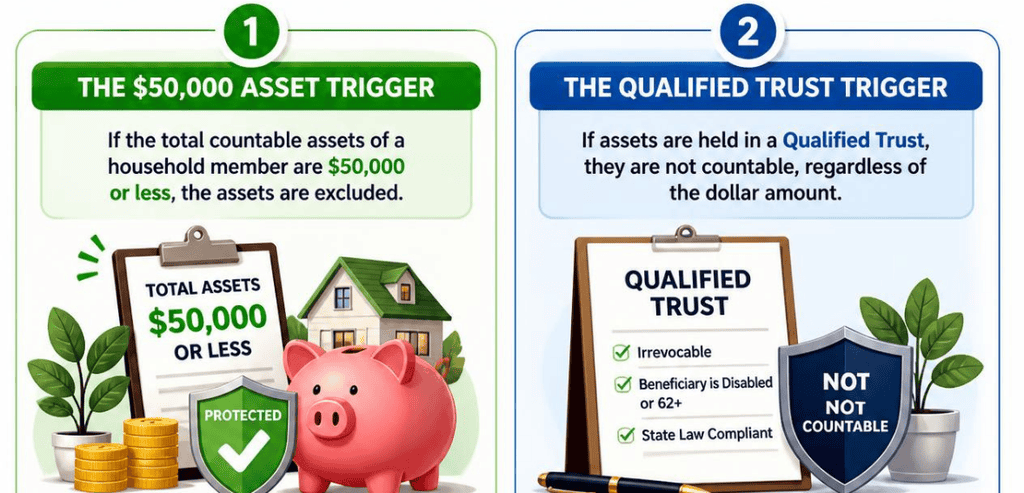
Before you can build an exception, you need to know what triggers the limit in the first place. Under HOTMA, a family becomes ineligible for continued assistance in two situations.
The first threshold is the cap on family net assets. Statutorily set at $100,000, this limit is adjusted for inflation by HUD on an annual basis. It is $105,574 for 2026. When net countable assets of a household exceed the cap, the limit is breached.
Ownership of real property is the second threshold. Families may not own real property that is “suitable” for the family’s occupancy. Real property that is unsafe, does not meet the disability needs of a family member, or is located such that it would cause a hardship, may not be considered suitable. How to assess suitability is explained in HUD’s HOTMA resident asset and real property fact sheet.
An important point to note is that in a situation of total non-enforcement, owners are still required to compute net family assets in the manner prescribed by HUD. The math still exists. Only the enforcement policy changes.
Four Ways Owners Can Respond at Reexamination
HUD gives Multifamily owners four options for handling the asset limit at annual and interim reexamination, and your choice must live in your Tenant Selection Plan.
The first choice is total non-enforcement. Here, the owner does not take action against whatever limit they have for current residents. The second choice is full enforcement. Here, limits are applied without any exceptions. The third choice is limited enforcement. In this case, the owner does not enforce limits for a defined period (usually up to six months) to allow the affected families time to resolve the situation. The fourth choice is an exception policy, where the owner defines particular exception categories based on the characteristics of the household. Owners can add an exception policy to either limited or total non-enforcement. It is this kind of flexibility that captures the heart of HOTMA asset limitation exceptions.
Whatever you decide, the exception applies only to current residents at reexamination. It does not apply to new admissions or initial certifications. An applicant failing the asset test at move-in must be excluded from admission. There are no exceptions for individuals who have never been admitted.
Where Exception Policies Fit
An exception policy allows owners to safeguard certain household categories. Owners may use family type as an exception basis, according to HUD. Owners may also consider age, disability, income, the ability of the family to find suitable alternative housing, and if supportive services are provided. A property that generally applies the policy, but exempts low-income elderly families, is an example of this policy.
All exceptions must also meet the requirements of the Fair Housing Act. Exceptions may not create a disadvantage to a protected class. The National Low Income Housing Coalition also provides information on HUD’s asset limits and how exception categories work.
What Goes Into a HOTMA Asset-Limitation Exception File
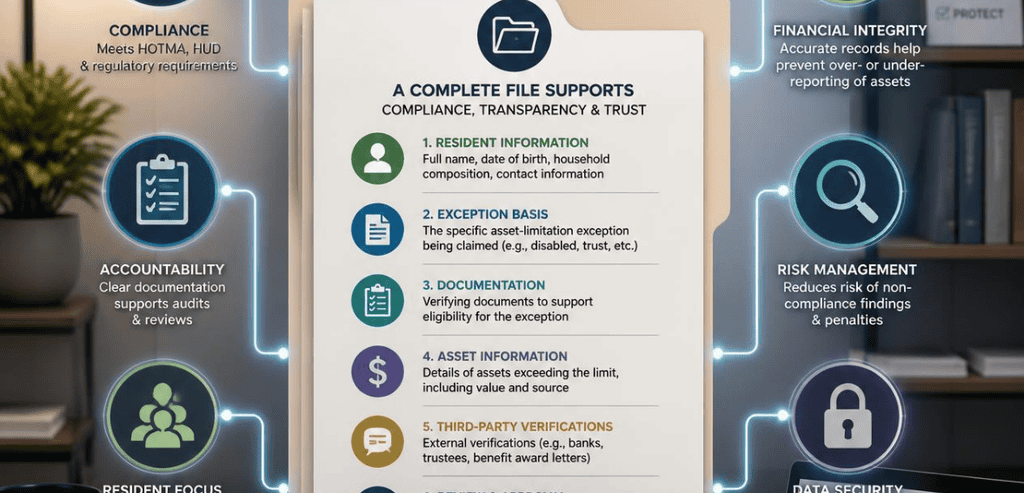
Here is the workflow core. When you apply an exception to a household, the file has to answer one question for any reviewer: why did this resident keep assistance when their assets crossed the line?
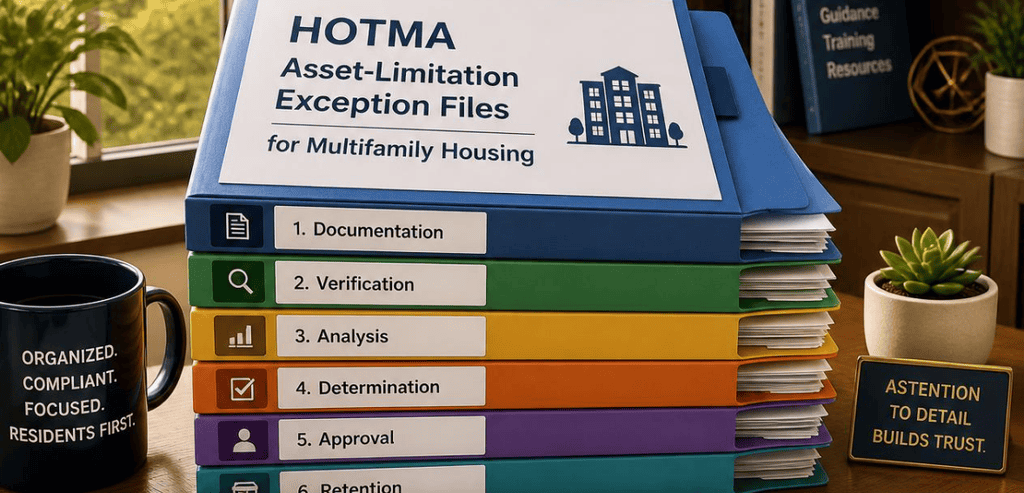
An exception file begins with the asset calculation. This shows the net family assets figure along with supporting documents and the date. Then, you cite your policy. The file should indicate the exact provision of your Tenant Selection Plan allowing the exception and should indicate the household category the resident belongs to. The file also contains the determination along with the reviewer’s name, supporting evidence for the category, and the resulting decision. The file also contains the notice sent to the resident along with the date the decision takes effect. When combined, these documents take an exception from being a discretionary decision to a covered and documented action.
An exception from your policy should not be made unless there is a compelling justification which should be fully documented. The goal is maintaining consistency. If two elderly residents with like circumstances receive different outcomes, your files will be first to reveal the inconsistency. Standard documentation is your best defense.
Documenting the Policy Basis
An exception file is only as strong as the policy behind it. The Tenant Selection Plan must already describe the exception before staff applies it. A file that grants relief without a matching TSP provision is a finding waiting to happen. So the sequence is always policy first, then file. Never the reverse.
The Cure Period and Reasonable Accommodation
Many owners combine exceptions with a cure period. With a limited enforcement approach, a family is typically provided six months to bring assets back under the limit prior to assistance termination. The file should include the cure clock, any evidence the family provided, and if they returned to compliance.
Reasonable accommodation is a second layer. If a household requires more time due to a disability, and there is a clear connection to the disability and the need for additional time, then the owner may provide relief for more than the standard six months. That decision should be documented in the exception file along with the accommodation request and the reasoning. Not doing this is one of the quickest ways to create a compliance and civil rights problem.
Why the Tenant Selection Plan Comes First
The Tenant Selection Plan (TSP) goes beyond the forms and paperwork. With the TSP, you have a formal record for your enforcement decisions. Effective May 31, 2024, HUD requires that owners revise their TSP and their policies and procedures regarding the Enterprise Income Verification. As of now, HUD has issued findings for TSPs that are missing, outdated, or incorrect.
Complete conformity with HOTMA is not yet in effect, but the requirement to have a TSP is in place. If your TSP is silent on whether you will enforce, partially enforce, or grant exceptions to the asset limit, then your exception files are without justification.
Building a Repeatable Exception Workflow
A strong process leads to strong exception files; the judgment of a single staff member does not. To ensure consistency in definitions for all residents, lock your policy language within the TSP. Create one checklist for all staff for each reexamination to ensure the asset calculation, policy citation, determination, and resident notice are consistently captured in the same order.
Before you trust your software, check the outputs and validate that notice letters no longer reference the old asset rules and instead reference the current HOTMA language. Training staff to understand the term “exception” to mean “documented exception” as opposed to a spoken exception is a must. The sign of a successful process is having the same, simple, and somewhat monotonous workflow across all exception files.
The 2027 Compliance Deadline
Timelines have shifted before, and precision matters here. The full compliance date for Sections 102 and 104 of HOTMA for Multifamily Housing is now January 1, 2027, according to HUD’s publication of Notice H 2025-07 on December 17, 2025. This new published date of January 1, 2027, is in place of the previously published date of January 1, 2026, which replaced 2025 compliance dates.
Do not interpret the extension to mean a pause. The underlying requirements of HOTMA still apply. The deadlines for TSP and EIV updates have also passed. HUD will consider Management and Occupancy Reviews (MORs) that are completed after the compliance date to be HOTMA deficiency findings. You may check the status and access the notices on the HUD Multifamily HOTMA website. The extension should be considered the implementation window, not a break.
Common Mistakes to Avoid
The most common mistake is using a TSP exception that was never authorized. The second is discriminating by the absence of a checklist and treating similar households differently. The third is incorrectly applying exceptions to new admissions. The fourth is the failure to provide a reasonable accommodation for a disability by misclassifying it as a routine request. Each of these makes a defensible file an audit risk.
Conclusion
HOTMA asset limitation exceptions give Multifamily owners a humane, lawful way to keep vulnerable residents housed when their assets cross a federal line. But discretion without documentation is just risk. The exception file is what converts a policy choice into proof. Build your Tenant Selection Plan first, document every applied exception the same way every time, and track cure periods and accommodations with care. Do that, and the January 1, 2027 compliance date becomes a milestone you meet with confidence instead of a scramble. Start tightening your files now, while you still have runway.
Frequently Asked Questions
What is a HOTMA asset-limitation exception file?
It is the documentation an owner keeps whenever it applies a written asset-limit exception to a current resident at reexamination. The file shows the net family assets calculation, the Tenant Selection Plan provision that authorizes the exception, the determination made, and any resident notice or cure tracking. It exists to prove the decision was consistent and policy-based.
Can HOTMA asset limitation exceptions apply to new applicants?
No. Owner discretion applies only to existing residents at annual or interim reexamination. Applicants and households at initial certification must meet the asset test. If they exceed the net family assets cap or own suitable real property, they cannot be admitted, and no exception file applies.
What factors can an owner use to define an exception category?
HUD allows exception categories based on family type. Owners may consider age, disability, income level, whether the family can find suitable alternative housing, and whether supportive services are provided. Every category must comply with fair housing and civil rights requirements, including reasonable accommodation obligations.
When must Multifamily owners fully comply with HOTMA?
Under Notice H 2025-07, full compliance with HOTMA Sections 102 and 104 for Multifamily Housing is required for certifications effective on or after January 1, 2027. The Tenant Selection Plan and EIV policy updates, however, were due earlier and are already being enforced through findings.