

by Rinki Pandey September 10, 2026
Hand the vendor one property’s prior-year CAM reconciliation and make them run it live in the demo. Whatever breaks is what you’d have bought.
The Test: Can It Reconcile a Full Year in One Pass?
Common area maintenance reconciliation is the annual true-up between what you billed tenants in monthly estimates and what the property actually spent, with each tenant’s share pulled from their lease’s pro-rata formula. It’s a single calculation that reaches into everything. The general ledger supplies the actuals. Lease abstraction supplies the share, the base year and the exclusions. Expense pools decide which tenants see which costs. Gross-up adjusts variable expenses to a stated occupancy so a half-empty building doesn’t underbill its tenants. Caps limit the increase. Then the whole thing has to land on a tenant statement that a tenant’s auditor can follow.
A feature list tells you none of that. A vendor can check boxes for “CAM tracking,” “lease management,” and “tenant billing” and still be unable to carry a cap forward on a cumulative compounded basis. Residential-first platforms usually bolt CAM on as a report that reads the ledger after the fact. Commercial-native platforms model the recovery as a lease obligation, so the clause drives the number instead of a person retyping it. If you’re comparing tools across both categories, the difference shows up here before it shows up anywhere in property management software.
Two things during the demo tell you the answer is no. The first is an export to a spreadsheet halfway through, because a spreadsheet step means the software doesn’t hold the logic. The second is the phrase “that’s a services engagement,” which means their implementation team does the reconciliation by hand and will keep doing it, at an hourly rate, every year you’re a customer.
The output isn’t only a tenant invoice. Reimbursements a tenant pays toward your operating expenses are rental income to you (26 CFR 1.61-8 — Rents and royalties), and the IRS treats what you receive for the use of the property as taxable income against which rental expenses are deducted (Topic no. 414, Rental income and expenses). A reconciliation you can’t reproduce is a tax figure you can’t defend.
The Nine Lease Clauses the Software Has to Model
Every commercial lease you sign adds a rule to the math. The software either encodes that rule as data on the lease record or it doesn’t, and when it doesn’t, someone rebuilds the whole calculation in a spreadsheet each January. Take nine clauses to the demo and make the vendor configure them in front of you, on a test lease, while you watch.
| Clause | What it changes in the math | Demo question |
|---|---|---|
| Base year stop | Only expenses above a fixed year’s actuals are recoverable; the base itself may need restating if occupancy shifts | Show me a lease with a 2022 base year and a restated base after a gross-up change |
| Expense stop per square foot | A dollar threshold per rentable foot replaces the base year as the floor | Where is the stop stored, and does it escalate on its own schedule? |
| Cumulative vs. non-cumulative caps | Unused cap room either carries forward to later years or is lost annually | Run five years with a cumulative cap and show the carryforward balance |
| Compounding vs. non-compounding increase limits | The cap applies to the prior year’s capped amount or to the original base | Toggle compounding on the same lease and show both results side by side |
| Controllable vs. non-controllable pools | How do I define pool membership per lease, not per property? | |
| Variable expenses are inflated to a stated occupancy so partial vacancy doesn’t undercharge occupied tenants | Which expense accounts are flagged variable, and who can change that flag? | |
| Pro-rata share denominator | Leased area as the denominator pushes vacancy cost to tenants; gross leasable area leaves it with ownership | Show the denominator on the tenant statement, not just in a setup screen |
| Exclusions and amortized capital | Capital expenditures generally must be capitalized rather than deducted as a current expense (Topic no. 414, Rental income and expenses), so recoverable capital enters as an amortization schedule with an interest rate | Amortize a roof over 15 years at a stated rate and show the annual charge |
| Anchor and co-tenancy carve-outs | Separate expense pools per tenant class; anchors often pay a fixed contribution outside the pool | Build two pools on one property and reconcile both in the same run |
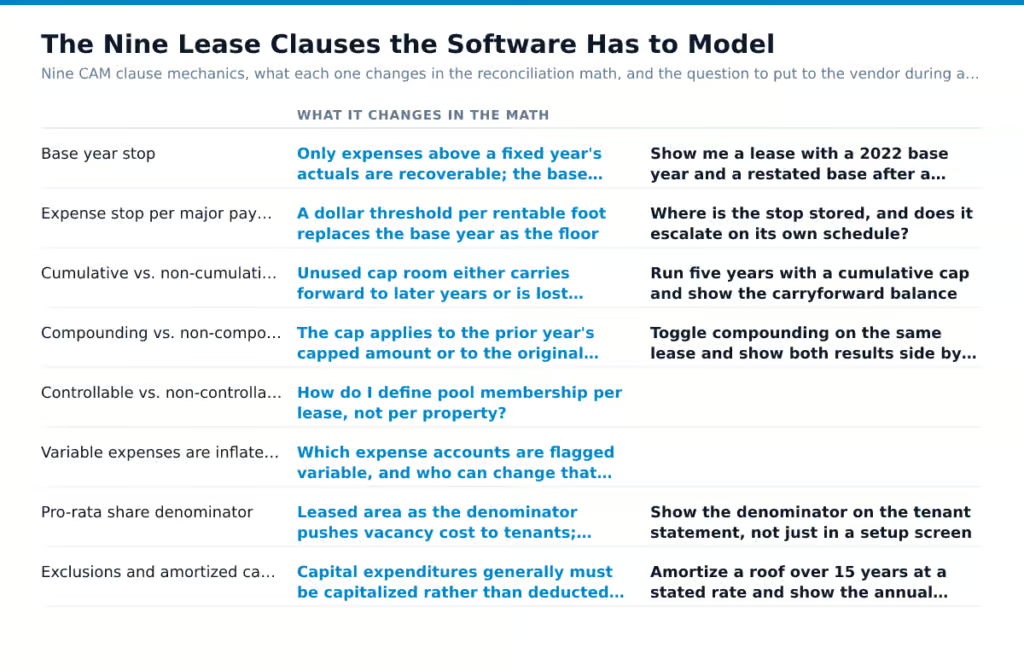
Add the audit rights window and the true-up payment or credit deadline as a tenth item, because those are dates the system should be tracking against the reconciliation run. If a clause can only be handled by a manual journal entry, ask who writes that entry next year after the analyst who understood it leaves.
Running the Demo: A Scripted Ninety-Minute Test
Schedule this after you’ve shortlisted two or three vendors, and refuse the generic demo. Bring one property you already know cold: a mixed-use or multi-tenant office building, twelve months of GL detail, and three leases with genuinely different structures, say a gross lease with a base year, a net lease with a cumulative cap, and one with a fixed CAM stop. You already reconciled that property by hand, so you know the right answer. Send the files two days ahead and tell the vendor the demo is a working session, not a presentation.
- Have an implementation person, not a salesperson, abstract one of your leases live while you watch, and point to the exact fields holding the cap, the base year and the gross-up percentage.
- Load the expense pool, then ask them to exclude one capital item mid-run and re-run the reconciliation without rebuilding the pool.
- Change a tenant’s square footage effective mid-year and confirm the pro-rata share prorates by day rather than snapping to the year-end figure.
- Generate the tenant statement and open the backup: every line should trace to GL detail you can attach and a reviewer can follow.
- Pull the audit trail for the changes you just made, and ask whether a prior-year reconciliation can be locked against edits.
- Ask what renewal pricing looks like, what the termination clause says, and what a full data export costs on the way out.
- Confirm the tenant portal displays the true-up and accepts payment for it.
Time the whole pass with a stopwatch and set it against the hours your team currently spends in Excel on that same property. Done looks like a statement you’d mail tomorrow, produced from your data, with backup a tenant’s auditor could open. Anything that ended in “we’d configure that during onboarding” stays on your list of unanswered questions, alongside the other property management due diligence you run before signing.
Where the Big Platforms Actually Differ
The decision isn’t which vendor demos best. It’s which tier of product can carry your worst lease, because recoveries you bill are rental income to you the moment the tenant pays them (26 CFR 1.61-8 — Rents and royalties), and a reconciliation your system can’t compute is one you’ll rebuild in Excel every January.
| Criterion | Enterprise commercial-native (Yardi Voyager Commercial, MRI) | Mid-market hybrid (AppFolio commercial, Buildium-class) | Accounting-first stack plus lease module | Free or low-cost commercial tools |
|---|---|---|---|---|
| CAM capability to verify in the demo | ||||
| Realistic portfolio fit | Large mixed portfolios with negotiated, non-uniform leases | Small office, flex and retail with fairly uniform lease forms | Low property count, simple NNN, one or two expense pools | A handful of single-tenant buildings |
| Implementation reality | Months, with lease abstraction as the long pole | Weeks, if your leases match their template | Days, plus your own spreadsheet | Immediate, and you own every calculation |
| Question that disqualifies it | Can we get lease and ledger data out in full, on demand? | Show me a cumulative cap with carryforward, live | How does it handle a base year? | Where does gross-up happen? |
| Pricing shape to pin down | Per-unit or per-square-foot with a monthly minimum | Per-unit with a stated floor | Per-seat accounting plus module fee | Free, until your time is priced |
Enterprise wins when a single mis-grossed-up lease costs more than the license. Mid-market wins when your leases are uniform and your AP volume is the real pain. Accounting-first works below roughly a dozen simple NNN properties. We tell clients to read the termination clause and the data-export right before the per-unit price, a point we’ve made across our property management software coverage.
Getting Paid the True-Up
A reconciliation only matters once it turns into money. The true-up invoice is large, irregular, and unfamiliar to whoever opens it, which is the exact profile of a charge that gets disputed and the exact amount you don’t want to pay a percentage on. ACH is the default here. Nacha sets same-day settlement windows and a per-transaction dollar cap (Treasury/Fiscal Service, Federal Government Participation…), so a five-figure true-up may need to go through a standard next-day entry rather than same-day, and your bank’s file cut-off decides which. Card acceptance on a five-figure balance costs a percentage of a number too big to give a percentage of.
If you do take cards for CAM billing, ask two things before you turn it on: what the batch cut-off time is, and whether faster funding is included in your rate or priced as a separate line. Set the billing descriptor to the property name tenants recognize, not the management entity.
Watch the lease deadline too. Recovered CAM is rental income when received (26 CFR 1.61-8 — Rents and royalties).
Pull your three largest true-ups from last year and check what each cost you to collect. If any went on a card, price the same invoice as an ACH debit and ask your processor to name the difference in writing.
Frequently Asked Questions
What is the 4-3-2-1 rule in real estate?
There isn’t a single industry-standard 4-3-2-1 rule in real estate; the meaning turns on who is using the phrase and what they are trying to simplify. In commercial operations, it doesn’t tell you anything useful about whether software can bill recoveries correctly or survive an audit. If a vendor reaches for slogans instead of showing lease clauses, charge codes, and approval history, you’re hearing marketing, not seeing proof.
What commercial real estate software is best for brokers?
For brokers, the best software is usually brokerage software, not landlord accounting software. A broker needs deal pipeline, contact history, commission tracking, tour activity, and document workflow, while a property manager needs lease-level billing logic, recoveries, and ledger posting. If your firm does both, judge the stack by the handoff: a signed deal should move from listing to lease record to billing setup without someone retyping suite, term, rent steps, and recovery language.
Is there free commercial property management software worth using?
Free commercial property management software is worth using only for a short pilot on a simple rent roll. The break point is lease complexity: once a lease has expense stops, admin fees, exclusions, or midyear occupancy changes, a free tool usually pushes the real work into spreadsheets and email approvals. Charges a tenant pays under the lease are generally treated as rental income, so your system needs records that tie each billback to the lease and the ledger (Topic no. 414, Rental income and expenses) (26 CFR 1.61-8 — Rents and royalties).