

by Christopher Hayes September 9, 2026
Managing affordable housing is hard enough without a surprise audit finding. Yet many owners and agents lose points during a Management and Occupancy Review for one avoidable reason. They cannot show clean, well-organized resolution logs. HUD’s Enterprise Income Verification (EIV) system flags problems every month. It spots identity mismatches. I
t flags families who may have underreported income. What HUD really wants to see is proof that you acted. This guide breaks down EIV identity verification, the EIV income discrepancy report resolution process, and how to build resolution logs that hold up under review. Get this right, and you protect your funding, your residents, and your peace of mind.
What Is the EIV System?
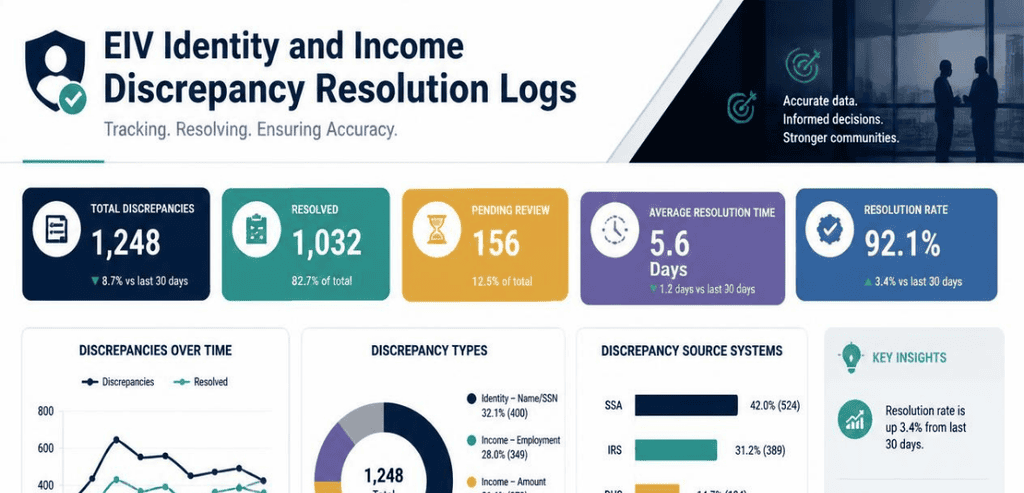
HUD Enterprise Income Verification (EIV)
The EIV system is the tool HUD employs for tenant income verification. Public Housing Agencies (PHAs), private owners, and management agents utilize the system throughout the U.S. The system obtains data from two of its federal partners. One is the Social Security Administration (SSA). The other is the Department of Health and Human Services (HHS) via the National Directory of New Hires (NDNH).
EIV performs data matching between the federal data and what is reported by tenants on their certification forms. In the event of a mismatch, EIV generates reports that need to be addressed. This article focuses on the Identity Verification Report and the Income Discrepancy Report. Both reports are part of the compliance workflow.
EIV contains sensitive data, such as Social Security numbers, wages, and benefits. HUD takes misuse of the system seriously. Unauthorized use can lead to a $5,000 fine and/or a felony and imprisonment. Each report must be handled with appropriate care.
Understanding EIV Identity Verification
Identity verification is the first gate in the EIV workflow. Before HUD can share any income data, it must confirm who the tenant is. HUD sends three pieces of personal information to SSA. These are the tenant’s name, Social Security number, and date of birth. SSA then checks its own records for a match.
Identity Verification Statuses You Will See
EIV indicates one of five statuses on the Summary Report for households. “Verified” means the identity was confirmed by SSA, and the income data will process without issue. “Pending” indicates that the match is still ongoing and there is no need for you to take action. “Failed” means that SSA was unable to confirm due to inaccurate data, and “Excluded” means that HUD will not provide SSA with that individual’s identifiers. Finally, “Deceased” means that SSA has that individual listed as deceased.
Status “Verified” is the only reason that the tenant’s income data is accessible in EIV. In the case where identity is not verified, EIV will show no wage or benefit data for that individual, thereby creating a verification gap, and you will need to obtain verification from another source.
Failed Identity Checks and How to Fix Them
A failed status usually points to a typo or an outdated record. EIV splits these failures into two report types. The Failed EIV Pre-Screening report updates weekly, every Saturday morning. The Failed SSA Identity Test report updates monthly. You must review the failed reports and act within 30 days of the report date.
Most of the time, addressing the issue is straightforward. Start by double-checking the data entry. Review the name, DOB, and SSN in your system against the tenant’s original documents. If you find your system to be at fault, please make the necessary correction and resubmit the certification. For public housing, the correction is made on the HUD-50058, while for the multifamily programs, the correction is made on the HUD-50059 in TRACS.
In some cases, the problem will be with the tenant’s record at the SSA. In this situation, only the tenant can request the correction by calling the SSA at 1-800-772-1213 or visiting the local office. Keep in mind that an invalid SSN will never verify. SSA does not issue numbers starting with 000, 666, or the 900 series. If you come across any of these, you are dealing with either a placeholder or a mistake and not a real record.
The EIV Income Discrepancy Report Explained
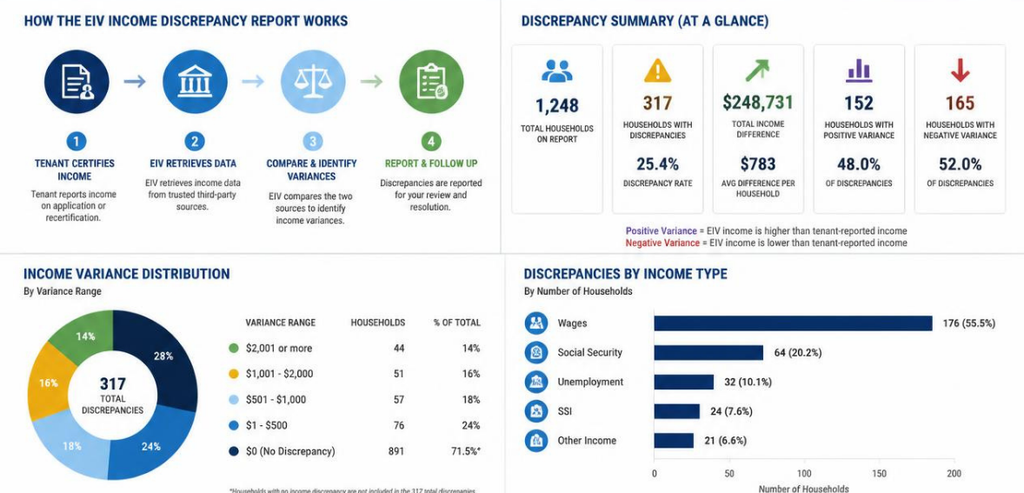
The Income Discrepancy Report is where most compliance work happens. It compares the income a tenant reported at recertification with what SSA and NDNH actually show. When the federal data is meaningfully higher, EIV raises a flag. This is your signal to investigate possible unreported or underreported income.
How the Period of Income Works
The report provides an overview of the Period of Income (POI). The POI begins 15 months prior to the annual recertification of a household and ends 3 months prior to the recertification date. For instance, a household that recertifies on May 1 will have a POI from the previous February to the following January.
This time frame is critical. Any income received by the tenant outside the POI will not be counted towards the discrepancy amount. During case resolution, the income received during this time frame should be the only income considered. For case resolution, examining the effective dates for wages and benefits can be the difference between a resolution and a major costly mistake.
The Discrepancy Threshold
EIV does not flag every small difference. A discrepancy generally becomes reportable when annualized income exceeds the reported amount by $2,400 or more per year. That works out to about $200 per month. HUD uses this threshold because most leases require tenants to report cumulative income increases at that level. When the gap clears the threshold, the report expects you to dig in.
The EIV Income Discrepancy Report Resolution Process
This is the core of the workflow. A flag on the report is not a conclusion. It is a starting point. Your job is to determine whether the discrepancy is valid or invalid, then document the outcome either way.
Valid Versus Invalid Discrepancies
Always begin every case by contacting the household. Send the tenant a written notice and allow a reasonable time to respond. Consider 10 to 15 business days as a reasonable time to respond. While waiting for the response to the notice, gather third-party income verification. Compare the income verification against the certifications in effect during the POI.
The discrepancy is valid if the tenant failed to report income. In this case, a corrected HUD-50059 must be done to capture the unreported income. A notice must be sent to the tenant to inform them of the funds they owe. Overpaid assistance must be recovered or a repayment agreement must be established. Collection costs can be retained, but HUD must be reimbursed for the recovered assistance.
If the income was reported, or if the timing or the owner’s calculations resulted in an invalid flag, then the discrepancy is invalid. It must also be documented. The file must also show the reason the flag was invalid. It is important to note that undercharges due to owner’s failure to properly execute HUD‘s rent calculation do not create a tenant repayment liability.
When a Tenant Disputes the Data
Sometimes a tenant insists the EIV data is wrong and you cannot obtain matching verification. In that situation, the tenant must come to the office and self-certify that the EIV information is inaccurate. The statement must be signed and dated by the household. Keep it in the tenant file alongside the discrepancy report. Incorrect data can also be a warning sign of identity theft, so treat unusual mismatches with extra attention.
Building Strong EIV Resolution Logs
Resolution logs turn your work into proof. HUD reviewers cannot see the phone calls you made or the verifications you chased. They can only see your file. A strong log tells the whole story without you being in the room.
What Belongs in Every Resolution Log
A resolved flag connects the outcome with an explanation. Resolution logs should contain the original EIV report, the date the discrepancy was first identified, and all documented efforts to resolve the discrepancy. Attach all third-party verifications. Document the dates the tenant was contacted and the dates any notices were sent. Explain your determination regarding the discrepancy and whether you found it valid or invalid. If the determination was that monies were owed, then include the corrected certification, the notice of funds due, and the claim or collection documentation.
The rule is simple. The Income Discrepancy Report and annotated resolution notes must be maintained in the tenant file regardless of the determination of the discrepancy. A file with only a discrepancy flag will be an unresolved finding.
Record Retention Rules
HUD is clear about the life of certain records. The Income Report, the Summary Report verifying identity with a “Verified” status, the Income Discrepancy Report, and the related supporting documents must be retained in the resident file for the duration of the tenancy and 3 additional years. This information is available in HUD Handbook 4350.3. The retention and resolution rules are available in Chapter 9 of the Handbook 4350.3.
Tenant files must also be available for review by the resident. A tenant may authorize a third party to review the file by signing an authorization. Logs that are well organized simplify the process of fulfilling such requests.
Common EIV Compliance Mistakes to Avoid
The most common finding is a gap in the paper trail. Staff clear a discrepancy in their heads, but don’t write anything down. Another mistake is overlooking failed identity reports after the 30-day deadline. A third example is the lack of frequent reviews of the EIV. The EIV should ideally be reviewed at a minimum of one-month intervals and prior to each certification. If the EIV is not reviewed on a regular basis, minor issues may escalate into overpayment cases and audit findings.
National Center for Housing Management (NCHM)
Employee training helps bridge these gaps. For instance, the National Center for Housing Management provides its unique EIV certification. Their training courses assist with understanding reports, addressing discrepancies, and maintaining system security. The likelihood of findings decreases with the quality of training provided to staff.
Conclusion
EIV compliance rewards habit, not heroics. Identity verification confirms who your tenants are. The income discrepancy report confirms what they earn. The EIV income discrepancy report resolution process ties the two together and protects program integrity. But none of that matters at a review unless your resolution logs prove it happened.
Treat every flag as a task with a paper trail. Investigate fast, document fully, and retain records for the required term of tenancy plus three years. Do that consistently, and your next Management and Occupancy Review becomes a formality instead of a fire drill. Strong EIV identity and income discrepancy resolution logs are the quiet backbone of affordable housing compliance.
Frequently Asked Questions
What is the difference between the EIV Identity Verification Report and the Income Discrepancy Report?
The Identity Verification Report confirms a tenant’s identity by matching their name, Social Security number, and date of birth against SSA records. The Income Discrepancy Report compares reported income to federal wage and benefit data to spot unreported or underreported income. Identity must be verified before any income data appears in EIV.
How long do I keep EIV resolution logs and reports?
Keep the Income Report, the Verified Summary Report, and the Income Discrepancy Report with all supporting documentation in the resident file. The retention period is the term of tenancy plus three years, as required by HUD Handbook 4350.3.
What happens when an EIV income discrepancy is found to be valid?
You process a corrected certification to include the missing income, notify the tenant of funds due, and collect the overpaid assistance or arrange a repayment plan. You then reimburse HUD for the recovered amount and document every step in the tenant file.
How quickly must I act on a failed identity verification?
Review failed identity reports and correct the discrepant data within 30 days of the report date. Confirm your own data entry first, update the HUD-50058 or HUD-50059 as needed, and retransmit it so EIV can attempt a new match.