Category Archives: Property Management Software

tenant portal

How to Get More Tenants to Use the Portal for Payments, Documents, and Maintenance Requests

Getting tenants to actually use your property management portal feels like pushing a boulder up a hill. You set it up, send the login details, and then watch half your residents still slide paper checks under the door or call the office to report a leaky faucet. Sound familiar? You’re not alone. Landlords and property managers across the country wrestle with low tenant portal adoption every single day — and it costs them time, money, and sanity.

The good news is that with the right strategy, you can dramatically improve portal usage, reduce manual work, and create a smoother experience for everyone involved. This guide breaks down exactly how to make that happen.

Why Tenants Resist Using a Portal in the First Place

Why Tenants Resist Using a Portal

Before you can fix the problem, you need to understand it. Most tenants don’t refuse portals out of stubbornness — they avoid them out of habit, confusion, or distrust. Older renters may feel intimidated by new technology. Younger tenants surprisingly sometimes prefer texting over logging in to a platform. And some residents simply never received proper onboarding when they first moved in.

Distrust is also a big factor. Tenants are concerned about the safety of saving payment info online. Uncertainty about the portal’s safety is a major factor. Whether maintenance requests are being seen is a big concern. All these concerns need answers, not just the “follow this link to log in” answer buried in the welcome email. This is the basis for a successful adoption of renter self-service. Yes, you are launching a new feature, but look at the bigger picture and the changes it brings.

Start With a Strong Onboarding Experience

The single biggest driver of portal adoption is what happens in the first week. If a new tenant signs their lease and never hears another word about the portal, they’ll default to whatever feels easiest — which is usually a phone call or a check.

Make portal onboarding a formal part of your move-in process. During the move-in walkthrough, pull up the portal on a tablet or laptop and walk the tenant through it in person. Show them how to make a payment, submit a maintenance request, and find their lease documents. That five-minute demo is worth more than a dozen emails.

Follow up with a welcome message sent directly through the portal—not just a standard email. This reinforces that the portal is the primary communication channel from day one. When tenants see their first official communication come through the platform, they start to associate it with reliability.

Make It Easy to Get Tenants to Pay Online

Get Tenants to Pay Online

Payment is the highest-stakes function of any tenant portal. It’s also the behavior that, once established, tends to stick. When you successfully get tenants to pay online for the first time, the chances they’ll do it again are very high.

Removing barriers is key. Multiple payment methods should be used. An ACH bank transfer, a credit card, and a debit card should be the required methods. Each tenant sends money differently. High fees for convenience are a simple way to make tenants use checks. Either minimize fees or, where possible, absorb them.

Autopay is highly useful. Automatic payments can be pushed on tenants by saying that they will not have to pay late fees or even remember their payment due dates. Even the most lenient landlords will incentivize pushing autopay by offering rewards, such as gift cards, or by granting payment leniency as a credit. After about a month, that additional credit is considered a good payment by the landlord, since the late payment is no longer late, thereby incentivizing rent payments.

The autopay system also allows for a more direct tenant-landlord relationship. It increases trust and decreases the need to take direct action to ensure payment, as it is not expected to be late. Check the portal for communication and check back to build the payment system.

Use Documents to Drive Regular Portal Visits

Most tenants log in once to pay rent and then forget the portal exists. A smart way to change that is to make the portal the exclusive home for all important documents. Lease agreements, renewal notices, inspection reports, community updates, and move-in checklists should all live there — and only there.

When a tenant needs their lease for a car loan application or a utilities transfer, make sure the portal is the fastest and easiest way to get it. If they can just log in and download it themselves without calling your office, that’s a win for them and for you. This kind of frictionless self-service builds real loyalty over time.

Send regular document updates through the portal notification system. Even a monthly community newsletter pushed through the platform gives tenants a reason to log in. Every visit builds familiarity, and familiarity builds adoption.

Streamline Maintenance Requests to Build Trust

Maintenance is the emotional core of the tenant-landlord relationship. When things break, and nothing gets fixed, tenants lose faith in you and in any system you ask them to use. But when a maintenance request is submitted through the portal and responded to quickly, that’s a trust-building moment.

Keep the process simple and quick. No more than 2 minutes should be needed to submit a request. Immediate auto-confirmation should be followed by a status update within a day. Notifications are needed when a work request is scheduled or completed.

No other factor can so fully change a renter’s relationship with the portal as rapid responsiveness. With every tenant request you handle efficiently, you let the community members know that maintaining their apartment is a priority. An efficient response encourages tenants to continue using the portal. The greatest motivator of continued use of the portal is tenant-driven, self-propagating positive word of mouth. Use these techniques to engage more renters and help them use the portal more efficiently.

Train your maintenance team to update request statuses in real time. Even a simple “vendor scheduled for Thursday between 10 am and noon” update makes an enormous difference. It shows tenants the system is working and that their concerns matter.

Communicate the Benefits Clearly and Often

Communicate the Benefits Clearly

Many tenants don’t use the portal because they don’t fully understand what it offers. Your job is to make the value crystal clear — and to keep reinforcing it.

Create a simple one-page “What You Can Do in the Portal” guide and include it in the lease packet. Reference the portal in every communication. When a tenant calls to report an issue, respond warmly but guide them to submit it through the portal for faster tracking. When someone emails about a late fee, redirect them to the payment history section of the portal, where they can see the full timeline.

Don’t frame the portal as something that saves you work. Frame it as a way to give tenants more control. Renter self-service adoption skyrockets when people feel like they’re gaining independence, not being managed. “You can check your balance anytime, 24/7, without waiting for office hours” is a far more compelling message than “please use the portal to reduce our call volume.”

Leverage Resident Feedback to Improve the Experience on Tenant Portal

When tenants feel that their voices are included, the likelihood of their interactive engagement with your systems increases. Implement a feedback loop that is embedded in your portal experience. After a maintenance request transitions to closed status, an in-portal brief satisfaction survey is sent. Inquire from tenants about which features of your platform they use the most, and what barriers to your platform’s potential they feel the most.

Use that feedback to make real changes — and then tell tenants you made them. “Based on your feedback, we’ve added a document search feature” is a powerful message. It shows residents that their input has value, and it turns the portal into something collaborative rather than transactional.

This approach also surfaces technical issues early. If multiple tenants report confusion about the same feature, you can address it before it becomes a larger adoption problem.

Tools and Platforms Worth Knowing

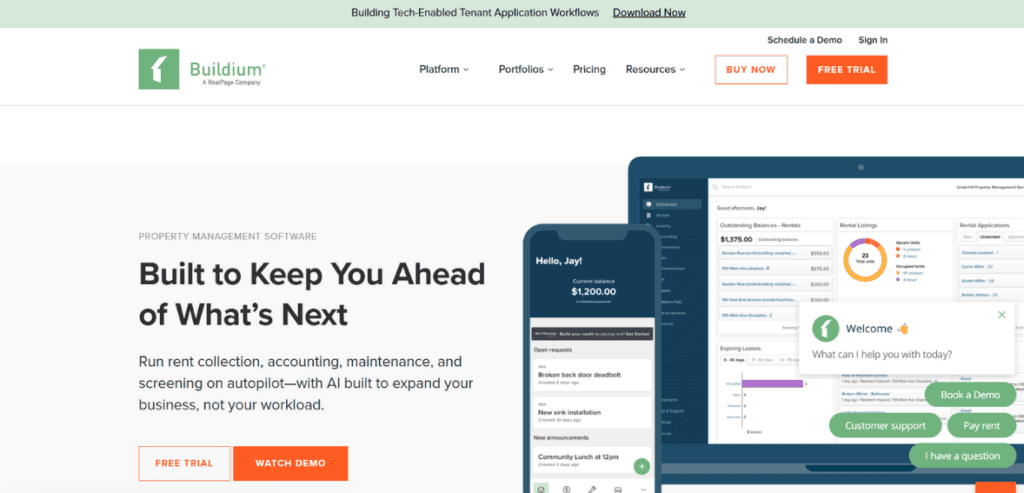
Buildium

Buildium is a property management software that includes a tenant portal with payment, maintenance, and document storage features. Buildium built its tenant portal with a focus on user friendliness. Buildium created robust reporting options to help property managers see portal usage levels among their tenants.

AppFolio

AppFolio’s tenant portal is much nicer than those of other software on the market. They allow tenants to pay rent and submit maintenance requests while communicating with the management team through their mobile app. Their autopay system is easy to set up, and tech-comfortable tenants prefer using their portal.

TenantCloud

TenantCloud is a strong option for independent landlords managing smaller portfolios. It offers a free tier with core portal features, making it accessible for landlords who want to get tenants to pay online without a large software investment.

Conclusion

Getting tenants to embrace a self-service portal isn’t a one-time announcement — it’s an ongoing commitment to making their lives easier. When you invest in strong onboarding, remove barriers to online payment, keep maintenance communication fast and transparent, and consistently show residents the value of logging in, adoption follows naturally. The landlords who see the highest portal engagement aren’t the ones with the most sophisticated software. They’re the ones who treat the portal as a relationship tool, not just an administrative shortcut. Start with one change this month, measure the results, and build from there.

Frequently Asked Questions

How do I convince older tenants to use a tenant portal?

Older renters often resist portals not because they can’t learn but because no one has taken the time to show them. Schedule a brief in-person or phone walkthrough at move-in. Keep the instructions simple and focused on two or three core tasks — paying rent and submitting a maintenance request. Patience and personal attention go a long way.

Should I require tenants to use the portal, or keep it optional?

Making the portal mandatory for certain functions — such as maintenance requests — can accelerate adoption. However, most landlords find a gentler approach more effective: make the portal so convenient that opting out feels like extra work. Combine strong encouragement with minor incentives rather than strict requirements, especially at first.

What is the best way to increase tenant autopay enrollment?

Offer a meaningful but low-cost incentive for early enrollment, such as a one-time rent credit or a small gift card. Pair that with clear messaging about the benefits — no late fees, no missed payments, no stress. Send a targeted campaign at lease signing and again 60 days before renewal when tenants are already thinking about their housing situation.

How long does it typically take to see significant improvement in portal usage?

Most property managers who implement a structured adoption strategy see meaningful improvement within 60 to 90 days. Quick wins often come from autopay enrollment drives and maintenance workflow improvements. Full adoption across a property typically takes one full lease cycle, as turnover brings in new tenants who are onboarded correctly from the start.

Property Management Software for Small Landlords

When DIY Landlords Outgrow Spreadsheets: Signs It’s Time to Use Property Management Software

There’s a moment every self-managing landlord eventually hits. The spreadsheet that once felt like a smart, scrappy solution starts fighting back. A rent payment gets logged in the wrong cell. A lease renewal slips through the cracks. A maintenance request lands in your inbox and gets lost beneath 40 other unread messages. Suddenly, what was manageable at two units feels genuinely chaotic at five. If any of this sounds familiar, you’re not alone — and you’re probably closer to needing property management software for small landlords than you realize.

This article walks through the real signs that your DIY system has hit its ceiling, what the right tools can do for you, and how landlords at every stage are making the shift without losing control of their business.

The Spreadsheet Trap: Why It Works at First (and Fails Later)

Spreadsheets are free, flexible, and familiar. For a first-time landlord with one or two rentals, they make perfect sense. You track rent, document expenses, note lease dates, and call it a day. The system works because the volume is low and everything fits in your head.

But rental portfolios grow. Tenants multiply. Maintenance calls start coming from three directions at once. Tax season stops being a few receipts in a folder and becomes a small accounting project. At that point, the spreadsheet isn’t your assistant anymore — it’s your bottleneck. The hidden cost isn’t the software you haven’t bought yet. It’s the hours you’re burning on tasks that could be automated, the mistakes you’re making because nothing is connected, and the growth you’re leaving on the table because your systems can’t scale.

Five Clear Signs You’ve Outgrown Your DIY System

You’re Chasing Rent Every Single Month

If you’re sending out “friendly reminder” texts every month and anticipating Venmo payments, that’s a system problem, and not a tenant problem. Self-managing landlords encounter manual rent collection as one of the biggest time drains. It’s also one of the easier problems to fix. DIY landlords can avoid this manual process by using rental management software that integrates with payment processing and tenant collections. That payment processing and collections are automated. With this system, you are no longer the middleman. Late fees are automatically enforced in this scenario.

Your Lease Renewals Are a Scramble

Leaving a lease expiration date untouched for 2 weeks can be a financial disaster. You could lose revenue due to a vacancy. You could be forced to enter a short-term lease. You might also be left exposed legally in certain jurisdictions. Lease renewals that are less visible in a spreadsheet are much easier to overlook. The best property management systems provide lease renewal notifications several weeks in advance. In most systems, you can complete a renewal offer and send it to the tenant directly, streamlining a time-consuming task.

Maintenance Requests Are Falling Through the Cracks

A tenant texts you about a leaking faucet. You mean to call the plumber. A week passes. Now you have an upset tenant, a potential water-damage issue, and a complaint that could turn into a bad review—or worse. When maintenance communication lives across text messages, voicemails, and email threads, there’s no paper trail, and everything depends on your memory. Centralized maintenance tracking is one of the most underrated features of modern landlord software. Every request is logged, timestamped, and tied to a specific unit.

Tax Season Takes You Days Instead of Hours

Self-managing landlords often underestimate how much time poor financial recordkeeping costs them come April. When income and expenses aren’t categorized automatically throughout the year, you’re left reconstructing twelve months of transactions from bank statements and crumpled receipts. That’s not just exhausting — it’s expensive, because you’re likely missing deductible expenses you forgot to log. Integrated accounting features in property management platforms track every dollar in and out, generate expense reports by property, and make tax prep dramatically simpler.

You’re Turning Down Growth Because You’re Already Overwhelmed

This sign is the most expensive. If you’re more anxious than excited about adding a unit to your portfolio, your operational systems are limiting your business’s growth. The right landlord growth tools don’t just walk your portfolio with you; they help you understand it, lessening its daunting side. If the systems you have for rent collection, lease management, tenant communication, and financial reporting are all the same, adding a new property means just a few more inputs, as opposed to a whole new system and a whole new workload.

What to Look for in Property Management Software for Small Landlords

What to Look for in Property Management Software for Small Landlords

The market has expanded significantly over the last few years, which is good news for independent landlords. You no longer have to choose between a basic free tool with no real features and an enterprise platform designed for 500-unit apartment complexes.

Software should prioritize ease of use. If a solution requires a manual and takes weeks just to get started, you are just introducing frustration. Prioritize software designed for small- and medium-sized landlords and choose intuitive options.

The importance of tenant communication and document storage is often understated. Storing documentation such as leases, maintenance records, and communications protects you legally and helps streamline your processes.

What truly makes a software comprehensive is its reporting and accounting capabilities. Software designed to manage property costs will provide you with tools to generate reports and separate costs by property.

Stessa

Stessa is popular among small landlords, hitting the sweet spot between comprehensive, efficient, and free. Stessa syncs with bank accounts and credit cards, and automatically sorts transactions. After transactions are sorted, Stessa generates reports ready for Tax Day. The free version is functional for most needs, but there are paid upgrade options. The paid version incorporates rent collection, tenant screening, and lease management. That said, the free version may meet the financial reporting needs of small landlords, making Stessa the ideal choice for landlords just getting started, particularly those with a financial management focus.

TenantCloud

TenantCloud compiles a number of tools in a single place for functions such as maintenance tracking, tenant screening, rent collection, lease management, and accounting. Independent landlords can get their accounting done with ease and for free if their portfolio is no more than 75 rental units. Portfolios with greater numbers rely on tiered pricing for larger numbers. It’s not a sophisticated, tricked-out accounting system, and it isn’t nearly as powerful as one. Having a small portfolio is adequate, manageable, and highly functional.

Buildium

Buildium is a little pricier than its competitors, but it can be worth it for landlords with many sites who are looking for the most utility. Tenants can be screened, and financial data can be reported and found in the owner’s portals. For committed landlords looking for a portfolio software a step above the rest, Buildium is a great choice.

Making the Transition: How to Switch Without the Headache

Making the Transition

The main reason landlords avoid switching to newer systems isn’t the expense; it’s inertia. People are naturally resistant to change and are more comfortable with the old. However, this should be encouraging. Modern platforms have features specifically designed to ease this transition and even provide resources to import data for you. Many also have a variety of customer support options to assist during this process.

You need to choose one platform with a 30-day commitment. It is extremely likely that this platform will have a free tier or trial. For this initial period, you should upload the leases you are currently using and add your properties. After this, you need to set up your tenants’ payment accounts. Run the systems concurrently for one rent cycle to confirm that all necessary data has been imported. After all this is done, you should be completely done with the old system.

The transition is certainly not the easiest to achieve, but for landlords who have switched systems, almost all say they wish they had done it much earlier. Time saved after the switch is also significant, with most estimating they have saved a lot of time in a matter of 2-3 months that would have been possible in the previous systems.

Conclusion

Spreadsheets are a starting point, not a strategy. Every landlord who manages their own properties eventually reaches a crossroads where the manual approach costs more in time, stress, and missed opportunity than any software subscription ever would. Whether you own two units or twenty, the right property management tools create consistency, reduce costly errors, and free you to focus on what actually grows your portfolio — finding good tenants, maintaining your properties, and making smart acquisition decisions.

The signs are usually obvious before we admit them. Rent is late because the reminder system is you. Leases are expiring without a plan. Maintenance requests are scattered across your inbox and your memory. If you recognize yourself in any of that, the spreadsheet era is over. The good news is that the alternative has never been more accessible, affordable, or purpose-built for independent landlords like you.

Frequently Asked Questions

Is property management software worth it if I only have two or three rentals?

Absolutely. Many platforms offer free tiers specifically designed for small portfolios. Even at two or three units, automated rent collection alone can save several hours each month and eliminate the stress of chasing payments. The earlier you build the right habits, the easier it is to scale.

What’s the best free property management software alternative for new landlords?

Stessa and TenantCloud both offer genuinely capable free plans. Stessa is the stronger choice if your primary need is financial tracking, while TenantCloud is better if you also need rent collection, maintenance logging, and tenant communication in one place.

Can I use property management software if my tenants aren’t tech-savvy?

Most modern platforms are built with tenants in mind, not just landlords. Setup is usually a matter of clicking a link and creating an account. Many tenants actually prefer paying rent through an app rather than writing a check or processing a Venmo transfer each month.

Will switching to rental software help me at tax time?

Significantly. Platforms that automatically categorize income and expenses throughout the year mean you’re not reconstructing your financials in March. Many also generate Schedule E-ready reports, which simplifies the filing process, whether you’re doing your own taxes or working with an accountant.

Buildium Alternatives

Best Buildium Alternatives for Property Managers Who Want Leasing, Maintenance, and Payments in One Platform

The problem isn’t too few tools. It’s too many tools that don’t integrate well. Leasing is in one system. Maintenance is in another. Payments are in yet another portal. Reporting is somewhere else. That patchwork delays and misses updates and frustrates teams.

That leads many property managers to seek alternatives to Buildium. It’s recognized across the industry, and in many cases, it’s sufficient. However, not every team can cope with the same configuration, pricing structure, or workflow. Some managers need more automation. Some desire a better owner experience. Others require more robust accounting, faster maintenance coordination, and software that staff and residents can use easily every day.

When looking for the best Buildium alternatives, the objective is not simply to swap one system for another. It is to find a system that integrates leasing, maintenance, and payments, and is simple. In this guide, we address the top options for teams seeking a true all-in-one experience, especially those considering property management software for mid-size portfolios. We also look at what each platform offers that sets it apart in a rental software comparison, so you can find a solution that aligns with your desired operating style and growth stage.

Why Property Managers Look for Buildium Alternatives

Image Source

Brand recognition doesn’t mean Buildium will be the best option for every portfolio. Property managers start looking for Buildium competitors when the software becomes misaligned with how the team works cohesively. This could be due to cost, functionality, or user experience when software requires too much manual work. There are often too many tasks that still require manual effort. Leasing is one of the primary drivers of team change.

Modern leasing requires online applications, screening, document workflows, e-signing, vacancy marketing, and communication inquiries to move, and everything in between. Maintenance pressure is another primary motivator. Managers want service requests and technician updates to be unified with vendor communication, approvals, and resident notifications. Equally, dominant pain points are in payment and rent collection. Accounting teams should be able to collect and account for rent with less friction and no missing pieces.

For growing operators, this pain point gets even more acute. As the number of units increases, so does the cost of inefficiency for workflow gaps. What is acceptable in a smaller team or workflow becomes a bottleneck. This is why the search focuses more on overall operational fit than on individual attributes.

What to Look for in an All-in-One Property Management Platform

Selecting a suitable property management software provider often requires a deep analysis of the property’s operational needs, including the size of the property management team and the operational complexities encountered each month in running the property. Strong property management software providers, also called all-in-one providers, ideally integrate and centralize management of the property’s entire resident lifecycle, including vacancy marketing, lead management, applications and lease signing, payments and collections, maintenance coordination, communications with owners and residents, and business performance reporting.

Ease of use is a highly subjective parameter that potential customers often underestimate because they lack an understanding of the software’s workflows, which can increase operational efficiency. A software can have all the relevant features, but is rendered ineffective for the property management team if it requires too many clicks to complete daily tasks, and the depth of the accounting functionality required by property management teams is rarely warranted, given the software’s status as solely an operational tool. The depth of reporting, trust accounting, bank reconciliation, and simplified management of owner statements are core accounting functionalities that must integrate smoothly with operational tools.

Vendor support and onboarding are often overlooked, and potential customers often underappreciate the relevance of how quickly the team can learn the systems and the vendor’s contribution to improving the customer support in navigating potential operational challenges to a successful transition. For firms looking at alternatives to Buildium, these details often trump charting a feature set.

AppFolio Property Manager

AppFolio

Image Source

For the previous statement to hold true, property management software vendor products must include the ability to complete all leasing, accounting, maintenance, communications, and reporting in a single, unified, seamless, user-customizable, and holistic solution. Thus, it is of little wonder that almost all property management software vendor comparison reports mention AppFolio. AppFolio offers an integrated solution to leasing, accounting, communications, maintenance, and reporting that modern property managers want.

AppFolio’s leasing process is well executed. They handle manual tasks by integrating online applications, tenant screening, digital leasing workflows, leasing postings to various listing channels, and online payment portals. Collection and ledger updates can also be automated. The maintenance side also has automated support for request tracking and communication.

AppFolio is best suited for mid-sized portfolios, as it strikes a balance between functionality, complexity, and ease of use. The features of AppFolio are highly prized by managers who want a highly refined, easily adaptable system, along with a combination of simpler functions.

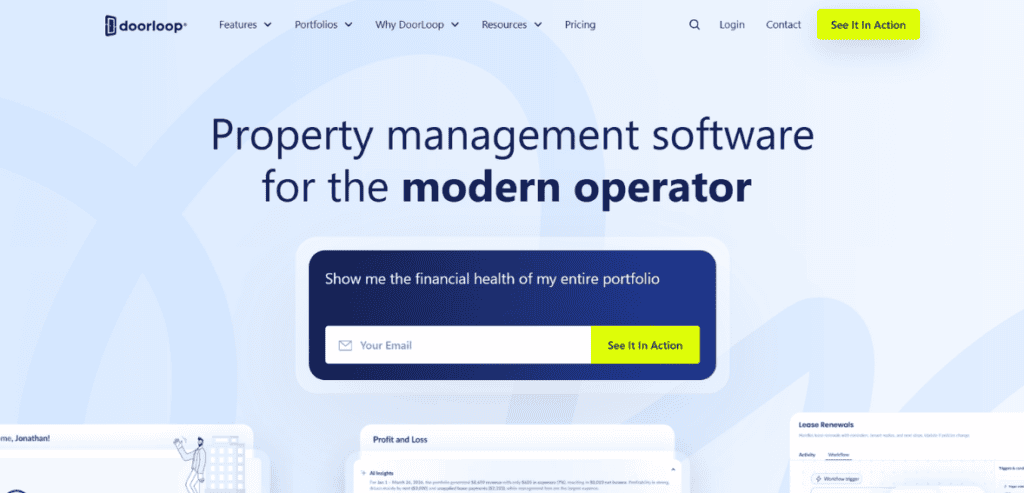
DoorLoop

The ease of use and willingness to help draw users into the value of the combination of accounting, rent collection, maintenance tracking, leasing workflows, and integrated communication tools, in an approachable way. This real advantage of easy navigation does not go unnoticed and attracts more users to the system.

An entire team will not be spending time learning an advanced system, putting them at an advantage. The leasing workflows feature straightforward procedures such as online applications and e-signing, with fully integrated listing support. The maintenance step of the request chain can also be controlled from the platform, which will be advantageous to all users.

Some users consider DoorLoop in the same competitive range as Buildium. As it is more flexible in that range, DoorLoop is perceived as more competitive than Buildium. It does not have to be the best for every single unique specialized process, as the best of them requires winning in all those types. That range of simplicity and depth has been the best for many emerging firms.

Propertyware

Propertyware

Image Source

Propertyware is popular for single-family homes and scattered-site portfolios. However, it can be used more widely than that. Propertyware is the most flexible option for its most detailed control. That is valid for the most-discussed alternatives in Buildium.

Its depth of operation has been an advantage for lots of its users. This is valid for leasing, maintenance, inspections, communications with owners, and accounting, as they are all integrated in the broad platform. Its flexible customization for field operations has enabled many users to have advanced control of the process. This is particularly true for maintenance management in scattered portfolios, as the service coordination is more demanding than in one-location communities.

Most likely, Propertyware will require more configuration and more hands-on system setup than most newer systems. It may not be the most user-friendly system, especially if your team needs a quick win. However, if your company requires a high degree of flexibility and demands a system tailored to your specific business operations, this system can work well. In a comprehensive analysis of rental software systems, the rent manager’s autonomy provides value and warrants consideration.

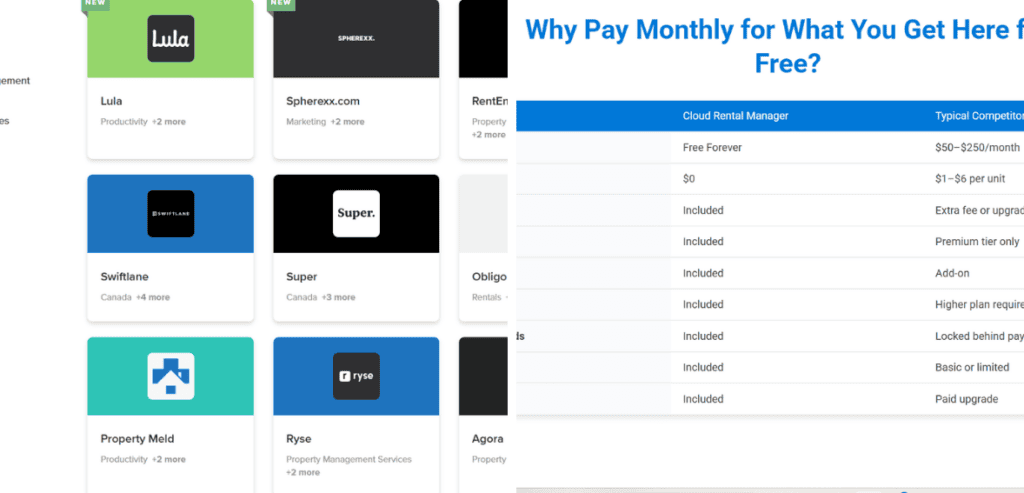
Cloud Rental Manager

Cloud Rental Manager

Cloud Rental Manager has been and continues to be an integral component of the property management software ecosystem, largely due to the breadth of functionality it offers. Firms that have more complicated and more extensive reporting, and/or accounting and operational requirements, repeatedly choose it. It also provides a wide range of capabilities for leasing, maintenance, and payments, effectively serving as a one-stop shop for teams at no cost.

Many clients find it especially good for accounting and system customization. It may also be the best choice for firms that have more complex reporting requirements or more intricate operational workflows than competing systems. Marketing, applications, and lease administration are included in the leasing functionality. In maintenance, work order management and status tracking are consolidated with operational and financial record linkages. In today’s environment, online payment collection and resident payment conveniences are also included.

Cloud Rental Manager provides more configurability than simpler software. However, as the saying goes, ‘with great power comes great responsibility.’ Some teams, including yours, may consider this a drawback, while others may see it as a benefit. Whether your business leans towards more flexible options rather than more straightforward ones tends to be a deciding factor for this type of software.

TenantCloud

TenantCloud’s lower price point and broader feature set mean it can, and typically does, appeal to independent landlords and smaller property managers, but also has the capacity to service growing businesses. This is especially true for larger teams that want digital tools but don’t want to pay a steep price to get them. This is the reason it is considered a more accessible alternative to Buildium.

TenantCloud offers the digital tools needed to transform most property managers’ businesses, including consolidated online rental payment processing, lease and maintenance request management, and tenant communication systems. Your decision to use several digital tools is likely why you are just beginning to explore property management software. The appeal of TenantCloud is that it does not feel overloaded, and for many, it offers the practicality they desire.

TenantsCloud is recognized for its straightforward functionality and affordability. However, that comes at the cost of limiting enterprise-class control. This means, for larger, more demanding operational portfolios, more advanced automation and deeper accounting than is generally recognized for TenantCloud will be required. Because of this, smaller teams are better for TenantCloud, as it is recognized as one of the better options for rental software for teams in a growth phase, helping avoid enterprise-class control.

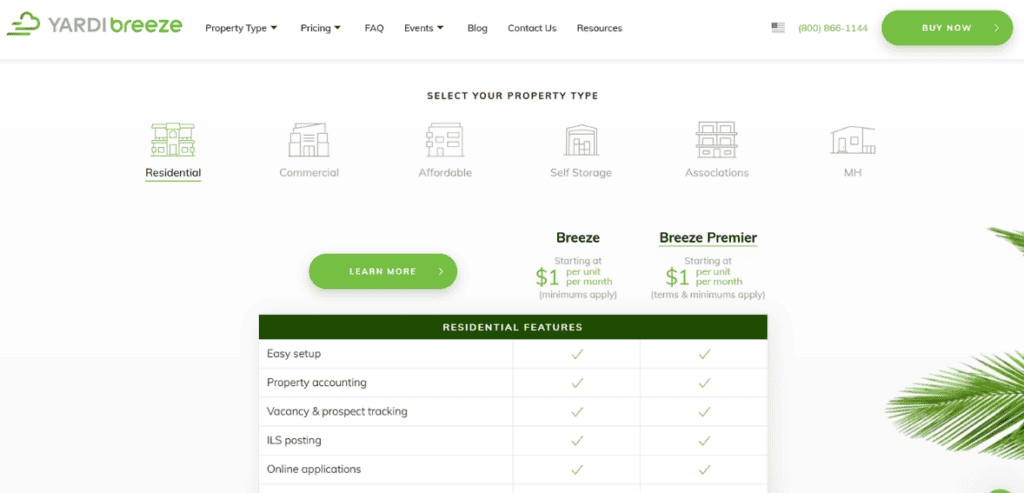
Yardi Breeze

Yardi Breeze

Image Source

Yardi Breeze is part of the Yardi family of products, and clients in the real estate industry can be confident in its reliability and longevity. Yardi Breeze is seen as a simpler entry point into Yardi than their larger enterprise software solutions. This also supports the need for customers to have robust software functionality while avoiding the need to move to large enterprise software too quickly.

Yardi Breeze stands out among Buildium’s competitors by offering integrated accounting, leasing, maintenance, and payments, as well as a familiar all-in-one solution. It allows online applications and rent collection, as well as work order tracking. This keeps the team focused on the processes that matter in one software. Operational unity is the most sought-after attribute from most buyers.

The portfolio complexity is the greatest determinant of this software’s operational fit. Some managers will find it dependable and well-balanced, while others will think Yardi Breeze would fit better within a larger Yardi ecosystem. Yardi Breeze is for teams that need a vendor’s software package with a well-known name, integrated core software, and good quality features.

Hemlane

Hemlane differs from most competitors in this space by offering only a selection of the core functionality provided by an all-in-one software. These would be leasing, maintenance, and rent collection. Hemlane also includes local support and operational efficiency-focused features that could help managers seeking more than just a database.

Considering Buildium alternatives, Hemlane uniquely accommodates leasing and maintenance visibility. All-in-one managers can market units, manage leads, screen applicants, schedule maintenance, and collect payments. This is especially useful for remote owners/managers of distributed properties. The model aims to keep people communicating and to minimize the disorganization caused by unintegrated systems.

While Hemlane may not be the primary option for large, accounting-heavy operations, it is certainly a primary option for leasing- and service-coordination-focused managers. In rental software comparisons, it provides a slightly divergent perspective than competitors, primarily focused on back-end operational complexity.

How to Choose the Right Buildium Alternative

It is important to understand the areas where your current processes fail to determine the alternatives to Buildium. Once you determine your biggest issue, if it is leasing, it is important to concentrate efforts on lead-to-lease speed, syndication of listings, applications, and electronic signatures. Should maintenance be a daily source of frustration, focus on workflows for work orders, vendor coordination, and communication with residents. In the end, if your rationale is based on accounting, your focus should be on reporting techniques, reconciliation, and the overall quality of the owner statements.

Portfolio size is also impactful. The best property management software is usually designed for mid-sized portfolios. They may have outgrown basic tools, but may not require the added expenses or operational overload of enterprise solutions. That is where software selection complexity most often converges. Mid-size operators need a delicate equilibrium.

Considering the demo should not be the final consideration. While a system may look good in a sales spiel, the everyday use might be different. Consider all onsite staff, back-office employees, suppliers, owners, residents, etc., who will use the software. Along with feature rosters, the right system will be one your staff will enjoy using daily.

Conclusion

The system with a long list of features is not always the best.  The best system should integrate the most vital processes in a clear, efficient way while enabling scalability. From a property manager’s perspective, if you want to centralize leasing, maintenance, and payments, there are good alternatives to Buildium worth considering.

AppFolio offers scale and refinement, while DoorLoop embodies simplicity and speed. For more complex operations, Propertyware and Rent Manager offer greater control, whereas TenantCloud and Yardi Breeze’s integrated options offer value and affordability. For the practical operational side of leasing and maintenance, coordination with Hemlane is a good option. Each of these alternatives to Buildium can be a viable competitor; your portfolio, processes, and expected future growth will also be significant considerations.

The best comparative analysis of rental software considers more than the front-end features. It should focus on the underlying functionality that the software will support. The business will have more space to grow, residents will receive greater service, owners will see clearer reports, and the team will be more efficient.

Frequently Asked Questions

What are the most appropriate Buildium alternatives for mid-size property management companies?

Depending on criteria such as ease of use, advanced accounting, customizations, or fast leasing workflows, appropriate choices are AppFolio, DoorLoop, Rent Manager, Propertyware, and Yardi Breeze. Many buyers look for property management software for mid-size portfolios that achieves a desirable balance between depth and usability.

Which Buildium competitor offers the best functionality for leasing, maintenance, and payments integrated into a single platform?

While many platforms perform well across all three functions, AppFolio and DoorLoop are highly reviewed for seamlessly integrating the three workflows. Also, Rent Manager and Propertyware are usually better options when the operational intricacies are above average. The best competitor to Buildium usually comes down to whether operational simplicity, flexibility, or depth of financial controls deserves priority.

How does Buildium compare to the rest of the property management software ecosystem?

Yes, Buildium still works well for many property management companies, including older competitors that offer newer and more specialized options. Weaker workflow automation, better user experiences, and better fits for more specialized portfolio types are often the trade-offs. Many of these trade-offs are why teams look to Buildium alternatives when they begin to scale or when their current process starts to feel fragmented.

What are the important features that should be included in a rental software comparison?

Leasing workflow, maintenance coordination, online payments, depth of accounting, quality of reports, usability, ease of onboarding, and quality of support should be the most important features in a rental software comparison. The best rental software comparisons also consider the alignment of the platform with the user’s portfolio and operational model, rather than the number of features the company showcased in the demo.

When to Upgrade Your Property Management Software (and Signs You’ve Outgrown Your Current System)

Knowing when to replace your property management software is the key to keeping your business running efficiently. When your portfolio expands, older systems can slow down operations, cause errors, and frustrate tenants or employees. Being aware of the signs that your current software does not suffice anymore ensures you invest in a solution that increases efficiency, enhances communication, and is capable of long-term growth.

Old System vs Modern Property Management Software

FeatureOld SystemModern Property Management Software
Booking Management
Manually tracking bookings across Airbnb, Vrbo, and Booking.com
Channel management that syncs calendars and avoids double bookings
Guest CommunicationGuest messages scattered across multiple inboxesUnified inbox with automated guest messaging and templates
Payments
Manual payment requests and tracking
Online guest payments with automated reminders and secure processing
Financial Management
Spreadsheets for expenses and revenue
Real-time financial reporting and owner dashboards
Maintenance Requests
Guests call, text, or email to report issues
Automated maintenance requests with vendor assignments and tracking
Accessibility
No mobile access, tied to your desktop
Mobile-friendly app that keeps managers, cleaners, and co-hosts connected
Integrations
Limited integrations with other tools
Centralized system connected to OTAs, smart locks, accounting, and cleaning apps
Cost Efficiency
Rising costs with no added features
Transparent pricing with automation and core features included

Indications That You’ve Grown Out of Your Existing Property Management System

Updating Property management software

Communication With Owners and Guests Feels Cluttered

Effective communication lies at the core of every effective short-term rental business. But when you’re struggling back and forth between Airbnb, Vrbo, Booking.com, SMS messages, and email, communication can become strained. This wastes time and causes you and your customers a lot of stress. The modern property management software makes it easy by consolidating all your messages in a single inbox.

You can view all your conversations in one spot, send speedy replies, and even program responses to answer those frequent questions. Owners also have their very own portal to access bookings, revenue, and reports, to stay updated without endless follow-ups. With a unified system communication becomes effortless, saving hours each week while improving guest satisfaction and owner relationships.

Your Payment Process Needs an Upgrade

Chasing payments, sending invoices, and managing late fees manually can become a daily headache. If your current system still relies on manual tracking, it’s time for an upgrade. An updated property management software simplifies collecting payments fast and securely.

Visitors can pay online with credit cards, ACH transfers, or e-checks. You can also automatically send rent reminders and generate payment reports with no additional effort.Also with an integrated owner portal, property owners can view real-time payment information and statements. This transparency eliminates confusion and strengthens your trust with your clients.

You Don’t Have Clear Financial Insight

Operating a rental company with no proper financial information means chasing your destination blindly. If your software doesn’t provide you with real-time insight into income and expenses, you have no choice but to work with spreadsheets and guesswork.

Modern property management software has integrated accounting and reporting capabilities that reveal where your money’s coming from in real time. You can monitor revenue, expenses, taxes, and profits from a single dashboard, which allows you to make better and quicker business decisions. It’s simpler with these insights to predict income, spot trends, and remain in complete command of your finances.

Your System Isn’t Mobile-Ready

Sometimes guests arrive early, cleaners require instant updates, and even some bookings occur at odd times. If your software isn’t mobile-friendly, you’re one step behind.

A mobile-optimized property management platform allows you to do all this from your smartphone, you can confirm reservations, assign maintenance, message guests, and check reports all from the comfort of your mobile. Your staff can also use the same system from their devices, to ensure everyone is in sync.

Managing Various Types of Properties Becomes a Challenge

When your business expands, you’ll probably be working with a combination of various properties—apartments, villas, or even hotels. But not all platforms are designed to accommodate this type of variety. A dynamic property management platform will easily transition between property types.

It’ll allow you to adjust specific pricing, automate guest communication, and monitor performance for listings in one location. With an updated system, you can scale your business with confidence without requiring individual tools for each type of property.

Your Software Doesn’t Integrate with Other Tools

If you find yourself constantly struggling between various platforms for bookings, accounting, pricing, and cleaning, then your system isn’t working for you—it’s working against you.Today’s rental software is the central platform, integrating all your business operations in one platform.

It ties into OTAs, payment gateways, accounting platforms, and smart devices such as locks and thermostats for you to work seamlessly. This eliminates redundant work and lost data between systems.When all systems are integrated, you save time, minimize errors, and provide guests with a more streamlined experience from reservation to checkout.

Security and Compliance are Falling Behind

Each reservation contains sensitive information—credit card numbers, contact data, and IDs. Without adequate safeguarding, you expose yourself to loss of reputation and guest trust.

A protected, cloud-based property management solution shields information through encryption, secure payment processing, and rigorous access controls. It also allows you to meet local privacy and payment standards, keeping both you and your guests secure.

Increasing Costs without Actual Value

If your software is becoming increasingly pricey without introducing new functionality, it’s time to rethink. Paying for added-cost features such as automated messaging or reporting eats into profit.

Search for a platform that offers clear and transparent pricing and continuous updates. A great provider introduces new functionality to aid your growth, without any hidden fees to complicate scaling.

Why Upgrading Your Property Management System Is Worth It

Property management software

An updated property management system streamlines the tasks of collecting rent, scheduling maintenance, and performing tenant screenings, allowing for more critical work to be accomplished. It will also make accounting easier by producing invoices, monitoring payments, and mailing monthly statements automatically. This reduces errors, accelerates cash collection, and conserves time spent on financial handling.

But outdated solutions can be restrictive as they are only accessible from one site, are more expensive to maintain, and are hard to scale as your company expands. A cloud-based property management system eliminates these issues. Data can be accessed anywhere, it is easy to integrate with other software such as payment processors, and it includes automatic data backup and updating, which saves time and money.

Another significant advantage of contemporary software is enhanced data reporting and management. Rather than merely storing data, newer systems take it one step further by analysing it to provide useful information. You can get in-depth reports on rent, maintenance requirements, and property performance to enable you to make better and quicker business decisions.

Improved systems also enhance tenant and employee satisfaction. Tenants can simply log in via online portals or mobile applications to see rent payment history, maintenance reports, or inspection schedules without being on-site. For employees, mobile access enables them to work effectively from anywhere, minimizing errors and enhancing productivity.

Security and compliance are other major advantages. Updated systems allow you to monitor tasks such as insurance renewals, smoke detector checks, and pool safety certifications, so you never fall behind deadlines. Cloud platforms also include robust data security in the form of encryption, authentication, and automatic backups, which protect sensitive tenant and property information.

Lastly, updating your property management software saves costs in the long term. Automation is time-saving, increases efficiency, and improves tenant retention. Most contemporary systems also feature AI driven management tools for predictive maintenance, so you can identify and repair issues before they become costly. Overall, a contemporary, cloud-based property management system can make your business quicker, wiser, and more sustainable.

Features You Should Look for in an Updated Property Management System

Real estate

When updating a property management system, it’s essential to select one that not only meets your present requirements but also facilitates growth. One of the leading features to search for is the ability to obtain access to historical reconciliations. This enables you to quickly retrieve old bank statements and financial transactions without going through files, making it simpler to monitor performance and remain audit-ready.

Monthly financial statements are a necessity, too. The system must automatically generate detailed reports listing rent payments, expenses, balances, and charges for every unit. Customizing these reports means you will always have the correct and current financial information to suit your preferred format.

Tenant charge management is also critical. Seek out software that allows you to add distinct charges or credits to every tenant account with ease. This maintains accurate billing and promotes transparency for both tenants and owners. Effective payable management is a capability that can save you hours of labor. The top property management systems enable you to input invoices, automate payments, and even print checks from the platform.

Add built-in bill payment features—such as electronic funds transfers or automatic check mailing—to further simplify your workflow. For extra safety, ensure the system allows the assignment of a single point of contact (SPOC) for online payment processing. This guarantees that only approved users handle sensitive payment arrangements. Digital check image access is another helpful feature, providing clarity and effortless record-keeping for each transaction.

Finally, consider a system that stores all owner and tenant information in an organized and easily adaptable manner. Selecting a property management system with such functionalities will save you time, minimize errors, and help you manage your properties better—all from a single, centralized dashboard.

Types of Property Management Software

Types of software for real estate

Property management software exists in various forms to suit different needs and sizes of properties.

  • Residential PMS: Simplifies the management of apartments, houses, or complexes. It manages rent collection, communication with tenants, maintenance requests, payments to vendors, screening of tenants, and everyday tasks via web or mobile applications.
  • Commercial PMS: Suitable for offices, shopping areas, industrial premises, and malls. It assists with administration, maintenance monitoring, and financial reporting.
  • Community PMS: Handles common areas within communities such as condos or townhomes. It addresses amenities, rule enforcement, and community money issues.
  • Vacation Rental PMS: Ideal for short-term rentals, Airbnb, and holiday homes. It handles bookings, listings, guest messages, and property maintenance in one platform.

Integration with Other Systems

Real estate

Having a property management software that integrates seamlessly with other systems makes it easier to handle properties. Integration enables various tools to exchange information, reducing time and errors. For instance, integration with accounting software guarantees complete financial data accuracy and transparency.

Integration with a CRM facilitates more efficient handling of tenant communications and relationships. Power BI tools can offer real-time dashboards for rapid insights and decision-making. Marketing platform integrations enable promotion of vacancies, and payment gateway connections enable easy online rent collection and security.

New Trends in Property Management Software

Property management software continues to improve with new technology, providing smarter and more effective ways of managing properties. Artificial intelligence and machine learning are utilized to forecast maintenance requirements, price optimization, and identify market trends before they occur. Not to forget Blockchain is assisting in the safety of lease transactions and agreements, making records more efficient and transparent.

Additionally big data provides bespoke property suggestions, providing tenants with a more intelligent search experience. Mobile apps enable managers to do tasks remotely, while virtual reality provides remote property tours, allowing prospective tenants to view spaces without visiting in person.

Conclusion

Upgrading your property management software can completely change the way you do business. A new system enhances efficiency, elevates tenant and staff satisfaction, and delivers improved financial insights. An investment in the correct software means easier operations, minimized errors, and a scalable solution that adapts to your expanding portfolio. Take the transition today and stay ahead in managing your properties with confidence.

FAQs

What are the signs that I should upgrade my property management software?

If your system is slow, not automated, or can’t handle multiple properties well, it’s time to upgrade.

Can multiple types of properties be managed with modern property management software?

Yes, most contemporary solutions enable you to manage residential, commercial, and vacation rentals all in one place.

Is cloud-based software better than server-based solutions?

Cloud-based software includes mobile access, real-time updates, and integration compared to conventional server-based systems.

Does an upgraded system assist in tenant communication?

Yes, it offers unified inboxes, automated messaging, and tenant and owner portals that facilitate smooth communication.

Will updating enhance financial management?

Yes, updated software offers real-time reporting, automated billing, and comprehensive insights to enhance accounting and tracking.

Property Manager

How to Find and Hire the Best Property Managers in Your Area

Finding a reliable, capable property manager can turn property ownership from a labor-intensive task into a seamless source of passive income. Tenant relations, maintenance, rent collection, leasing, legal compliance, and even emergency repairs are all handled by a property manager, who acts as your local eyes and ears.

According to Investopedia, when owners lack a local presence or would rather not manage daily operations, property management is frequently best outsourced. Selecting the right expert is crucial to protecting your property and your peace of mind, regardless of whether you’re a first-time landlord or growing your real estate portfolio.

Begin with a Strategic Search: Local Referrals and Directories

Begin with a Strategic Search: Local Referrals and Directories

When you’re ready to find a trusted property manager, starting local is often the smartest approach. Searchable directories of nearby property managers with reviews, price comparisons, and contact details are available on websites such as Zillow and All Property Management.

Managers who are members of the National Association of Residential Property Managers (NARPM) are screened and held to ethical standards, so if professional accreditation is important to you, look for them. It is very helpful to get recommendations from other property owners or real estate experts.

Rather than joining a big company where your asset is just one of many, experience gained over dinner or at a networking event might lead you to a boutique manager who handles each property as if it were their own.

Vetting Candidates: Questions That Reveal Quality and Fit

The key to a successful search is not only who answers, but also who is aware of your objectives and the kind of property you are looking for. Arrange for your shortlisted candidates to have interviews.

Pose targeted queries: How much time does it take to fill a position? What standards do you apply when screening potential tenants? How do you manage price changes and rent adjustments? Discussions on Reddit emphasize that an in-depth discussion, usually lasting an hour, can disclose a manager’s responsiveness and depth of process.

Examine how many units they oversee and how many employees they have. Lower attention to each property may result from a large portfolio. A smaller manager, on the other hand, might provide a customized strategy; just make sure they can grow with your company. Stability and adaptability are guaranteed by the harmony between professionalism and individualized care.

Understanding Services, Costs, and Contracts

Understanding Services, Costs, and Contracts

Usually costing between 4% and 12% of monthly rent, property management also comes with extra fees for setup, leases, vacancies, and maintenance coordination. The time savings and avoidance of empty months or tenant disputes may make these fees seem excessive, but they are well worth the investment.

Carefully go over service agreements. Are regular property inspections covered by the contract? Do repair authorizations have a cap ,or are they clear? Does the property manager have any go-to suppliers that provide high-quality work at a reduced price? What are the procedures for rent disputes or evictions? Clarity and regular communication are essential for preventing miscommunications and expensive surprises, as the TransUnion team emphasizes.

Credentials and Industry Standards

While many top managers are certified by trade associations such as IREM or NARPM, not all advisors will have official credentials. For instance, IREM’s Certified Property Manager (CPM) designation indicates a high level of expertise in property assets, ethics, and education.

Credentials show dedication, but daily behavior is the true test. Request reports of previous problems, such as maintenance schedules, turnover metrics, or emergency repairs. To learn about responsiveness, transparency, and tenant satisfaction, have direct conversations with current landlords who have collaborated with the candidate.

Balancing Local Knowledge with Future Needs

Employing a manager with local knowledge can make all the difference if your properties are dispersed throughout different states or cities. They can adjust marketing strategies to local rental laws, market rates, and landlord-tenant codes. But you also want someone who can grow with you, like recommending vetted colleagues in other areas or acting as your multi-market partner.

You can make sure you’re not constrained by location by striking a balance between local presence and scalable structure. Similar to Airbnb’s quality and proximity-focused co-host model, many landlords now utilize co-host networks or real estate platforms that pair owners with high-performing, small-scale managers in their local area. As your real estate investing strategy expands across cities or states, working with local experts who can scale with your portfolio becomes critical to long-term success.

Real-World Pitfalls: Why Not All Property Managers Are Equal

Real-World Pitfalls: Why Not All Property Managers Are Equal

Even managers with extensive training can make mistakes. Stories of neglect—ignored maintenance, mysterious charges, or owners left chasing unpaid rent—are highlighted in international reports. Subcontractor kickbacks, unclear fee structures, or inadequate oversight are the root causes of many issues.

Making decisions only based on cost or location may result in annoyance and legal risk. Find a person who is willing to share the rent roll data, vendor invoices, back-end logs, and inspection summaries to prevent these problems. Make sure the partnership is based on mutual respect rather than merely a contract.

Building Trust Through Client–Manager Relationship

Building Trust Through Client–Manager Relationship

A successful property manager turns into an extension of you. Communication and trust must be the cornerstones of this. Establish clear escalation procedures for emergencies, plan frequent performance evaluations, and decide on financial thresholds for repairs.

Gaining familiarity with the decision-making process can help you avoid unpleasant surprises, regardless of your level of involvement. Your workflow can be made more transparent and simple with a cloud-based portal for online approvals, digital statements, and tenant requests.

How Property Managers Handle Tenant Relations Can Make or Break Your Investment

Tenant relations is one of the most overlooked yet important facets of property management. Occupancy rates, internet reviews, and long-term profitability are all directly impacted by a manager’s interactions with tenants, including how they handle complaints, enforce lease terms, and resolve conflicts. Tenants who experience neglect or poor treatment are more likely to terminate their leases early, postpone rent, or post unfavorable reviews online, all of which can turn off potential candidates.

Spend some time learning about the communication style of the tenants when you interview property managers. Do they use threats or empathy when reminding people? Do they follow up after the job is completed and react quickly to maintenance issues? Request examples of how they have helped a good tenant through a difficult time or defused a heated argument.

A company’s values are frequently more evident in the way these stories are told than in a slick website or five-star review. Additionally, managers who perform post-move-out surveys or exit interviews can give you information about how the tenant is feeling about the property.

Small but significant improvements, such as installing a safe package drop box or enhancing the landscaping, can be guided by that data and not only support higher rent but also increase the property’s appeal through word-of-mouth. These soft skills are essential in a market where tenants frequently shop on their phones and vacate within a year. They serve as the cornerstone of sustained success.

How Modern Technology Can Boost Efficiency and Owner Peace of Mind

An exceptional property manager stands out by using technology to increase transparency and streamline operations. From a single platform, tools like Buildium, AppFolio, or Propertyware facilitate the automation of rent collection, maintenance tracking, lease document management, and the creation of clear owner reports. In addition to saving time, this lowers errors and raises tenant satisfaction.

Owners have real-time access to financials and performance metrics, and tenants can track progress and submit repair requests. Additionally, advanced features start screenings, automate late fees, and track vendor dependability. Technology makes sure that nothing is overlooked.

Above all, it fosters trust. You’ll always have the information you require, when you need it, saving you the trouble of searching for updates and providing you with complete insight into your investment. Tech-forward solutions not only save time but also optimize property inspections, maintenance tracking, and tenant communication—ensuring no detail is missed in the day-to-day operation of your rental.

When The Relationship Isn’t Working: How and When to Reevaluate

Over time, even the best tenancy experiences changes. A need for a reevaluation may be indicated by high turnover, unresolved maintenance issues, or inconsistent statements. It makes sense to audit your management team annually, much like real estate investors reassess underperforming assets.

You can check up-to-date reviews and customer satisfaction ratings on sites like Yelp, RateMyAgent, or NARPM listings. Transition strategies, such as how the next manager will seamlessly handle tenant transition or onboarding, should be in place if performance is lagging.

Working With Rental Agents vs. Full-Service Property Managers

Working With Rental Agents vs. Full-Service Property Managers

Some owners decide to work with a tenant’s agent to find renters and manage check-ins when they own a property through short-term listings or platforms like Airbnb—without committing to full-service property management. Although this model gives you more flexibility, it also puts more of the burden of continuing tenant care on you.

Whether you want operational partnership or transactional assistance will ultimately determine the best course of action.

Conclusion: How to Hire With Confidence

The process of selecting the best property manager involves combining research, interviews, and expectations that are in line. Start with a reliable resource or recommendation. Look for proven methods and local knowledge. Inquire directly about openings, screening, upkeep, and costs. Put transparency ahead of low prices.

Additionally, keep in mind that the best managers protect and responsibly grow your asset rather than merely filling units. You can find a partner who will safeguard your investment and increase your peace of mind by carefully considering the hiring process. Your property can prosper with the correct manager, and your job becomes less demanding and more strategic.

Should I Accept Rent in Cash?

Some landlords still do it the old-fashioned way – they collect rent in cash. It’s quick and simple, and might seem easy for small properties or tight-knit tenants. You count some bills and sign some fake signature and there you go.

But let’s be real—it’s 2025. Is accepting cash in rent still smart?

Nowadays, with digital rent collection tools springing up everywhere, the game has changed. They help us do things easier, faster, and most importantly safer. Whether you own one or 20 units, chances are you’ve thought about whether it’s time to make a change.

Cash may feel simple, but is it working for you?

In this blog post, we’ll run through it. The pros. The risks and why modern payment tool collection make it a breeze to accept payment. Let’s discuss what’s best for you – collecting rent in cash or digitally.

rent in cash

Pros of Accepting Rent in Cash

Let us discuss with the pros first. Collecting rent in cash can be beneficial and some landlords still benefit from this arrangement. Here’s why.

Immediate Payment, No Waiting

The moment you get rent in cash, the process is complete. No more having to wait three business days. Never experience the frustration of waiting for a bank transfer that hasn’t arrived yet. You can receive the cash in your hand right away. It is useful if your bills are approaching due, you need cash for repairs, or you just need immediate access to money. When we have cash, we have money we can use right now. No middleman. No delay. Landlords handling only a few rentals usually care most about getting things done rapidly.

No Processing Fees

Have you ever felt annoyed by having to pay credit card fees? Or the little fees that banks apply to ACH transfers? Such issues are not present when you collect rent in cash.

You can protect all the money your tenant provides. Every dollar. It really adds up the more time goes on, especially when you are running out of profit. Eliminating such extra costs seems like a great benefit for small landlords. Every month, you won’t lose 2–3% just to get your payment. It’s simple and the cash belongs completely to you.

Simplicity for Some Tenants

For many tenants, technology is not simple to access. A few individuals decide not to use credit cards. A number of people do not own a bank account. For people renting, the main choice is to pay rent in cash. This situation arises mostly in areas where not everyone is familiar with technology or has access to it. However, it’s also true that certain people believe in cash more than in digital alternatives. It’s based on their experiences.

rent in cash

Accepting the things they believe helps you find a common starting point with them. Doing this can enhance trust, help the landlord and tenant get along, and improve rent payment.

Risks of Accepting Cash Payments

Let’s face it—accepting rent in cash can be a real problem. Things that once were simple can now quickly turn into a problem. Here are the risks you face if you choose to take money in cash in 2025.

Security & Theft Risks

Cash is easily susceptible to theft and loss. As soon as your cash gets lost or stolen, you will not have it anymore. There’s no way to go back after making a transaction. If you have rent money or leave it in cash, you are only putting yourself at risk. There are also safety considerations, not only money issues. Troubles can occur when others realize you have a lot of money.

No Proof of Payment

Here’s where things get messy. Let’s say a tenant hands you cash. A month later, they claim they already paid. You say they didn’t. They say they did. Without a solid paper trail—like a digital receipt—you’ve got nothing to prove your side. And that’s a stressful place to be. Disputes over rent can spiral quickly, especially if there’s no clear documentation.

Tax Reporting Challenges

rent in cash

Handling taxes is not simple if you have a lot of cash. It is your responsibility to note down every payment you make. Skipped a few steps? That’s trouble. You are required by the IRS to have detailed information. If there is something wrong with the figures, it may lead to concerns. If you don’t keep track of amounts and records well, it can appear as if you are lying. You definitely don’t want that to happen during an audit.

Legal & Regulatory Red Flags

Depending on where you live, too much unreported cash can look suspicious. Some cities now require documented rent receipts. Others tie eviction protection and rent caps to proper paperwork. No record? You could lose your legal standing fast.

Why Digital Payments Are a Better Choice?

You won’t need to worry about cash, payments, or “you didn’t get my money” issues if you use digital. There are several cloud tools simplifying rental collection and financial reporting. They are safer, cleaner, and convenient for you. Here is why you should consider:

Built-In Payment Tracking

No more paper notebooks. You don’t have to guess anymore. You don’t have to track any details on your own, as digital platforms manage all the records for you. All payments are logged right away. A confirmation is sent to both you and your tenant. There’s no doubt about who sent money, when the transaction took place, or the amount transferred. When you have your rent in cash, you need to maintain records but that issue is resolved with digital payments.

Payment History Helps in Legal Disputes

Suppose we face difficulties that we didn’t expect while collecting rent in cash. Your tenant isn’t paying on time or is giving less money than the set amount. Showing proof of rent in cash can be quite complicated. But digital payments are not like this. You can review all your transactions with info like time, cost, and the documents received. If you need to face legal concerns, the information you have online can help and protect you. You can rely on the evidence.

Recurring Payments for Hassle-Free Collection

An outstanding feature is Auto-pay. The majority of digital rent platforms allow tenants to have payments made regularly. So, the rent gets paid on schedule, without you having to do a thing. It also makes sure your tenants meet their obligations. Those days of forgetting things and sending “Oops, I forgot!” texts are over. The platform commonly takes care of late fees, if you charge any.

rent in cash

How Payment Processors Simplify Rent Collection?

Payment processors are the tech behind your rent payments. Think Stripe, Square, or PayPal. They securely move money from your tenant’s account to yours.

But there are rental-specific tools too. Cozy, Avail, and RentRedi focus on landlords. They make rent collection easy and safe.

These platforms handle the money transfer so you don’t have to worry. No cash handling. No trips to the bank.

Options Tailored for Landlords

Some platforms go beyond payments. Rentec Direct, Buildium, and AppFolio combine rent collection with property management. Here are some property management trends for 2025 that can you need to keep an eye.

You can send invoices, track late fees, and manage leases all in one place.

This means less juggling between apps and spreadsheets. It’s all streamlined for landlords like you.

Faster Payments with Less Admin Work

No more counting rent in cash or chasing checks. Money goes straight into your account—sometimes the same day. That frees up your time and energy. You get paid faster and with less hassle. That’s a win-win.

Addressing Common Concerns About Digital Rent Payments

“What If My Tenant Doesn’t Use Digital Tools?”

Not everyone is tech-savvy. Some tenants might prefer rent in cash or checks.

Offer hybrid options like bank deposits, money orders, or apps like Venmo and Zelle.

You can also help by showing tenants how to use these tools. A little guidance goes a long way.

“Aren’t There Processing Fees?”

Yes, digital payments often have processing fees. But many landlords treat these fees as tax-deductible expenses. Some even include them in the lease or share them with tenants. The convenience usually outweighs the cost.

“Is It Safe?”

Digital platforms use bank-level encryption. They offer strong fraud protection. Carrying rent in cash puts you at risk, but these tools keep your money secure. You’re safer with digital payments than with piles of bills in your pocket.

Best Practices If You Still Accept Rent In Cash

Always Issue a Receipt

If you take rent in cash, always give a receipt. Use a numbered receipt book to keep things organized.

Make sure your tenant signs it, too. Keep a copy for yourself.

This simple step protects you both if questions come up later.

rent in cash

Store Cash in a Safe Place

Don’t leave cash lying around—especially not at home or in your car.

Keep it in a locked safe or secure box. Deposit the money into your business bank account as soon as possible.

The less cash you hold, the less risk you face.

Track Payments Digitally Too

Even with cash, you need a digital record. Use a spreadsheet or bookkeeping software.

Record dates, amounts, and tenant info to stay organized.

Good records make tax time easier and help avoid confusion.

Conclusion

Cash has some clear benefits. It’s quick, fee-free, and works for tenants without bank accounts.

But honestly, the risks often outweigh the perks. Safety, proof of payment, and legal headaches come with cash.

Digital payments bring peace of mind. They’re secure, fast, and professional.

For today’s landlords, going digital isn’t just a nice option—it’s a smart move.

If you want fewer hassles and more control, it’s time to make the switch.

Frequently Asked Questions

1. Is it legal to accept rent in cash?
 Yes, it’s legal in most places. But check local laws. Some require receipts or digital records.

2. What’s the safest way to accept cash rent?
 Always issue a signed receipt. Store cash securely and deposit it quickly into your bank.

3. How can I prove a tenant paid rent in cash?
 Keep a receipt signed by the tenant. Also, maintain a payment log to back up your records.

4. Are digital rent payments secure?
 Absolutely. They use encryption and fraud protection, making them safer than handling cash.

5. Can I charge tenants fees for using digital payments?
 Some landlords do. Fees are often tax-deductible or split with tenants. Be clear in your lease terms.


Pros and cons of Zillow

The Top Rental Listing Sites For Property Managers

Choosing the right rental listing site can make all the difference in finding reliable tenants quickly and managing your property with ease. With so many platforms available—each offering different features, pricing, and audience reach—it’s important to pick one that aligns with your goals.

Some sites offer maximum exposure, while others provide advanced tools for screening tenants, collecting rent, or analyzing market trends. Whether you’re a landlord looking for a free listing option or a property manager in need of an all-in-one solution, this guide breaks down the best rental listing platforms to help you make an informed decision.

How to Choose the Right Rental Listing Site

Finding the right rental listing site is crucial for attracting quality tenants quickly and efficiently. With numerous platforms available, landlords must consider several factors to determine which one best suits their needs. Key aspects such as cost, features, audience reach, ease of use, and reputation all play a role in making an informed decision. Below, we break down these essential factors to help you choose the best site for listing your rental property.

1. Consider the Cost

The cost of listing your rental can vary significantly across platforms. Some websites, like Oodle and Rentdigi, offer free listings, which are ideal for landlords on a budget. However, these sites may lack advanced features such as tenant screening and lease management. On the other hand, paid platforms like Zillow and Rentals.com charge listing fees, typically offering premium exposure, tenant verification, and marketing tools.

Some platforms operate on a subscription model, like Rentometer, which provides valuable rental pricing insights but may not be necessary for every landlord. If you manage multiple properties, investing in an all-in-one property management platform like DoorLoop may be more cost-effective in the long run. Evaluating what you get for the price will help you determine the best platform that fits your budget and rental goals.

2. Look for Must-Have Features

Not all rental listing sites offer the same tools, so it’s important to choose one with features that align with your needs. If tenant screening is a priority, platforms like Zillow and Rentals.com provide background and credit checks to ensure reliability. For landlords who want a seamless rent collection process, Zillow and DoorLoop offer integrated online payment options.

Listings with high-quality photos and virtual tours tend to attract more interest, a feature commonly found on Zillow, Apartments.com, and Rentals.com. Additionally, some platforms, such as DoorLoop and Rentdigi, offer syndication services, meaning your listing gets automatically posted to multiple rental sites. For those who need lease management and maintenance tracking, DoorLoop provides a full-service solution. Selecting a platform with the right tools can save time, reduce stress, and make the rental process much more efficient.

3. Think About Audience Reach

A rental listing is only effective if the right people see it. Websites like Zillow, Trulia, and Apartments.com have a broad reach, making them ideal for landlords in high-demand areas or major cities. If you’re renting out a single-family home or targeting suburban markets, platforms like Homes.com and Rentals.com might be a better fit. Free sites like Oodle and Rentdigi can be useful for price-conscious renters, but they may also attract a higher volume of unqualified leads.

Some platforms, such as DoorLoop and Rentdigi, allow landlords to syndicate their listings across multiple websites, increasing visibility. In competitive rental markets, platforms that offer premium listing placements, such as Zillow’s paid listings or Apartment Guide’s advertising services, can help attract more applicants. Choosing a site with the right audience reach ensures that your property is seen by the right tenants.

4. Choose an Easy-to-Use Platform

A rental listing platform should be intuitive and simple to navigate for both landlords and tenants. A clean and organized dashboard can help landlords manage multiple listings, track applications, and communicate with prospective renters efficiently. Sites like Zillow, Trulia, and Apartments.com are known for their user-friendly interfaces, making it easy to list properties, update information, and interact with applicants.

Additionally, mobile compatibility is crucial for landlords who want to manage their listings on the go. Some older classified sites can be more difficult to use, leading to frustration for both landlords and potential tenants. A platform with an intuitive design and smooth functionality will make the listing and rental process significantly easier.

5. Check Reviews & Reputation

Before committing to a rental listing site, it’s wise to research its reputation and read reviews from other landlords. Platforms like Trustpilot, Google Reviews, and Reddit provide insights into user experiences, highlighting common issues such as poor customer service, low-quality leads, or scam risks.

Established sites like Zillow, Trulia, and Apartments.com generally have strong reputations and a track record of success. Free platforms like Oodle can sometimes attract spam messages, while subscription-based services like Rentometer have been criticized for providing inaccurate pricing data. Evaluating user feedback can help you avoid unreliable platforms and choose one with a strong reputation for delivering results.

Top Rental Listing Sites for Landlords and Renters

Finding the right platform to list your rental property can significantly impact the quality of tenants you attract and the ease of property management. Some websites focus on high traffic and broad reach, while others specialize in advanced tools for screening, rent collection, and tenant communication. Here’s an in-depth look at the best rental listing sites, what they offer, and how they compare.

1. Zillow Rentals

Zillow rental manager

Zillow is one of the largest real estate platforms, covering both home buying and renting. With over 135 million property listings, it offers unparalleled exposure for landlords. The Zillow Rental Manager tool streamlines the process of listing properties, screening tenants, and collecting rent online.

Features:

Zillow Rental Manager: Easily manage multiple properties, post listings, and screen tenants.

3D Virtual Tours: Enhance your listings with high-quality virtual walkthroughs.

Tenant Screening: Built-in background and credit checks.

Online Rent Collection: Tenants can pay rent online, making transactions seamless.

Mobile App: Upload, edit, and manage listings on the go.

Pros:

Massive audience ensures high visibility.

Advanced tools simplify tenant screening and rent collection.

3D tours improve engagement with potential renters.

Cons:

Limited ability to categorize listings by neighborhood.

Only the first listing is free; additional ones cost $9.99 per week.

Some landlords find the financial tools lacking for deposits and extra fees.

2. Rentals.com

Rentals

Rentals.com is a platform under RentPath that caters specifically to single-family homes, townhouses, condos, and rent-to-own properties. It is particularly popular among first-time renters and millennials.

Features:

Prioritized Listings: Older listings maintain visibility rather than being pushed down by new ones.

Extensive Search Filters: Helps tenants find rentals based on their exact preferences.

Unlimited Applications: Landlords can receive and review applications at no extra cost.

Video Tours: Showcase properties with detailed video walkthroughs.

Pros:

Helps landlords maintain listing visibility over time.

Attracts a large pool of renters, especially younger demographics.

Free and unlimited applications for serious renters.

Cons:

Some landlords report slow updates and site glitches.

Pricing ranges from $49.99 to $84.99 per month, which can be expensive.

Some users find lead quality lower than expected.

3. Oodle

Rental Listing

Oodle is a classified ads platform, similar to Craigslist or Facebook Marketplace, where landlords can post rental listings for free. It’s one of the biggest classified listing sites on the web.

Features:

Free Listings: Post unlimited rental properties at no cost.

Wide Exposure: A vast user base increases chances of finding tenants.

Search Filters: Allows users to refine searches, including filtering by email.

Pros:

Completely free to use.

Quick and easy to list properties.

Large audience reach.

Cons:

High risk of scam messages from unverified users.

No built-in tenant screening or rental management tools.

4. Trulia

Trulia

Trulia is a subsidiary of Zillow that provides in-depth neighborhood insights to help renters make informed decisions. The platform is widely used for apartment and home rentals and integrates with Zillow’s listings.

Features:

Crime Maps & Neighborhood Insights: Helps renters evaluate safety and amenities.

Local School Ratings: Useful for families looking for homes in good school districts.

User Reviews: Renters can read and leave reviews about neighborhoods.

Pros:

Ideal for renters looking for detailed neighborhood information.

Well-integrated with Zillow for maximum exposure.

Helps landlords attract informed tenants.

Cons:

Some landlords and renters report encountering scams.

Does not offer much beyond what Zillow provides.

5. Rentometer

Rentometer

Unlike typical rental listing sites, Rentometer is a data-driven platform that helps landlords set competitive rental prices based on real market data.

Features:

Rent Comparison Tools: Analyze rental prices in any location.

Market Trends & Analytics: See how rental prices change over time.

Property Type Filters: Compare prices based on home size and location.

Pros:

Helps landlords set the right rental price using data-driven insights.

Provides detailed pricing metrics (average, median, percentiles).

Great for real estate investors analyzing rental markets.

Cons:

Some users find the pricing estimates inaccurate or outdated.

Paid subscriptions required for full access ($29/month – $199/year).

6. Apartment Guide

Rental Listing Sites

Apartment Guide is a well-known platform specializing in big-city rentals like apartments, townhomes, and condos.

Features:

High-Quality Photos & Descriptions: Listings come with detailed images and specs.

Advanced Filters: Helps tenants find properties based on location, price, and amenities.

Save Favorite Listings: Renters can bookmark properties they like.

Pros:

Free and easy-to-use interface.

Offers good exposure for landlords renting out city apartments.

Supports leasing single-family homes and townhouses.

Cons:

Some listings have misleading photos.

Less effective for rental properties outside major cities.

7. Homes.com

property manager

Homes.com is one of the largest property search engines, mainly focusing on single-family homes.

Features:

Concierge Real Estate Marketing: Uses AI-driven advertising for property promotion.

High-Traffic Site: Ensures strong listing visibility.

Pros:

Excellent for single-family home rentals.

High web traffic attracts more renters.

Cons:

You need to pay for leads instead of listing for free.

Customer service can be inconsistent.

8. Rentdigi

Rentdigi

Rentdigi is a landlord-friendly platform that provides free listings and automatic syndication to other rental sites.

Features:

Free Listings: No charge for adding properties.

Syndication: Automatically posts to MyNewPlace, Oodle, and Trovit.

Tenant Screening Tools: Custom screening questions for better tenant selection.

Pros:

Completely free to use.

Good SEO ranking, making listings visible on Google.

Cons:

Less traffic compared to Zillow or Apartments.com.

9. DoorLoop

listing sites

DoorLoop is a comprehensive property management software that allows landlords to list rentals, collect rent, and manage maintenance requests all in one platform.

Features:

Automated Listings: Syndicates to Zillow, Trulia, and Apartments.com.

Online Rent Collection: Tenants can pay digitally.

Tenant Communication & Maintenance Tracking: Tenants can submit repair requests and message you directly, while you track, prioritize, and close out maintenance tasks.

Pros:

Full property management system.

Helps keep properties occupied with automation.

Cons:

Transaction fees (3.75%) on rent payments.

Conclusion

The right rental listing site depends on your specific needs as a landlord. If you’re looking for maximum exposure, platforms like Zillow and Apartments.com attract a large audience. For landlords who want free listing options, Oodle and Rentdigi provide cost-effective alternatives.

If you need help setting competitive rental prices, Rentometer offers market insights, while full-service property management tools like DoorLoop streamline the entire rental process. By carefully considering factors like cost, features, audience reach, and ease of use, you can choose the best platform to find quality tenants and simplify your rental management.

Sales Comparison Approach

5 Different Ways to Determine Rental Property Value

Real estate is among the most popular investment classes globally, thanks to its potential for both income generation and capital appreciation. Rental Property Value plays a crucial role in investment decisions, as it determines both the income potential and long-term profitability of a rental asset. Rental properties offer a steady income stream through monthly rent payments while also benefiting from the potential growth of property value over time. However, determining the correct value of a rental property is not a simple feat. Professionals use several methods to estimate the worth of a rental asset, each of which relies on different assumptions and market data.

Nowadays, investors need to weigh many factors—including location, market trends, rental income potential, maintenance costs, and financing conditions—to arrive at a realistic valuation. Additionally, the availability of data and the investor’s risk tolerance often dictate which method is most appropriate.

The Income Approach

The Income Approach is a popular method among investors for evaluating the worth of properties that generate income, such as residential buildings, commercial offices, and retail spaces. This valuation technique focuses on the future income potential of a property. The premise is straightforward: the value of a property can be derived from its ability to produce consistent income.

To apply the Income Approach, specialists first determine the net operating income (NOI) of a property, which is the difference between the total income earned and the operating expenses incurred. After establishing the NOI, the next step involves using a capitalization rate (cap rate). This rate indicates the expected return on investment and varies depending on the market conditions, type of property, and associated risk levels.

The cap rate is a simple yet powerful tool in real estate valuation. It represents the rate of return on an investment property based on the income that the property is expected to generate. The basic formula is:

Value = Net Operating Income (NOI) / Cap Rate

For example, if a property has an NOI of $100,000 and the prevailing cap rate in the market is 8%, the estimated value of the property would be $1,250,000. This method is particularly useful when comparing similar properties within the same market. However, selecting the correct cap rate is critical, as it must reflect current market conditions, property risk, and investor expectations.

Discounted Cash Flow (DCF) Analysis

DCF analysis builds on the Income Approach by projecting future cash flows from the property and discounting them back to their present value using a discount rate. This method is more comprehensive than the cap rate approach as it takes into account the property’s performance over time rather than just a single year’s NOI. The steps in a DCF analysis typically include:

1. Forecasting Income and Expenses: Estimate the rental income, vacancy rates, operating expenses, and capital expenditures over a chosen time period (often 5-10 years).
2. Calculating the NOI: Subtract the operating expenses from the rental income.
3. Determining the Terminal Value: Estimate the property’s value at the end of the forecast period, usually based on a terminal cap rate.
4. Discounting Cash Flows: Use a discount rate that reflects the investment’s risk to determine the present value of both the forecasted cash flows and the terminal value.
5. Summing Up the Values: The total present value represents the property’s valuation.

DCF analysis is more complex and requires detailed assumptions about future performance, but it offers a dynamic view of the property’s value that is particularly useful in volatile or emerging markets.

Pros and Cons of the Income Approach

Pros:

– Directly relates value to the income potential, which is crucial for rental properties.
– Reflects changes in market conditions through adjustments in the cap or discount rates.
– Can be used for properties of different sizes and complexities.


Cons:

– Requires accurate and detailed data on current and projected income and expenses.
– Choosing the appropriate cap rate or discount rate can be subjective and may vary between investors.
– Future projections are inherently uncertain, making the analysis more sensitive to economic changes.

The Sales Comparison Approach

The Sales Comparison Approach, also known as the market approach, is based on comparing the subject property to similar properties that have recently sold in the same or similar areas. This method is commonly used by appraisers and real estate agents, as it reflects the market’s perception of value.

Here’s how it works:

1. Identify Comparable Properties (Comps): Find properties that are similar in location, size, condition, and amenities. The more similar they are, the more reliable the comparison.
2. Adjust for Differences: No two properties are exactly alike. Adjustments are made for differences in key factors such as square footage, age, location advantages, and recent renovations.
3. Determine the Market Value: Analyze the adjusted sale prices of the comparable properties to estimate the value of the subject property.

This method is particularly effective in active markets with a high volume of recent sales data. It works best in neighborhoods where property characteristics are relatively uniform. However, in markets with fewer transactions or in cases where the subject property is unique, the Sales Comparison Approach may be less reliable.

Pros and Cons of the Sales Comparison Approach

Pros:

– Directly ties the valuation to actual sales prices, capturing current market dynamics.
– The concept of comparing similar properties is easy to understand and communicate.
– Used by most appraisers and investors, providing a common ground for negotiations.


Cons:

– The accuracy of the valuation depends heavily on finding truly comparable properties.
– Determining the right adjustments for differences can be subjective.
– In rapidly changing markets, recent sales might not fully reflect current trends or future expectations.

The Cost Approach

The Cost Approach is based on the idea that a property’s value can be determined by calculating the cost to replace or reproduce the property, minus any depreciation. This method is particularly useful for new properties or unique structures where comparable sales data might be scarce.

Here are the components of this approach:

1. Replacement or Reproduction Cost: Estimate how much it would cost to build a similar property using current construction costs.
2. Depreciation: Subtract any loss in value due to physical deterioration, functional obsolescence, or external factors.
3. Land Value: Add the value of the land on which the property sits, as the cost approach typically considers the value of the land separately from the improvements.

For a new or nearly new rental property, the cost approach can provide an accurate valuation. It is also useful when the property has unique characteristics that make it difficult to find suitable comparables. However, for older properties or those in markets with frequent sales data, the cost approach might not reflect the true market value as accurately as the income or sales comparison methods.

Pros and Cons of the Cost Approach

Pros:

– Provides a clear, methodical calculation based on tangible costs.
– Particularly useful for new buildings where market data is limited.
– Often used to determine replacement cost for insurance claims.

Cons:

– May not capture the impact of market sentiment and demand.
– Estimating depreciation accurately can be challenging and somewhat subjective.
– Often less reliable for properties that have been significantly altered or have aged considerably.

Gross Rent Multiplier (GRM) Method

The Gross Rent Multiplier (GRM) is a simplified method for valuing rental properties based solely on the relationship between the property’s sale price and its gross rental income. It is calculated by dividing the property’s sale price by its annual gross rental income.

GRM = Property Sale Price / Annual Gross Rental Income

For example, if a rental property sells for $500,000 and it generates $50,000 in annual gross rent, the GRM would be 10. Investors can compare the GRM of a subject property to that of similar properties in the area to assess whether the property is over- or under-valued.

Pros and Cons of the GRM Method

Pros:

– Easy to calculate and understand, making it useful for quick assessments.
– Helps investors quickly narrow down potential investment properties before conducting a more detailed analysis.
– Common in real estate markets and often referenced in listings and market reports.

Cons:

– The GRM does not account for property expenses, meaning it can oversimplify the value.
– Less useful for properties with irregular rental incomes or those that require significant maintenance and upgrades.
– GRMs can vary widely between different markets, limiting its utility for cross‐regional comparisons.

Hybrid and Advanced Valuation Methods

While the methods discussed above are among the most common, many investors and professionals also use hybrid approaches or advanced techniques to refine their valuations further. Two such methods include:

1. The Residual Land Value Approach

This approach is especially useful in cases where the value of the land itself may be significantly higher than the value of the improvements (buildings). The process involves estimating the value of the completed project (using one of the primary methods) and then subtracting the cost of construction. What remains is the residual value attributable to the land.

This method is often used in redevelopment projects where investors plan to demolish existing structures and build new ones.

2. Sensitivity Analysis and Scenario Modeling

Given the uncertainties in market conditions and future performance, many investors employ sensitivity analysis and scenario modeling to see how changes in key assumptions—such as rental growth rates, vacancy rates, operating expenses, or discount rates—impact the overall valuation.

By creating multiple scenarios (optimistic, pessimistic, and most likely), investors can better understand the range of potential outcomes and make more informed decisions. This method is often integrated with DCF analysis, allowing for a dynamic view of risk and return.

Best Practices in Real Estate Valuation

One of the best practices in real estate valuation is to use more than one method to arrive at a well-rounded estimate of property value. For instance, combining the Income Approach with the Sales Comparison Approach can provide a dual perspective: the former focuses on the property’s ability to generate income, while the latter offers insights into what buyers are willing to pay based on recent transactions.

To that end, here are some additional practical considerations when valuing rental properties

1. Data Collection and Accuracy

The foundation of any valuation method is accurate data. Whether you’re using the Income Approach or the Sales Comparison Approach, gathering reliable financial records, market comparables, and property details is crucial. This includes historical operating expenses, occupancy rates, and market trends. Advanced technology, such as data analytics and real estate software, can help streamline this process and ensure that your assumptions are well grounded.

2. Market Conditions and Local Factors

Local market conditions, including employment rates, population growth, and zoning regulations, play a significant role in property valuation. A rental property in a booming urban area may command a higher cap rate and GRM than a similar property in a declining market. Investors should always consider macroeconomic trends and local market dynamics when choosing valuation methods and interpreting their results.

3. Risk and Return Considerations

Valuation is not solely about numbers—it’s also about risk assessment. The selection of discount rates in DCF analysis or cap rates in the Income Approach reflects the investor’s required rate of return and perceived risk. Factors such as tenant quality, lease terms, and potential regulatory changes must be factored into your analysis to ensure that the property’s valuation accurately reflects its risk profile.

5. Financing and Leverage

The financing structure of a rental property can significantly impact its overall value. Debt financing, for example, can amplify returns through leverage, but it also increases risk. Some investors incorporate financing factors into their valuation models to simulate scenarios under different loan terms, interest rates, and amortization periods. This approach is especially important for properties where the investor’s capital structure plays a key role in determining overall returns.

6. Future Development and Redevelopment Potential

Sometimes, a rental property’s value is not fully captured by current income or comparable sales data, particularly if the property has significant redevelopment potential. In such cases, investors may adjust their valuation to account for the possibility of future upgrades, zoning changes, or redevelopment projects that could significantly enhance the property’s value.

Examples of Valuing a Real Estate Rental Property

Example 1: Urban Multifamily Property

Consider a multifamily rental property in a major city. The investor begins by gathering data on similar properties in the neighborhood. Using the Sales Comparison Approach, they identify several properties that have sold recently and adjust for differences in age, amenities, and location.

Next, they apply the Income Approach by calculating the property’s annual net operating income and applying a market cap rate derived from comparable properties. Finally, a sensitivity analysis is performed using DCF to forecast potential variations in rental income and expenses over the next ten years. By integrating these methods, the investor arrives at a valuation that not only reflects the current market conditions but also accounts for future income variability.

Example 2: Suburban Single-Family Rental

For a suburban single-family rental property, the process might differ slightly. The investor may find that sales data is abundant, making the Sales Comparison Approach particularly effective. However, given the lower rental income and possibly higher vacancy rates, the Income Approach using a conservative cap rate may reveal a more cautious estimate of value. In this scenario, the investor uses both methods to cross-verify the property’s value.

Additionally, by employing the GRM method as an initial screening tool, they can quickly assess whether the property’s asking price is in line with market norms before committing to a more detailed analysis.


While these valuation methods are powerful tools, they are not without limitations. Each method relies on assumptions that can introduce bias or error. For example, the accuracy of the Income Approach is highly dependent on the quality of the underlying financial data, while the Sales Comparison Approach can be misleading if the comparable properties are not truly similar. Furthermore, market fluctuations and economic shifts can quickly render a valuation obsolete. Investors must continually update their assumptions and remain aware of emerging trends to maintain accurate valuations.

In addition, the methods themselves can be misapplied if the investor or appraiser lacks a deep understanding of local market conditions or fails to account for unique property characteristics. As a result, it is often beneficial to seek professional advice or use a combination of approaches to minimize the risk of error.

The Role of Technology in Modern Valuation

The advent of advanced data analytics and real estate technology has revolutionized the way properties are valued. Modern software platforms can integrate data from multiple sources—such as historical sales, current rental listings, and economic indicators—to produce more accurate and dynamic valuations. Artificial intelligence and machine learning models are increasingly used to analyze patterns and forecast market trends, helping investors refine their assumptions and improve their decision-making process.

These technological advancements not only streamline the data collection process but also allow for real-time updates to valuation models. For instance, a sudden shift in market demand or a change in local economic conditions can be quickly incorporated into the valuation, providing a more responsive and current estimate of property value. In this way, technology enhances both the accuracy and efficiency of traditional valuation methods.

Conclusion

Valuing a rental property requires a combination of analytical approaches, market awareness, and reliable data. The Income Approach, Sales Comparison Approach, and Cost Approach each provide unique insights into a property’s worth, while methods like the Gross Rent Multiplier and advanced valuation techniques add further depth to the analysis. Given the complexities of real estate markets, no single method is universally applicable, making it important for investors to cross-reference multiple valuation models.

Additionally, factors such as market conditions, risk tolerance, and financing structures can influence a property’s true value. With advancements in technology and data analytics, real estate valuation continues to evolve, offering investors more tools to refine their assessments. By using a well-rounded approach and staying informed on market trends, investors can make more confident and strategic decisions when assessing rental properties.

Zillow Rental Manager Review: Pricing, Features, Ease of Use, and More

Managing rental properties can be time-consuming, but digital tools like Zillow Rental Manager aim to simplify the process. Designed for independent landlords and small property managers, this platform offers essential features such as rental listings, tenant screening, and online rent collection.

But is it the right tool for you? In this review, we’ll break down Zillow Rental Manager’s pricing, features, and overall ease of use. We’ll also explore real user experiences to help you decide if it’s the best fit for your rental management needs.

What Is Zillow Rental Manager

Zillow rentals manager

Zillow Rental Manager is an online platform specially designed for real estate business professionals, landlords, and property managers who are actively searching for a way to list rentals, manage applications, and collect payments easily and securely. Although it’s a reputable service platform, especially for distributing your property listings across Zillow, Trulia, and HotPads user experience may differ based on various aspects.

User Experience: What You Need to Know?

Zillow Rental Manager is a popular platform among landlords and property managers, offering tools for listing properties, screening tenants, and collecting rent. Many users appreciate its user-friendly dashboard, which provides a centralized hub for managing rental properties. With this dashboard, landlords can easily post listings, track tenant applications, and oversee payments, making the rental process more efficient. The platform also boosts property visibility by listings across its networks, helping users attract more potential tenants. Features like tenant screening and online rent collection add to its convenience, making it a solid choice for small to mid-sized landlords.  

That said, there are a few downsides. Many users has complained it’s fee structure add up, especially if a property takes longer to rent out. Additionally users also expressed their disappointment for lacking some advanced features that larger property management businesses need. Customer support experiences also vary, with some landlords reporting slow response times when issues arise.  

Overall, Zillow Rental Manager provides a simple and effective user experience. Its strengths lie in its easy-to-use dashboard, broad listing exposure, and built-in management tools. While it has a few drawbacks, it remains a useful option for landlords looking for a streamlined rental management solution.

What User's Reviews Say About Zillow

Zillow rental manager reviews

For gaining a transparent and honest perspective, analyzing several sources, including testimonials, social media engagement etc is necessary. Below are a few reviews from users: 


  • “The platform makes listing rentals easy and reaches a broad audience, but had problems with delayed customer service responses when problems arise.”


  • “It’s a solid option for independent landlords, but the costs can sneak up if you’re not careful. I accidentally forgot one listings active and got charged extra.”


  • “The tenant screening tools are quite helpful, but a it would been prefer if the platform offered more robust options for maintenance requests and communicating with tenants effectively.”

This feedback and review outline both positive advantages and negative drawbacks of the Zillow platform. Although it’s an efficient measure for marketing rental properties and screening tenants, this may not be enough for landlords without having a vast portfolio list of more complex management needs.

Key Features of Zillow Rental Manager

Zillow rental manager user experience

Zillow Rental Manager offers important tools to easily help landlords and real estate professionals effectively manage property tasks. Although it doesn’t provide a full package of features found in other property management systems, it covers the necessities well.

Listing Syndication

Another major benefit of this platform is the tool to automatically distribute your listing across other platforms. This efficiency not only saves time but also boosts visibility, allowing your rental listings to reach a broad audience without the hassle of manually posting on multiple platforms.

Renter Evaluation

The Zillow platform provides several Integrated features like automated screening provide credit assessments, background verification, and eviction of history reports, ensuring a smoother and more efficient management process.. Although this is a useful feature some users have felt that the screening features are too basic and not as advanced as required for management compared to the alternative competitor’s platform. 

Easily Manage Application

Landlords can easily build and manage rental applications through the platform, allowing prospective tenants to submit applications online. Zillow Rental Manager also offers electronic lease agreements, making it easier to handle document signing and lease management digitally.

Mobile Responsive

With its mobile responsive app, landlords can oversee their listings, communicate with tenants, and track payments. While this feature is loved by the users for its ease of use, it also points out the platform’s limitations, as it lacks more advanced property management tools.

Missing Features

Zillow offers an efficient user-friendly approach but it has its potential drawback of lacking numerical important features that are essential for the management of vast property professionals, or larger landlords. It lacks important tools required for maintenance request tracking, advanced tenant communication tools, or detailed financial reporting. For landlords or real estate professionals who handle multiple projects or need more dedicated software, opting for an alternative could be useful.

Zillow Rental Manager Cost Breakdown

Zillow rental manager price

This platform offers a “ freemium” cost model in which the basic are free of cost but additional tools for better management will require a specific price. Below you can find a structured list of the cost.

Property Listings

The initial listing is free of cost but after that, any additional listing will cost you $9.99 for per list weekly to remain active on the platform. This price comes with visibility across Zillow. Most landlords and real estate professionals have appreciated this measure but some have also reported unexpected charges after accidentally leaving their listings once their properties were rented.

Rental Screening Feature

The platform provides features of For $29 per applicant, the service includes background verification, credit assessments, and eviction history reviews. Landlords and real estate professionals have the option to either cover this fee or pass it on to the applicants. Although it has competitively cost many users have significantly noted occasional delays in receiving their screening results report. 

Rent Collection

Landlords can collect rent online through Zillow, with different fees based on the payment method:


  • Credit card : 2.95% transaction fee
  • Debit card payments: $9.95 per transaction
  • ACH transaction: Free

ACH is the preferred payment method for numerous users to avoid extra costs, but some Credit and debit card fees might be a deterrent for tenants.

Premium Listing Option

It offers a premium option for a cost of $2.45 per day per property called Zillow Feed Connect. This option helps to increase listing visibility by giving it a high position in its search results.

Fee Summary

  • Initial listing: Free
  • Additional : $9.99 each listing weekly 
  • Rental screening: $29 
  • Rent payment fees: 2.95% for credit cards, $9.95 for debit cards, free for ACH
  • Premium listing: $2.45 each day for every listing (optional)

While the free first listing is a draw for new users, costs increase for add up for those managing multiple properties or using premium features regularly.

Pros & Cons Users Should Consider

Pros and cons of Zillow

Pros

User-Friendly Interface

Zillow Rental Manager is designed for simplicity, making it easy for landlords to create listings, screen tenants, and collect rent. This is particularly useful for those who don’t need a advanced listing tool system.

Broad Listing Exposure

Listings are automatically syndicated across its networks. helping landlords reach a more larger range of clients eliminating the necessary to post on multiple sites manually.

Free First Listing

The initial listing doesn’t require any cost, making it an attractive option for beginners or or user with small listing. This allows users to test the platform before committing to paid listings.

The Screening Tool

Zillow offers tenant For $29 each applicant, the service provides background screenings, credit evaluations, and history reports. The process is simple and helps landlords make informed leasing decisions.

Cons

Drawback on Features for Large-Scale Landlords

Zillow Rental Manager lacks advanced tools like maintenance tracking, automated lease renewals, and financial reporting, making it less ideal for landlords managing multiple properties.

Fees Can Increase Overtime

While the first listing is free, additional listings cost $9.99 per week, and payment processing fees (2.95% for credit cards, and $9.95 for debit cards) can become costly over time. Forgetting to remove a listing after filling a vacancy may also lead to unnecessary charges.

Customer Support Issues

Many users report slow speed and not drawback on customer support, as Zillow primarily relies on ticket-based customer service instead of live chat or phone support.

Lacks Advanced Management Tools

Unlike full-scale property management software, Zillow Rental Manager does not offer features like tenant communication portals, faster maintenance updates, or in-depth financial analytics. This may be a drawback for landlords handling multiple rental units.

Conclusion

Zillow Rental Manager is a convenient tool for small landlords, offering easy listings, tenant screening, and rent collection. However, its fees and limited features may not suit larger portfolios. If you need a simple, user-friendly solution for basic rental management, it could be a good fit.

Integrating Smart Home Technology

Is Integrating Smart Home Technology the Key to Attracting High-Value Tenants and Streamlining Property Maintenance?

For property managers having “smart homes” in their portfolio is a strategic way stand out in the competitive rental market. High‐value tenants—often characterized by their willingness to pay a premium for quality amenities—are looking for modern conveniences that enhance comfort and reduce energy costs.

Simultaneously, property managers seek systems that reduce manual labor, facilitate proactive maintenance, and ultimately improve the bottom line. Smart home technology offers both these benefits by providing features such as remote access, automated control of appliances, predictive maintenance alerts, and enhanced security measures.

According to multiple industry surveys, a significant percentage of modern tenants expect smart features in their rental units. For instance, research shows that as many as 82% of renters desire at least one smart device in their home, with even higher preferences among tech‐savvy millennials. With the proven potential to save energy, improve safety, and provide real‐time property monitoring, smart systems are increasingly seen as essential for attracting high-quality tenants and managing properties more efficiently.

The Role of Smart Home Technology in Attracting High‐Value Tenants

smart home technology

Modern renters prioritize convenience, security, and cost savings, and smart home technology caters to these needs in several ways. Convenience is addressed through features like keyless entry systems, remote-controlled thermostats, and automated lighting systems, all of which can be controlled via smartphone apps, simplifying daily routines and enhancing the living experience. Security is improved with devices such as video doorbells, surveillance cameras, and smart locks, providing 24/7 monitoring and instant alerts.

These systems reduce risks compared to traditional mechanical locks, boosting tenant confidence in the safety of the property. Energy efficiency is another key benefit, as devices like smart thermostats and energy monitoring systems optimize heating, cooling, and lighting. Studies show that smart thermostats can reduce heating gas consumption by 10-12.5% and cooling electricity use by 13-14%, lowering utility bills while appealing to eco-conscious tenants.

According to a survey, 82% of renters want smart home devices, but nearly half don’t currently have them, indicating a significant market gap and opportunity for property managers. Additionally, a Schlage study revealed that 86% of millennial renters in multifamily units are willing to pay more for a “smart” apartment, which suggests that integrating such technologies can justify premium rental rates.

High-value tenants are not only attracted to advanced features at move-in but also by the ongoing benefits that smart home technology provides. These devices improve daily living by enabling automated routines, such as scheduled temperature adjustments and lighting controls, which enhance comfort. Energy-efficient devices reduce monthly utility costs, a key consideration for budget-conscious renters.

Enhanced security features contribute to a safer living environment, which is crucial for tenant satisfaction and retention. Research shows that properties with smart devices tend to have lower vacancy rates and higher tenant retention. In fact, smart home-enabled properties can increase rental fees by up to 30% while reducing turnover, directly supporting a stable cash flow for property managers.

Streamlining Property Maintenance Through Smart Technology

One of the most significant benefits of smart home technology is its ability to transition property maintenance from reactive to proactive. Property managers can use sensors and IoT devices to monitor the condition of appliances, HVAC systems, and other critical infrastructure in real time. Key aspects include:

1. Predictive Maintenance Alerts: Smart sensors can detect anomalies—such as unexpected temperature fluctuations, water leaks, or unusual equipment vibrations—and trigger alerts before a minor issue escalates into a costly repair. For instance, smart water leak detectors can notify property managers at the first sign of a leak, thereby preventing significant water damage and reducing repair costs.

2. Data-Driven Scheduling: By analyzing historical performance data and current usage patterns, AI-powered platforms can predict when equipment is likely to fail or require servicing. This allows maintenance teams to schedule repairs during low-occupancy periods, minimizing tenant disruption and extending the lifespan of property assets.

3. Reduced Downtime: Proactive maintenance reduces emergency repair situations and unscheduled downtime, both of which can negatively impact tenant satisfaction and increase overall operating costs.

Advanced property management software platforms integrate smart home technology with maintenance management systems. These systems can:

1. Automatically Log and Prioritize Requests: When a smart device detects an issue (e.g., a malfunctioning HVAC system), the system can automatically generate a maintenance ticket, prioritize the request based on severity, and even dispatch the appropriate contractor.

2. Maintain Detailed Records: Digital logs of maintenance activities help property managers track repairs, predict future issues, and budget for replacements or upgrades.

3. Enhance Communication: Integrated platforms facilitate seamless communication between tenants, property managers, and service providers, ensuring that maintenance issues are addressed promptly.

Home automation of maintenance workflows not only improves efficiency but also contributes to cost savings by reducing the need for manual intervention and lowering labor costs.

Key Smart Home Devices and Their Impact

Smart home technology comprises a range of devices that work together to deliver improved functionality and energy savings. The following are some of the most impactful components:

1. Smart Thermostats

Smart thermostats, such as the Nest Learning Thermostat and ecobee devices, have been shown to provide measurable energy savings. Research indicates that Nest users can reduce heating gas consumption by around 10% and cooling electricity usage by approximately 17.5% when compared to traditional thermostats. In a separate study of ecobee devices, users saw average electricity savings of 16% and gas savings of 10%.

These devices automatically adjust temperatures based on occupants’ behavior, ensuring comfort while minimizing energy consumption. Additionally, both tenants and property managers can control these systems remotely through smartphone apps, offering added flexibility and convenience.

2. Smart Locks and Access Control

Smart locks and keyless entry systems are gaining popularity in rental properties due to several key benefits. These systems enhance security by allowing tenants to use codes, biometrics, or smartphone apps for access, which minimizes the risks associated with lost keys and unauthorized entries.

They also streamline the turnover process for property managers who can remotely update access codes, thereby simplifying the move-in and move-out process and reducing the need for on-site visits. Additionally, these systems are increasingly appealing to tenants; a study found that over 61% of millennials are likely to opt for rentals that offer keyless entry, indicating a strong preference for smart-enabled properties.

3. Smart Security Cameras and Video Doorbells

Security is a key concern for tenants, and smart security systems play a crucial role in increasing property value. With 24/7 monitoring, security cameras and video doorbells provide real-time surveillance, alerting property managers or homeowners to any suspicious activity. In addition, recorded footage can be used as evidence in cases of vandalism or theft, strengthening overall property security.

These enhanced security features not only improve safety but are also directly associated with higher tenant satisfaction and retention rates.

4. Smart Lighting and Energy Management Systems

Energy-efficient lighting systems are increasingly favored in properties for their ability to reduce utility costs while adding to the modern appeal of the space. These systems feature automated controls that adjust the brightness based on occupancy or the time of day, effectively reducing energy consumption. When integrated with energy management platforms, these lighting systems can provide detailed usage data, facilitating further cost reductions.

Additionally, the eco-friendly appeal of energy-efficient upgrades is significant among eco-conscious tenants and can also contribute to a property’s green certifications, enhancing its overall value and attractiveness.

5. Additional Devices: Leak Detectors, Smoke Alarms, and Environmental Sensors

Other smart devices enhance both tenant safety and property management efficiency:

Leak Detectors: Early detection of water leaks helps prevent extensive water damage and reduces repair costs.
Smart Smoke and CO Detectors: These devices send immediate alerts in the event of a fire or carbon monoxide leak, ensuring tenant safety.
Environmental Sensors: Devices that monitor indoor air quality, humidity, and temperature contribute to overall comfort and energy savings.

Financial Benefits and Return on Investment

Integrating smart home technology into rental properties offers substantial financial benefits and a compelling return on investment (ROI).

Increased Rental Income:

Properties equipped with smart home features can command higher rental rates. Tenants are willing to pay a premium for conveniences such as energy savings and enhanced security. In competitive rental markets, offering smart technology can set a property apart, attracting quality tenants seeking a tech-forward living experience.

Reduced Operational Costs:

Implementing smart home devices can lead to significant reductions in operational costs. Smart thermostats and lighting systems help optimize energy consumption, which in turn lowers utility bills. Properties that use smart thermostats in common areas, for example, experience annual energy cost savings of 18% to 20%. Additionally, smart leak detectors and smoke alarms provide early warnings, enabling quick action to prevent costly repairs.

With the average cost of fixing a multi-unit leak at $12,000, early detection proves to be financially beneficial. Moreover, the enhanced security and monitoring capabilities of smart devices can result in lower insurance premiums, as properties with these features are less vulnerable to theft or damage.

Quantifiable ROI:

Investing in smart home technology offers measurable returns. The ROI timeline varies based on initial costs and rental premiums, but for many property investors, the payback period is typically under five years. Since most smart devices last over ten years, they provide long-term benefits. Additionally, smart home features enhance property appeal and market value, attracting tech-savvy tenants and potentially increasing resale values.

Conclusion

Integrating smart home technology into rental properties offers substantial benefits for both property managers and tenants. By providing modern conveniences, enhanced security, and energy efficiency, smart home features cater to the needs of high-value tenants while justifying premium rental rates.

Property managers also stand to gain from the operational efficiencies smart systems provide, such as proactive maintenance, reduced downtime, and lower overall costs. With a growing demand for tech-enabled living spaces, the strategic adoption of smart home devices is proving to be a valuable investment, not only in attracting quality tenants but also in boosting long-term property value and profitability.

Frequently Asked Questions

How can property managers secure smart home devices to protect tenants’ privacy?

To protect tenant privacy, property managers should ensure regular firmware updates, change default passwords, secure the home network, limit third-party access, and educate tenants on securing their personal devices. These measures help safeguard against security vulnerabilities.

What are the costs and ROI of implementing smart home technologies for property managers?

While the initial cost of smart home devices can be high, they can lead to higher rental income, lower operational costs, and reduced maintenance expenses. Many property managers find that the return on investment is typically under five years, with long-term savings and increased property appeal.

How can smart home technology improve energy efficiency in rental properties?

Smart home technology, such as smart thermostats and lighting systems, helps optimize energy use, reducing utility bills for tenants and property managers. Devices can adjust temperatures and lighting based on occupancy, leading to energy savings and improved efficiency.