Category Archives: Rental Property Management

Reasonable Accommodation Request

Reasonable Accommodation Request Audit Trails for Property Managers

Imagine a former tenant files a Fair Housing complaint a year and a half after they’ve moved out, claiming you denied their request for an assigned parking space at the building entrance. You recall the request and are sure it was granted, but the investigator asks for evidence. You have a faint memory and an email to maintenance that failed to include the word “disability.” It’s in these types of gaps that cases are won and lost.

A request for a reasonable accommodation can be one of the trickiest and most sensitive parts of the entire property management process. It involves a disability and private, protected information and touches on federal law. Your best defense is a clear, documented, and time-stamped request and response. This guide will explain how to create that, the value of strong documentation, and how it will benefit your residents and serve your business.

What Is a Reasonable Accommodation Request in Property Management?
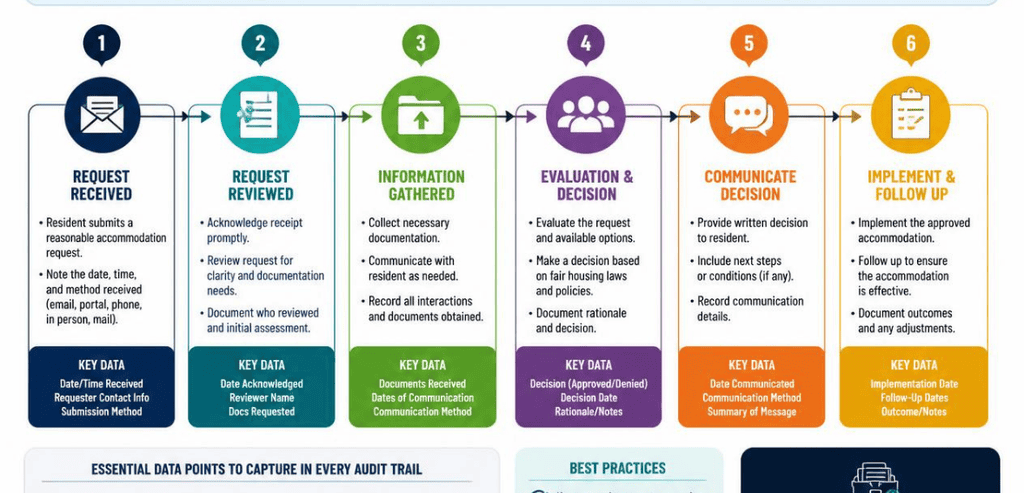
What Is a Reasonable Accommodation Request in Property Management

A reasonable accommodation is a change to a rule, policy, practice, or service that lets a person with a disability fully use and enjoy their home. The Fair Housing Act requires housing providers to grant these changes unless doing so would create an undue financial or administrative burden or fundamentally alter operations. Common examples include allowing an assistance animal despite a no-pet policy, assigning an accessible parking space, or letting a resident pay rent on a different day tied to when disability benefits arrive.

It’s useful to clarify definitions for two commonly confused terms. A reasonable accommodation typically refers to a modified policy. A reasonable modification refers to a change in the environment, such as adding a ramp or installing grab bars. While both are covered under the Fair Housing Act, there are different provisions on cost and what must be documented. Once either one is requested, the time limitation to respond is triggered and the obligation to document the request.

It is important to note that requests for reasonable accommodations or modifications need not be formal. The requestor does not need to submit a request using specific terminology or a specific request form. A statement such as “I need my dog because of my anxiety” is a request. Because of that informality, it is important to have a documented request for a reasonable accommodation or modification. If you only document requests that are submitted on formal request posted in a specific location, you will not capture requests that are submitted electronically or posted in informal locations such as a conversation in the hallway.

Why Audit Trails Matter for Fair Housing Compliance

Fair Housing compliance is not just about doing the right thing. It is about being able to prove you did the right thing. Denial of a reasonable accommodation is one of the most frequent sources of complaints handled by the U.S. Department of Housing and Urban Development (HUD) and the Department of Justice. When a complaint lands, the investigator does not care about your intentions. They care about your records.

There are financial consequences. Federal law allows an administrative law judge to impose a fine of $26,262 for a first offense of the Fair Housing Act, with greater amounts for subsequent violations. Those amounts are in addition to any damages and legal fees. If the Justice Department gets involved, those amounts are considerably greater. If there is no documentation, an enforceable decision becomes a costly settlement.

The request audit trail for reasonable accommodation requests reverses the situation. In this case, you provide an organized record that is time-stamped for each request with your response and the reasoning. This record illustrates your good-faith effort and the reason for your response and is the two major components that a fair housing investigation would be analyzing. Internally, you’re also protected, because due to staff turnover, the request may be addressed by someone who is no longer with the company.

What a Strong Reasonable Accommodation Audit Trail Includes
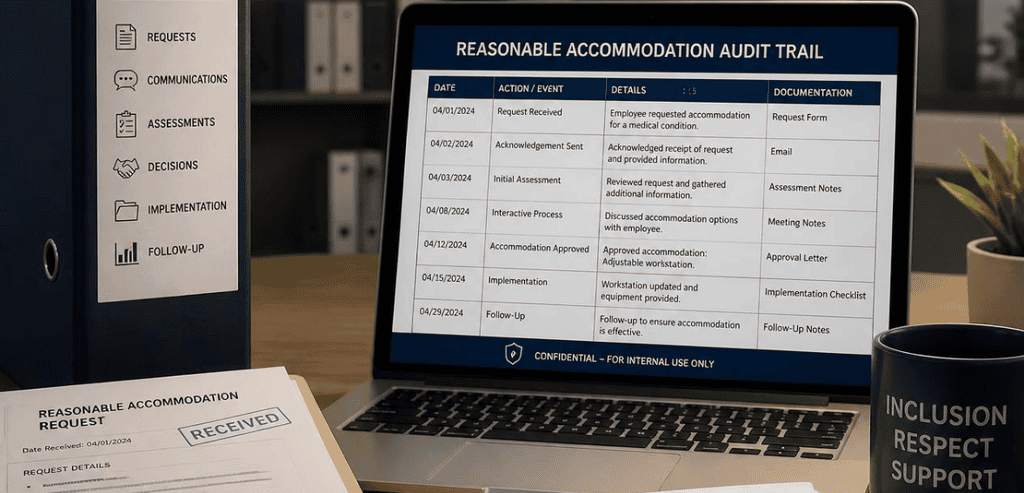
What a Strong Reasonable Accommodation Audit Trail Includes

A complete audit trail is not one document. It is a connected chain of records that tells the full story from the first contact to the outcome. The strongest chains capture three distinct phases.

Capturing the Initial Request

A request from a resident marks the beginning of the trail. Log the date and time of the request, who it was presented to, how it was submitted, and what the resident requested in their own words. Note if the disability and related need were apparent or not. The answer to this question will determine if you can ask for further information. If the request was made verbally, follow up with a written communication, if only to create a record of the communication for date and time. This will also create a record of the date the request was made and when your obligation to respond began, which is usually the date a dispute will be centered on.

Documenting the Interactive Process

Fair housing law strongly encourages an interactive process, a back-and-forth conversation where the provider and resident discuss the disability-related need and any workable alternatives. Every step of that dialogue belongs in the file. Save the emails, summarize the phone calls with dates, and record any verification you requested and received. If the disability is not visible, you may ask for reliable documentation confirming the disability and the connection to the requested change, but you cannot demand medical records or a diagnosis. Documenting this exchange shows you engaged in good faith rather than stonewalling, which is precisely the behavior investigators look for.

Recording the Final Decision

Your decision letter is the most singularly important document in the decision-making process because it closes the loop. State the action you approve and the date you approve it if you grant the request. If you deny the request, explain the legally defensible reason, be it fundamental alteration, undue hardship, or no disability-related need, and provide the option you proffered. A denial without a reason appears to be discriminatory, even if it is not. Including the final letter, proof of delivery, and any correspondence from the resident will ensure that the decision is not called into question.

Building a Compliant Workflow Step by Step

Good documentation occurs as part of a good process and not as an add-on at the end of the procedure. To start, you need to give every request a single contact point. This can include a dedicated email address, a form in a portal, or a contact at the front desk who has been properly trained so nothing slips through the cracks. After a request is received, you need to respond, let the requestor know that their request has been received, and then review the request; respond to the requestor to clarify details if needed, and after all the necessary information has been collected, respond to the requestor with a decision. The purpose of this procedure is to respond to requests promptly, with 30 days as a common benchmark. Responses that take longer can be interpreted as a constructive denial.

This procedure works best if it is consistent. If the same process is followed for each request, it will be documented that similar requests were handled in similar ways. This usually means requests that were received from different requestors will be treated in the same way, which is the best defense against a claim of discrimination. This procedure should be combined with frequent self-audits. Monthly reviews of accommodation files can help detect missing letters or requests that were ignored. This will help prevent outside investigations.

How Long Should You Keep Accommodation Records?
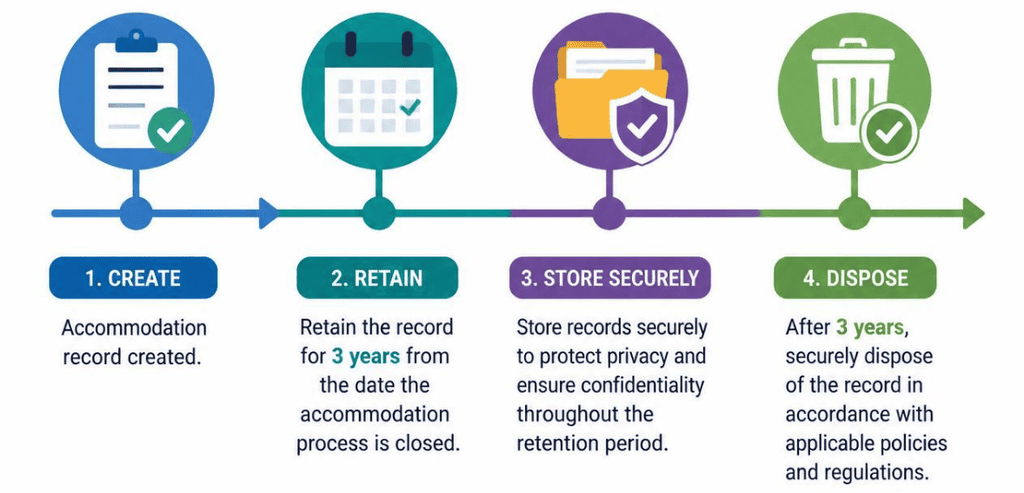
How Long Should You Keep Accommodation Records

Retention is where many otherwise careful managers slip. Because Fair Housing complaints can be filed up to a year after an incident with HUD and lawsuits can follow for two years in federal court, records need to outlive the tenancy by a wide margin. A practical baseline used across the industry is to keep accommodation requests, the evaluation, and the decision for several years after a resident moves out, with many attorneys recommending you align these files with your longest applicable claim window rather than your shortest.

Confidentiality goes hand-in-hand with retention. Records of accommodations should contain sensitive information regarding someone’s disability. Therefore, they should be stored separately from the general tenant files and be accessible only to the staff who truly require access. Digital storage can offer a secure record and controlled access to its contents. Compare that to an unlocked storage folder. The objective is to be able to provide a record quickly if you are asked, but without revealing private information to anyone who happens to open the file.

Tools That Help Property Managers Track Requests

You can maintain a solid audit trail with a shared spreadsheet and disciplined email habits, but purpose-built software makes the timestamps automatic and the storage centralized. Property management platforms increasingly build documentation and audit-log features directly into their workflows, which removes the human error that manual tracking invites.

AppFolio

AppFolio consolidates tenant communications and records, maintenance requests, and document storage in one property management platform. AppFolio’s recordkeeping communication logs provide time-stamped records of accommodation-related interactions for compliance between property management and residents.

Yardi

Yardi’s software aids management and accounting for residential and affordable housing. It has features for document management and compliance, which help large clients to standardize the recording of requests and decisions across many properties. Standardization across multiple entities can be a critical component of a legal defense strategy.

The software may have great capabilities, but its effectiveness is highly dependent on the processes that have been put in place. A system can record and time-stamp a conversation, but a system cannot log a difficult hallway conversation or draft a formal response. That remains the responsibility of the organization.

Common Mistakes That Break the Audit Trail

The failures that cause trouble are rarely dramatic. They are small and quiet. Managers forget to document verbal requests, treat an accommodation like a routine maintenance ticket, or deny a request without writing down the reason. Others let requests sit unanswered while they “think about it,” not realizing that silence can be read as refusal. Some store accommodation records in the general tenant file, mixing sensitive disability information with everyday paperwork and creating a privacy problem on top of a compliance one.

The same methodical approach solves every one of these. Document it, timestamp it, and secure it. If you handle every request the same way, you create a record (audit trail) of a request for a reasonable accommodation that isn’t bureaucratic for bureaucracy’s sake. It demonstrates that you provided a resident with a disability an appropriate accommodation, and it is why the complaint is closed with no judgment-related costs.

Conclusion

Reasonable accommodation requests will always be part of property management, and they will always carry legal weight. The managers who handle them well are not necessarily the ones with the best intentions. They are the ones who can prove their intentions with a clean, connected record. Build a single intake point, document the request, capture the interactive process, write a clear decision, store it securely, and keep it long enough to outlast any claim. Do that consistently and your audit trail becomes both a shield against liability and a genuine service to the residents who depend on those accommodations to call your property home.

Frequently Asked Questions (FAQs)

Do residents have to submit a reasonable accommodation request in writing?

No. The Fair Housing Act does not require a specific form or written request, and verbal requests are legally valid. Because verbal requests are harder to prove later, property managers should confirm them in writing to create a timestamped record while never requiring a written request as a condition of approval.

How quickly does a property manager have to respond to an accommodation request?

There is no single federal deadline, but responses are expected to be prompt and reasonable, and many state agencies point to roughly 30 days as a benchmark. An unreasonable delay can itself be treated as a denial, so acknowledging the request quickly and documenting each step is essential.

Can a property manager ask for medical records to verify a disability?

Not directly. When a disability and its connection to the request are not obvious, you may ask for reliable documentation confirming the person has a disability and needs the accommodation. You cannot demand a specific diagnosis, detailed medical history, or access to medical records.

How long should accommodation request records be kept?

Keep them well beyond the tenancy. Because complaints and lawsuits can be filed months or years after an incident, a common practice is to retain the request, evaluation, and decision for several years after move-out, stored securely and separately from general tenant files. Confirm the exact timeline with legal counsel based on your state’s rules.

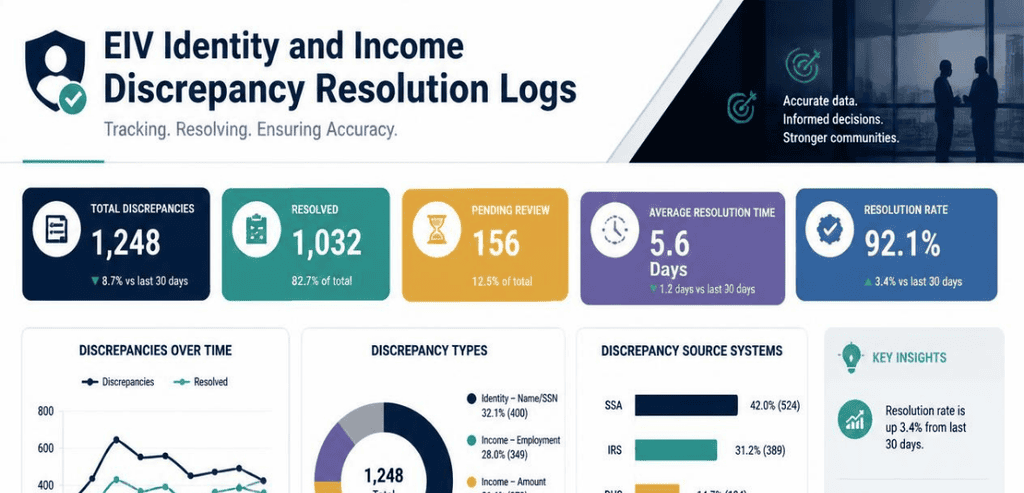
EIV Identity

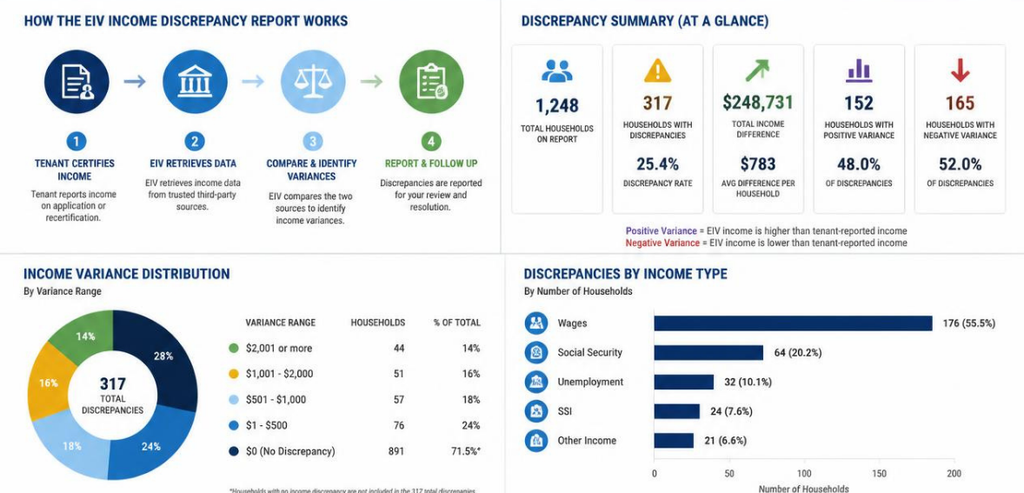
EIV Identity and Income Discrepancy Resolution Logs

Managing affordable housing is hard enough without a surprise audit finding. Yet many owners and agents lose points during a Management and Occupancy Review for one avoidable reason. They cannot show clean, well-organized resolution logs. HUD’s Enterprise Income Verification (EIV) system flags problems every month. It spots identity mismatches. I

t flags families who may have underreported income. What HUD really wants to see is proof that you acted. This guide breaks down EIV identity verification, the EIV income discrepancy report resolution process, and how to build resolution logs that hold up under review. Get this right, and you protect your funding, your residents, and your peace of mind.

What Is the EIV System?

What Is the EIV System

HUD Enterprise Income Verification (EIV)

The EIV system is the tool HUD employs for tenant income verification. Public Housing Agencies (PHAs), private owners, and management agents utilize the system throughout the U.S. The system obtains data from two of its federal partners. One is the Social Security Administration (SSA). The other is the Department of Health and Human Services (HHS) via the National Directory of New Hires (NDNH).

EIV performs data matching between the federal data and what is reported by tenants on their certification forms. In the event of a mismatch, EIV generates reports that need to be addressed. This article focuses on the Identity Verification Report and the Income Discrepancy Report. Both reports are part of the compliance workflow.

EIV contains sensitive data, such as Social Security numbers, wages, and benefits. HUD takes misuse of the system seriously. Unauthorized use can lead to a $5,000 fine and/or a felony and imprisonment. Each report must be handled with appropriate care.

Understanding EIV Identity Verification

EIV Identity Verification

Identity verification is the first gate in the EIV workflow. Before HUD can share any income data, it must confirm who the tenant is. HUD sends three pieces of personal information to SSA. These are the tenant’s name, Social Security number, and date of birth. SSA then checks its own records for a match.

Identity Verification Statuses You Will See

EIV indicates one of five statuses on the Summary Report for households. “Verified” means the identity was confirmed by SSA, and the income data will process without issue. “Pending” indicates that the match is still ongoing and there is no need for you to take action. “Failed” means that SSA was unable to confirm due to inaccurate data, and “Excluded” means that HUD will not provide SSA with that individual’s identifiers. Finally, “Deceased” means that SSA has that individual listed as deceased.

Status “Verified” is the only reason that the tenant’s income data is accessible in EIV. In the case where identity is not verified, EIV will show no wage or benefit data for that individual, thereby creating a verification gap, and you will need to obtain verification from another source.

Failed Identity Checks and How to Fix Them

A failed status usually points to a typo or an outdated record. EIV splits these failures into two report types. The Failed EIV Pre-Screening report updates weekly, every Saturday morning. The Failed SSA Identity Test report updates monthly. You must review the failed reports and act within 30 days of the report date.

Most of the time, addressing the issue is straightforward. Start by double-checking the data entry. Review the name, DOB, and SSN in your system against the tenant’s original documents. If you find your system to be at fault, please make the necessary correction and resubmit the certification. For public housing, the correction is made on the HUD-50058, while for the multifamily programs, the correction is made on the HUD-50059 in TRACS.

In some cases, the problem will be with the tenant’s record at the SSA. In this situation, only the tenant can request the correction by calling the SSA at 1-800-772-1213 or visiting the local office. Keep in mind that an invalid SSN will never verify. SSA does not issue numbers starting with 000, 666, or the 900 series. If you come across any of these, you are dealing with either a placeholder or a mistake and not a real record.

The EIV Income Discrepancy Report Explained

The EIV Income Discrepancy Report

The Income Discrepancy Report is where most compliance work happens. It compares the income a tenant reported at recertification with what SSA and NDNH actually show. When the federal data is meaningfully higher, EIV raises a flag. This is your signal to investigate possible unreported or underreported income.

How the Period of Income Works

The report provides an overview of the Period of Income (POI). The POI begins 15 months prior to the annual recertification of a household and ends 3 months prior to the recertification date. For instance, a household that recertifies on May 1 will have a POI from the previous February to the following January.

This time frame is critical. Any income received by the tenant outside the POI will not be counted towards the discrepancy amount. During case resolution, the income received during this time frame should be the only income considered. For case resolution, examining the effective dates for wages and benefits can be the difference between a resolution and a major costly mistake.

The Discrepancy Threshold

EIV does not flag every small difference. A discrepancy generally becomes reportable when annualized income exceeds the reported amount by $2,400 or more per year. That works out to about $200 per month. HUD uses this threshold because most leases require tenants to report cumulative income increases at that level. When the gap clears the threshold, the report expects you to dig in.

The EIV Income Discrepancy Report Resolution Process

This is the core of the workflow. A flag on the report is not a conclusion. It is a starting point. Your job is to determine whether the discrepancy is valid or invalid, then document the outcome either way.

Valid Versus Invalid Discrepancies

Always begin every case by contacting the household. Send the tenant a written notice and allow a reasonable time to respond. Consider 10 to 15 business days as a reasonable time to respond. While waiting for the response to the notice, gather third-party income verification. Compare the income verification against the certifications in effect during the POI.

The discrepancy is valid if the tenant failed to report income. In this case, a corrected HUD-50059 must be done to capture the unreported income. A notice must be sent to the tenant to inform them of the funds they owe. Overpaid assistance must be recovered or a repayment agreement must be established. Collection costs can be retained, but HUD must be reimbursed for the recovered assistance.

If the income was reported, or if the timing or the owner’s calculations resulted in an invalid flag, then the discrepancy is invalid. It must also be documented. The file must also show the reason the flag was invalid. It is important to note that undercharges due to owner’s failure to properly execute HUD‘s rent calculation do not create a tenant repayment liability.

When a Tenant Disputes the Data

Sometimes a tenant insists the EIV data is wrong and you cannot obtain matching verification. In that situation, the tenant must come to the office and self-certify that the EIV information is inaccurate. The statement must be signed and dated by the household. Keep it in the tenant file alongside the discrepancy report. Incorrect data can also be a warning sign of identity theft, so treat unusual mismatches with extra attention.

Building Strong EIV Resolution Logs

Resolution logs turn your work into proof. HUD reviewers cannot see the phone calls you made or the verifications you chased. They can only see your file. A strong log tells the whole story without you being in the room.

What Belongs in Every Resolution Log

A resolved flag connects the outcome with an explanation. Resolution logs should contain the original EIV report, the date the discrepancy was first identified, and all documented efforts to resolve the discrepancy. Attach all third-party verifications. Document the dates the tenant was contacted and the dates any notices were sent. Explain your determination regarding the discrepancy and whether you found it valid or invalid. If the determination was that monies were owed, then include the corrected certification, the notice of funds due, and the claim or collection documentation.

The rule is simple. The Income Discrepancy Report and annotated resolution notes must be maintained in the tenant file regardless of the determination of the discrepancy. A file with only a discrepancy flag will be an unresolved finding.

Record Retention Rules

HUD is clear about the life of certain records. The Income Report, the Summary Report verifying identity with a “Verified” status, the Income Discrepancy Report, and the related supporting documents must be retained in the resident file for the duration of the tenancy and 3 additional years. This information is available in HUD Handbook 4350.3. The retention and resolution rules are available in Chapter 9 of the Handbook 4350.3.

Tenant files must also be available for review by the resident. A tenant may authorize a third party to review the file by signing an authorization. Logs that are well organized simplify the process of fulfilling such requests.

Common EIV Compliance Mistakes to Avoid

The most common finding is a gap in the paper trail. Staff clear a discrepancy in their heads, but don’t write anything down. Another mistake is overlooking failed identity reports after the 30-day deadline. A third example is the lack of frequent reviews of the EIV. The EIV should ideally be reviewed at a minimum of one-month intervals and prior to each certification. If the EIV is not reviewed on a regular basis, minor issues may escalate into overpayment cases and audit findings.

National Center for Housing Management (NCHM)

Employee training helps bridge these gaps. For instance, the National Center for Housing Management provides its unique EIV certification. Their training courses assist with understanding reports, addressing discrepancies, and maintaining system security. The likelihood of findings decreases with the quality of training provided to staff.

Conclusion

EIV compliance rewards habit, not heroics. Identity verification confirms who your tenants are. The income discrepancy report confirms what they earn. The EIV income discrepancy report resolution process ties the two together and protects program integrity. But none of that matters at a review unless your resolution logs prove it happened.

Treat every flag as a task with a paper trail. Investigate fast, document fully, and retain records for the required term of tenancy plus three years. Do that consistently, and your next Management and Occupancy Review becomes a formality instead of a fire drill. Strong EIV identity and income discrepancy resolution logs are the quiet backbone of affordable housing compliance.

Frequently Asked Questions

What is the difference between the EIV Identity Verification Report and the Income Discrepancy Report?

The Identity Verification Report confirms a tenant’s identity by matching their name, Social Security number, and date of birth against SSA records. The Income Discrepancy Report compares reported income to federal wage and benefit data to spot unreported or underreported income. Identity must be verified before any income data appears in EIV.

How long do I keep EIV resolution logs and reports?

Keep the Income Report, the Verified Summary Report, and the Income Discrepancy Report with all supporting documentation in the resident file. The retention period is the term of tenancy plus three years, as required by HUD Handbook 4350.3.

What happens when an EIV income discrepancy is found to be valid?

You process a corrected certification to include the missing income, notify the tenant of funds due, and collect the overpaid assistance or arrange a repayment plan. You then reimburse HUD for the recovered amount and document every step in the tenant file.

How quickly must I act on a failed identity verification?

Review failed identity reports and correct the discrepant data within 30 days of the report date. Confirm your own data entry first, update the HUD-50058 or HUD-50059 as needed, and retransmit it so EIV can attempt a new match.

VAWA Emergency Transfer

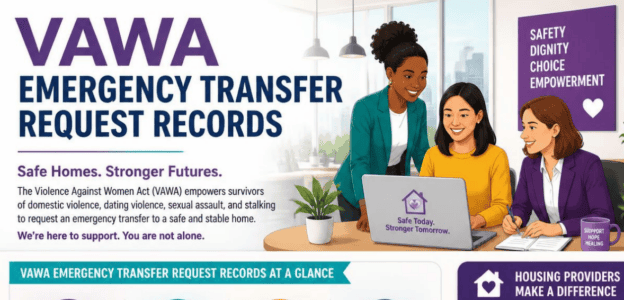
VAWA Emergency Transfer Request Records for Housing Providers

A resident knocks on your leasing office door. She is a survivor of domestic violence. She fears for her safety in her current unit. She wants to move now. What you do in the next few minutes matters. It also matters six months later, when a HUD reviewer asks to see your files.

This is where records for a VAWA Emergency Transfer Request come into play. They help keep survivors safe. They help protect your organization. For any covered housing provider, proper and complete records are not just paperwork. They are documented proof that the covered housing provider complies with federal law.

This guide explains what these records are, why they are important, and how to maintain them properly.

What Is a VAWA Emergency Transfer?

What Is a VAWA Emergency Transfer

The Violence Against Women Act (VAWA) protects tenants who are victims of domestic violence, dating violence, sexual assault, or stalking. Despite the name, these protections apply to survivors of all genders.

If a tenant is at risk, they can use an emergency transfer to move to a safer unit. A tenant can file a request if they believe staying in their unit poses an imminent threat of harm. A request is also acceptable if sexual assault occurred on the property in the last 90 days.

There are internal and external transfers. An internal transfer relocates the tenant to another unit within the same provider’s units. An external transfer places the tenant in a different property, where the tenant is a new applicant to that property. It is also required that Section 8 voucher holders are allowed to transfer to a new unit with full Housing Choice Voucher assistance.

Why Emergency Transfer Records Matter for Housing Providers

Records are the backbone of VAWA compliance. When a survivor asks for help, your response creates a paper trail. That trail shows whether you followed the rules.

Effective documentation serves three purposes: it shows you responded in a timely, survivor-centered manner; it fulfills your annual reporting requirement to HUD; and it protects you during an audit, a fair housing complaint, or litigation.

The stakes have been raised. As of October 1, 2022, HUD’s enforcement powers expanded to cover the 2022 VAWA reauthorization. In several enforcement actions, providers were found to violate the law for requesting inappropriate or overly burdensome documentation from survivors. Sound recordkeeping is your best defense against this type of action.

The Core VAWA Forms You Need to Track

The Core VAWA Forms You Need to Track

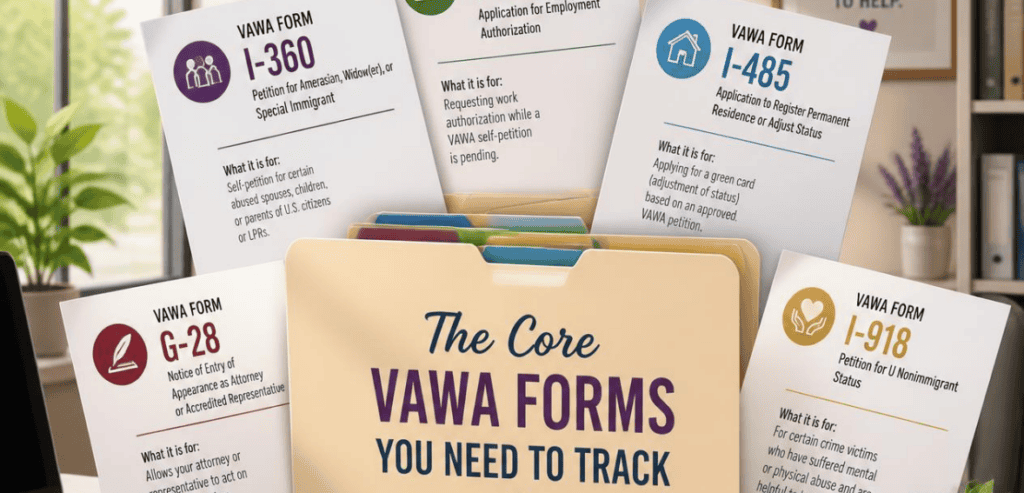
HUD publishes a set of model forms that anchor the entire process. Each one produces a record you may need later.

The Notice of Occupancy Rights (Form HUD-5380) explains VAWA rights to applicants and tenants. The Model Emergency Transfer Plan (Form HUD-5381) provides the framework for your written plan. The Certification form (Form HUD-5382) allows the survivor to self-certify. The Emergency Transfer Request (Form HUD-5383) is the written request a tenant is allowed to supply. The Emergency Transfer Data Collection form (Form HUD-5384) provides the data HUD wants in the format they want.

U.S. Department of Housing and Urban Development (HUD)

All of these requirements originate from HUD, the federal agency in charge. It specifies the requirements in 24 CFR part 5, subpart L. HUD also recently published the complete set of model forms with a new expiration date of January 31, 2028. Providers should always access the latest version of these forms from HUD. Forms can be accessed on the HUD VAWA resource page, which contains all forms and available translations.

A tenant is not required to use Form HUD-5383 for the process to be triggered. You must accept an oral request or any other form of written request. Regardless of the request form, it should be recorded in your log.

Building a Compliant VAWA Emergency Transfer Plan for Housing

Every covered housing provider must develop and implement a written VAWA emergency transfer plan. Housing programs under HUD were required to have these plans in place by June 14, 2017. Simply adopting HUD’s model plan word for word is not enough. You must tailor it to your program and its specific rules.

A compliant plan outlines the eligibility criteria for transfers and the required documentation. It describes the transfer process and how requests for transfer are prioritized. It describes the internal and external transfer processes, and it describes the situation where a safe unit is not available. It describes the confidentiality it assures throughout the process.

Your plan describes the standard of recordkeeping and reporting for your staff. In other words, your plan describes how records of transfers will be documented and how transfer records will be maintained. That plan-to-records connection is essential to being compliant. To create or amend your plan, the starting point should be the HUD Model Emergency Transfer Plan (Form HUD-5381).

There is one important limit that protects survivors. If you decide to have a policy that requires documentation of VAWA status, your plan must provide the tenant with a minimum of 14 business days to present the required documentation. The request for the documentation must also be made in writing.

What Records to Keep and How to Handle Documentation

Think of the record for each request as a small, complete file. It should trace the request from the day it arrived to the day it was resolved.

Begin with the request, whether written, oral, or on Form HUD-5383. Be sure to capture the date the request was received. You should explain how you managed the documentation. You may need to obtain written confirmation of abuse against the tenant or a member of the household covered by VAWA. That request may be satisfied by the submission of the self-certification form (Form HUD-5382). You may not request additional documentation if you do not have evidence that contradicts the abuse.

A survivor may opt to provide additional documentation. This may be a signed statement from a professional, or police, administrative, or court-related documentation such as a protective order. Whatever documentation the tenant provides should be retained in the file.

Lastly, describe the outcome. HUD has a clear definition of the outcomes. The outcome is approved if the tenant is found to be eligible. The outcome is denied when the incident is found not to be covered under VAWA. The outcome is incomplete if the review could not be completed, most of the time due to insufficient documentation. The date and the reason for each of the outcomes have to be provided in order to show that you were efficient in performing your duties.

Confidentiality Rules for Transfer Records

Confidentiality is not optional. It sits at the heart of every VAWA emergency transfer record.

You must keep strict confidentiality about a tenant’s status as a survivor. You cannot share information about the abuse with the person who committed or threatened it. You also cannot enter that information into any shared or public database without the tenant’s written consent.

Store these records apart from routine tenant files. Limit access to staff who truly need it. Train your team so they understand that a careless email or an open file on a desk can cause real harm. A breach does more than expose you to liability. It can put a survivor’s safety at risk.

Annual Reporting and Form HUD-5384

Annual Reporting and Form HUD-5384

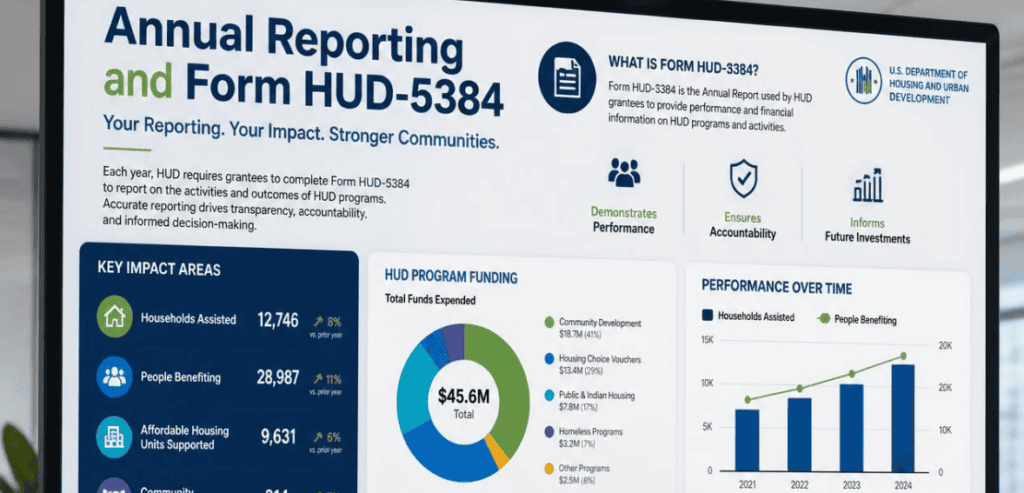
HUD wants to know how emergency transfers are working across the country. So covered housing providers must report requests and their outcomes to HUD on an annual basis.

Form HUD-5384 (VAWA Emergency Transfer Data Collection)

This is the format for that reporting. It includes fields for the total number of emergency transfer requests, how many requests resulted in internal and external transfers, how long the transfers took to process, and the reasons for the transfer requests that were denied.

There is a thoughtful design for privacy. Form HUD-5384 creates a way to report the aggregate data and not the data for every single survivor. HUD did that intentionally. Reporting aggregate numbers allows HUD to learn if the system is functioning, while maintaining the privacy of individual tenants and lessening the workload for the service providers.

Information can be collected through email, DocuSign, Microsoft Forms or other surveys, and can be embedded in a checklist. HUD can customize the questions for this program area. You have to fill out the form based on the timelines and instructions that HUD provides. You can find and review the HUD Emergency Transfer Data Collection form (Form HUD-5384) that has been published.

Your annual report is based on the case records you maintain; therefore, unorganized case records will prohibit accurate reporting. Organized case records will yield accurate reporting.

Common Compliance Mistakes to Avoid

Some patterns of noncompliance get repeated, yet they shouldn’t. Many service providers request more documentation from survivors than the law requires. Some refuse to accept verbal or non-form requests as legitimate. Others will completely bypass the request for documentation or give less than 14 business days for a response.

Another issue that is very common is a lack of training. The staff member who receives the very first request may or may not be aware of the plan. It is essential that every member of the team who may potentially receive a request is familiar with the VAWA emergency transfer plan and the surrounding rules of confidentiality. Most of the compliance issues that appear later on are a result of the response to the request in this first conversation.

Conclusion

VAWA emergency transfer request records sit at the meeting point of safety and compliance. They document that you treated a survivor with care and speed. They also prove to HUD that you followed federal law.

The path forward is clear. Build a tailored written plan. Use the current HUD forms. Keep a complete, confidential file for every request. Then roll those files into your annual report. Do this well, and you protect the people who need protection most. You also protect your organization from real legal and reputational risk.

Review your VAWA emergency transfer plan today. Check that your records match what HUD now expects. A short review now can spare you a painful audit later.

Frequently Asked Questions (FAQs)

What records should a housing provider keep for each VAWA emergency transfer request?

Keep the original request, the date it was received, any documentation the tenant submitted, all written communications, and the outcome with its date and reason. Together, these show a clear, timely, and survivor-centered response.

Can we require documentation before approving an emergency transfer?

Yes, but with limits. You must request it in writing and give the tenant at least 14 business days to respond. A survivor can satisfy the request with the self-certification form (Form HUD-5382). You cannot demand more proof unless you have conflicting information about the abuse.

How do confidentiality rules affect our recordkeeping?

You must keep a survivor’s status strictly confidential. Never disclose it to the abuser, and never enter it into a shared or public database without written consent. Store VAWA records separately and limit staff access to those who truly need it.

Does every housing provider have to report emergency transfers to HUD?

Covered housing providers must report emergency transfer requests and outcomes to HUD annually, typically through Form HUD-5384. The form collects aggregate numbers rather than individual survivor details, which protects confidentiality while still measuring how well the process works.

Security Deposit Transfer

Security Deposit Transfers When a Resident Moves to Another Unit

What landlords and property managers need to know before moving a tenant’s deposit across units

When a long-term tenant wants to shift from one unit to another unit within the same property, most property managers have no complaints. There is no vacancy loss, no need to find a tenant to replace the old one, and no turnover marketing is required. However, what happens to the security deposit that is sitting in your trust account? This is where it can get complicated and where most property managers make expensive and avoidable errors.

When it comes to a security deposit transfer, it is not just a case of moving a number from one ledger to another. There are legal issues and damage assessments to consider, as well as a number of documents to prepare. There is an order in which this has to be done, and if you do it in the wrong order, you are likely to incur penalty costs, have unresolved disputes, or an invalid claim to the security deposit when the tenant finally vacates.

This guide walks you through the complete workflow — from determining when a transfer is appropriate to reconciling both ledgers cleanly at the end.

When Is a Security Deposit Transfer Actually Allowed?

When Is a Security Deposit Transfer Actually Allowed

Not all jurisdictions allow for automatic transfers of security deposits. So, before thinking, you can just reassign the existing deposit for a new unit, and consider the rules governing your property.

Many jurisdictions consider the security deposit legally bound to a specific unit and tenancy. As the lease is signed for the unit, the security deposit covers the tenant’s obligations under that lease. If a tenant transfers to another unit, even if it is within the same building, the change is often interpreted as the original tenancy ending and a new one beginning. Because of that, the original deposit may need to be returned and a new one collected.

Some states are more flexible and allow transfers with proper written consent and documentation. Others require the landlord to treat the move exactly like a full move-out and move-in. The safest approach is always to consult your state’s landlord-tenant law or speak with a local attorney before processing any deposit transfer.

In addition to what state law says, the language in your lease also plays a role. If your lease states that the deposit is associated with the premises at a specific address or unit number, a transfer may later be contested without an amended lease.

How to Handle Existing Damages and Outstanding Balances Before Transferring

Assuming transfers are allowed, you cannot simply carry forward a deposit without addressing issues related to the old unit. This cannot be skipped. If skipped, it will create a paper trail that works against you in future disputes.

Do a move-out inspection on the original unit prior to the resident moving out. Write up condition reports on any issues you see. Photograph evidence of any issues you see, such as broken fixtures, unreported repairs, scuffs, and stains, and be sure they are time-stamped. You will need to compare these with your original move-in inspection from when the tenant first moved into that unit.

If there are damages beyond normal wear and tear, you are generally entitled to deduct those costs from the deposit before any transfer occurs. Waiting until the resident eventually vacates the new unit to address old damages is a serious mistake. Courts and arbitrators will ask why you didn’t address the damage when it was discovered. The answer “we transferred the deposit and hoped for the best” won’t hold up.

Likewise, check the account ledger for any due rent, late fees, utility fees, or other remaining balances associated with the old unit. They need to be collected from the tenant or adjusted against the security deposit before the transfer is completed. Unsettled liabilities will create confusion and possibly jeopardize your legal standing for claims you may have to pursue in the future.

Documentation the Tenant Must Sign Before the Transfer Is Processed

Documentation the Tenant Must Sign Before the Transfer Is Processed

This is where many landlords get careless and where most arguments arise. You will not be protected by unwritten rules or verbal agreements. Each and every stage of the transfer needs to be documented and signed by both parties.

A written transfer agreement or unit transfer addendum is the most important document you need. This agreement must indicate the transfer amount, that both parties have agreed to inspect the old unit, the agreed-upon deductions, the deposit amount for the new unit, and whether the new unit’s transfer terms require a new deposit.

Beyond the transfer addendum, you’ll also need a new move-in inspection report for the new unit, signed by the tenant. This document serves as the baseline for the new tenancy. Without it, you have no documented starting condition for the unit the tenant is moving into, which means any damage claim when they eventually leave will be contested.

If your original lease is being replaced by a new lease for the new unit, make sure the new lease explicitly references the transferred deposit. Ambiguity about how much was collected and when is one of the most common triggers for security deposit disputes.

Some landlords give tenants a written acknowledgment or receipt for the transferred money. While it’s not a requirement, it’s an added protective measure. It reduces the chance that the tenant will later claim they didn’t know what happened to their original deposit.

How to Reconcile the Old and New Ledgers Correctly

How to Reconcile the Old and New Ledgers Correctly

The security deposit transfer process requires thorough accounting. One error can cause audit findings, accounting errors, funds not being collected, or over- or under-application of funds.

The first step is to close the ledger for the old unit. This involves recording the move-out date, the inspection, and posting any deductions. Once the deductions have been posted, the remaining balance is eligible for transfer and should match the transfer addendum.

The new unit’s ledger requires a new security deposit entry on the effective date of the new tenancy. It should also include a posting of the transferred amount as a deposit. If the new unit has a larger or premium floor plan that requires a higher deposit, that additional amount will also require a posting to ensure a clear paper trail for all amounts.

Do not simply change the unit number on the existing deposit record. That approach creates a single entry that obscures the history of both tenancies. Keep records clean and separate. If you ever face a court claim or a regulatory audit, you want to show that each unit had its own complete, properly documented deposit history.

Because most property management software includes a way to link or cross-reference the accounts, AppFolio, Buildium, and Rent Manager, for example, include a deposit transfer workflow. These tools automate some entries in the deposit ledger, but won’t replace the legal documentation. They simply reduce the error of manual entry. You can find more information on managing security deposits and current best practices from the National Apartment Association and Nolo’s tenant-landlord law guides.

For landlords working with trust accounts for security deposits, be sure to adjust your ledger. Many states require security deposits to be held in separate accounts that earn interest. Also, moving funds to another sub-account must be done in a specific way. Accidental mismanagement of trust funds can also result in the loss of a property management license. A good description of security deposit regulations and how they differ from place to place can be found on Investopedia.

What Happens If the Deposit Doesn’t Cover the New Unit’s Requirements

Sometimes the existing deposit is smaller than what the new unit requires. This happens when a tenant is upgrading to a larger or more expensive unit. In this case, you have the right to collect the difference — but you must document it properly.

Provide written notice stating the new deposit requirement, the amount received from the transfer, and the shortfall the tenant must provide. Set a reasonable deadline to submit the additional funds based on the anticipated move-in date. Never allow a tenant to move into a new unit under the assumption that they will pay the full deposit later, as this almost always causes problems for you.

If the new unit has a lower deposit requirement, the surplus funds must be refunded to the tenant in accordance with your state’s deposit refund timeframes. There should never be a situation where you are simply holding surplus funds for your convenience.

Conclusion

Moving a resident from one unit to another can be one of the smoothest transactions in property management — or one of the messiest, depending entirely on how you handle the security deposit. A proper security deposit transfer rental workflow requires checking your legal authority first, thoroughly inspecting and settling the old unit, obtaining signed documentation at every step, and keeping the accounting separate and transparent for both units.

The effort you put into getting this right up front pays dividends when the resident eventually moves out entirely. You’ll have a clean, defensible paper trail, accurate ledgers, and zero ambiguity about what was collected, when, and why. That’s the standard every landlord and property manager should hold themselves to.

Frequently Asked Questions

Can I transfer a security deposit without a new lease?

Technically possible in some states, but not advisable. Without a new lease or a written addendum, both parties lack clarity on the terms governing the new unit. Always formalize the arrangement in writing, regardless of whether your jurisdiction requires it.

Do I need to return the original deposit and collect a new one?

It depends on your state law. Some states treat an internal unit move as a new tenancy and require a formal return and re-collection. Others permit a documented transfer. Check your local landlord-tenant statutes or consult a property management attorney before deciding.

What if the tenant refuses to sign the transfer addendum?

If the tenant won’t sign the documentation, do not proceed with the transfer. A transfer without signed consent creates a disputed paper trail. Address the tenant’s concerns, revise the document as needed, and ensure both parties understand what they’re agreeing to before anyone moves.

How long do I have to process damage deductions from the old unit before transferring?

Most states require landlords to return deposits or provide an itemized deduction statement within 14 to 30 days of move-out. Treat the vacating of the old unit as a move-out event and follow your state’s deadline for that unit before finalizing the transfer to the new one.

Tenant Document Retention

Tenant Document Retention Rules Property Managers Should Set Before Files Become Messy

Managing documents is straightforward for most property managers. The problem is that most property managers lack an effective solution for the long-term organization of their documents. Documents get signed, and agreements get completed, but the files are either thrown away or, worse, deleted before they are no longer of legal use. Then a fair housing complaint is submitted, and you need to find a prior move-in inspection, but it is not there.

Tenant document retention is important in property management. Keeping documents organized helps protect against litigation and supports compliance with federal and state laws. Failing to retain the proper documents can be the difference in winning or losing a case.

This guide covers exactly how long to keep different document types, what’s at stake when records go missing, and how modern digital tools make the whole system easier to manage.

Why Tenant Document Retention Is a Records-Management Problem—Not Just a Legal One

Why Tenant Document Retention Is a Records-Management Problem

Many believe that document retention only concerns the law. For most property managers, it’s just one more compliance-related box to tick: keep the documents for a few years, then dispose of them. However, the retention of tenant documents is primarily a records management issue.

Legal retention requirements provide you with the bare minimum. Good records management provides you with the means to order, store, categorize, and retrieve documents to enhance their utility to you. These are distinct skill sets, and most content targeting landlords and property managers combines them. What you’ll find plenty of are articles about fair housing, screening checklists, lease clauses, and the like. Few, if any, talk about the systems and management operations that will sustain the utility of your records for the long term after the lease is signed.

A well-structured retention policy defines what gets saved, in what format, for how long, and where. It also defines who can access records and what happens when the retention period ends. Without that structure, files accumulate in inconsistent ways—some in email, some in a shared folder, some in a property management platform, and some in a filing cabinet nobody has touched since 2019.

How Long to Keep Different Types of Tenant Documents

How Long to Keep Different Types of Tenant Documents

Retention periods vary by document type and jurisdiction. These are general best practices grounded in federal guidelines and common state-level requirements. Always verify requirements with a licensed attorney in your state.

Rental Applications

Retain all rental applications for at least 2 years, regardless of whether they are approved or denied. Because applicants have up to 2 years to file a complaint under the Fair Housing Act, a complaint may be filed during that period. If a denied applicant submits a complaint, alleging that your screening process is discriminatory, you will need to demonstrate that your criteria were applied to all applicants. To do this, you will have to retain all applications, not just the approved ones.

Lease Agreements and Addenda

Retain the signed lease, all addenda, and any amendments for the full tenancy plus three to seven years after move-out, depending on your state’s statute of limitations for contract disputes. Some states allow landlords or tenants to bring breach-of-contract claims for up to six years. A lease dispute two years after move-out is not unusual. Your signed documentation is the only evidence of what was agreed.

Move-In and Move-Out Inspection Reports

Inspection reports are often the deciding documents in security deposit disputes. Retain them for a minimum of three years after the end of a tenancy. Photos should be stored with the report and be date-stamped, tied to a specific unit, and tied to the move date. A report of an inspection is much weaker in small claims court without supporting photos.

Rent Payment Records

Payment history—including records of late fees, partial payments, and returned checks—should be retained for at least three to five years. These records matter in eviction proceedings, collections cases, and any dispute involving unpaid rent.

Maintenance Requests and Repair Records

The second most common cause of tenant lawsuits after disputes over security deposits is claims relating to the habitability of a rental unit. You should keep all maintenance requests, work orders, vendor invoices, and records of work completion for 5 years. If the tenant claims the repair was never completed, you will have the records to prove it was.

Correspondence

All communication to and from your tenants should be kept for a period of three to five years after your tenancy has ended. This includes any and all emails, text messages, notices, and even certified mail communication. This also includes any communications to enter a unit, any violation-of-lease communications, and all communications regarding the renewal and termination of the lease. In the event of a dispute, a court will usually review the communication timeline.

Fair Housing and Accommodation Records

If a tenant requested a reasonable accommodation or modification, keep that file for at least three years after the request was resolved. This includes the original request, any supporting documentation provided, your written response, and records of any accommodation made.

What Happens When You Can’t Produce Documents in a Dispute

What Happens When You Can't Produce Documents in a Dispute

This is where gaps in tenant document retention become genuinely costly. Fair housing complaints and small claims cases have one thing in common: the burden of proof usually falls on the property manager to demonstrate that policies were applied fairly and consistently.

In Fair Housing Complaints

When an applicant or tenant makes a discrimination complaint with HUD or a state agency, records will be requested as part of the investigation. Document records, a denial letter, and data about the treatment of other applicants are examples of the records an investigator will seek. Records missing from HUD Fair Housing complaints will be treated as an evidentiary gap rather than an absence.

A defense with no records relies entirely on verbal claims. You are asking the investigators to trust your word. The absence of records does not show that you acted appropriately. Settlement amounts from fair housing complaints can reach many thousands of dollars. A well-organized records system can provide adequate defense against many complaints that would otherwise go undefended.

In Small Claims Court

Small claims disputes over security deposits are among the most common landlord-tenant cases. Judges in these proceedings expect landlords to have documentation. A move-out inspection report with photos, matched against a move-in report with photos, tells a clear story. A landlord who says “we had damage” but can’t produce any records to support it often loses, even when the damage was real.

The same applies to eviction proceedings. A landlord who claims repeated late payment but can’t produce payment history faces a much harder case than one who arrives with a complete ledger. Courts reward documentation. They have no good mechanism for rewarding good intentions.

How Digital Storage and Tagging Reduce Time Spent Finding Records

The real problem is locating documents swiftly when needed. For example, a filing system consisting of several manila folders, separated by year, is a document retention system, but is a very poor example of effective records management. Often, a complaint or legal notice gives you a very limited time to respond to the request for the documents.

When done effectively, proper digital storage can alleviate the problem of slow document retrieval. The focus should be on having the correct file-naming and tagging system in place at the time of document upload.

AppFolio Property Manager

AppFolio enables property managers to store documents directly on work orders and on both tenant and property records. Because documents reside within a tenant profile, retrieving a complete file for a former tenant requires navigating to a single record rather than searching across multiple folders. Automated retention flags are programmable in select configurations, though some features depend on your subscription tier and version.

Buildium

Buildium’s document management tools allow uploads at the property, unit, and tenant level. Pairing this with a consistent file-naming convention—unit number, document type, date—means any staff member can locate a file without needing to know exactly where it is stored. Buildium also integrates with e-signature tools so executed documents land directly in the associated record.

Generic Best Practices for Any System

Applying a consistent tagging system across all platforms has a significant impact. Every document must include the property address or unit identifier, the tenant name, the document type, and the date. Keeping former-tenant documents in one location, with subfolders separated by tenancy periods, is more efficient than using folders separated by calendar years. The NOLO guide to landlord recordkeeping is a good resource that works well in a digital system.

Having a defined audit schedule for record review and purging expired records twice a year will prevent the archive from becoming an endless backlog. Records should be purged when their retention periods expire rather than accumulating indefinitely.

Building a Retention Policy That Actually Gets Followed

The best retention framework is a written one. A one-page policy document that specifies retention periods by document type, storage location, naming conventions, and the purge schedule gives your team a reference point. It also demonstrates to regulators and courts that your organization takes recordkeeping seriously.

Although SHRM’s records retention guidance is directed toward employers, its structural model is adaptable to tenant documentation systems. Property management also follows the same logic of categorizing records, determining minimum retention periods, and establishing review cycles.

Your policy should be reviewed annually. As state statutes of limitations vary, so do the regulations in the gaps between. Laws governing policies in 2021 may need to be rewritten by 2026 due to advances in laws on digital signatures and the admissibility of electronic records.

Conclusion

Tenant document retention isn’t the most exciting part of property management. But it’s one of the few areas where good habits pay off directly in legal protection, operational efficiency, and professional credibility. The managers who handle disputes cleanly—who can produce a complete file within hours rather than days—are almost always the ones who built their retention systems before they needed them.

Start with clear retention windows by document type. Move to a digital system with consistent naming and tagging. Write a policy, schedule annual reviews, and stick to it. When a complaint or dispute does arrive, and at some point it will, your records do the work.

Frequently Asked Questions

How long should a property manager keep tenant records after move-out?

Most documents should be retained for three to seven years after a tenancy ends, depending on the document type and your state’s statute of limitations. Leases and financial records typically require the longest retention periods, while some correspondence can be purged sooner.

Are there federal rules that govern tenant document retention?

The Fair Housing Act requires that records sufficient to defend against discrimination complaints be kept for at least two years. Some HUD programs impose longer requirements. State laws may extend these timelines further, so always verify requirements for your specific jurisdiction.

Does digital storage count as legal documentation in court?

Yes, in most jurisdictions, properly maintained electronic records are admissible. Date-stamped digital photos, electronically signed leases, and records stored in property management software typically meet evidentiary standards. The key is demonstrating that the records are authentic and have not been altered.

What’s the biggest risk of not having a formal retention policy?

The biggest risk is losing a case you should have won. When documentation is missing in a fair housing complaint or small claims dispute, investigators and judges draw inferences from the gap. A clear retention policy ensures records survive long enough to defend you—and that expired records are purged deliberately rather than accidentally deleted before their time.

Gen Z Renters

Gen Z Renters Are Here: How to Adapt Your Properties and Marketing

The rental housing market has become a strong influence on Gen Z renters, prompting new strategies for building properties, marketing them, and managing business activities. The generation needs different standards of convenience and transparency, as well as personalized services that differ from those of previous generations.

Property owners and managers need to accomplish their primary business goals of keeping their properties occupied and competing effectively in their industry. Gen Z renters need different rental options than previous tenant groups. They require digital leasing experience that provides uninterrupted service, and their decision-making is based on their assessment of what is valuable.

The traditional leasing system, which requires users to complete paper applications and experience delayed communication, will immediately cause them to abandon the entire process. Users expect companies to deliver immediate mobile-compatible services that include all necessary information from the beginning. Gen Z renters

face economic difficulties, which include increasing rental costs and student loan repayment obligations. Cost and perceived worth determine their product choice, their lifestyle requirements, technology needs, and budget limits.

The article explains the process of creating property changes and developing marketing strategies to attract Generation Z renters. It provides effective strategies to attract this growing renter demographic and convert them into paying customers who will continue renting from you throughout their tenancy.

Understanding What Defines Gen Z Renters

What Defines Gen Z Renters

Members of Generation Z exhibit distinct behavioral patterns and mental processes when approaching the practice of renting compared to previous generations. The digital natives of this generation use technology more extensively than previous generations, who relied on reading material to make decisions and engage in discussions, which affects how they search for and assess rental properties.

Generation Z renters choose to identify themselves through their need to see everything. The properties they rent should provide them with complete information on pricing and property details, as well as genuine ratings of the property. They will immediately stop trusting a rental company when they discover any concealed fees or confusing conditions. These renters expect immediate answers to their questions and efficient procedures for completing their lease agreements.

The other major characteristic is that Generation Z renters are very reliant on mobile devices. Mobile devices, including smartphones, are the primary means of connection, so property management needs to adopt a mobile-first approach.

Generation Z Renters choose their residence locations after assessing how their decisions will impact both people and the environment. The Generation Z Renters’ core values will drive demand for rental properties that align with them. Property features and marketing strategies need adjustments based on this understanding of Generation Z Renters because it establishes their specific needs.

Why Gen Z Renters Are Reshaping the Rental Market

The rental market undergoes major transformations as Gen Z renters bring their unique preferences to the market. Their entry into the workforce, along with their pursuit of self-sufficient living, creates new requirements that force real estate developers and leasing companies to rethink their building design methods.

The market now requires adaptable solutions, as customers demand better service to meet their evolving needs. Gen Z renters prefer flexible lease arrangements that allow them to make changes. The market now demands both flexible lease options and short-term contracts, as these have become increasingly necessary.

Technology has become a new force that creates change through its power. Gen Z renters demand a digital leasing experience that includes online applications, virtual property tours, and electronic payment methods. Properties that fail to offer these essential features will find it difficult to attract this demographic.

The situation requires examination of which two elements people consider most important. Generation Z renters prefer rental options that offer practical value rather than high-end, luxurious amenities. They prefer to spend less money, so they will accept smaller living spaces if the new location provides better advantages.

Gen Z renters search for places that help them establish social connections through shared common areas. Property owners must transform their operations because current market trends demand it. Adopting Gen Z renters as customers helps businesses maintain their market presence amid ongoing industry evolution.

Designing Properties That Appeal to Gen Z Renters

Properties That Appeal to Gen Z Renters

Property design is a key factor in attracting Gen Z renters. Gen Z is looking for functionality, aesthetics, and integration of technology. They prefer modern layouts that maximize efficient use of space, open floor plans, and multiple-use areas, as these layouts represent their lifestyles. Small units can also be attractive to Gen Z renters when well-designed.

Gen Z renters expect technology integration in every apartment. Examples of this integration include smart locks, high-speed internet, and mobile app-based control of many apartment features. These technologies enhance the convenience of living in a community and enable residents to have a smooth living experience.

In addition to being very important, sustainable design features are an important factor in attracting Gen Z renters. Examples of sustainable design features include energy-efficient appliances, recycling/composting programs, and eco-friendly building materials.  Sustainable design features also help residents save money on utilities.

Common areas should provide opportunities for residents to interact with one another. Co-working space, lounge areas, and fitness facilities build a sense of community among Gen Z renters.  These common spaces reflect their preference for socializing and for building meaningful relationships with one another.

By incorporating the above design elements into a property or development, it will better meet Gen Z renters’ expectations and be more desirable overall.

Must-Have Amenities for Gen Z Tenant Expectations

Gen Z renters demand premium amenities that provide three essential benefits. Gen Z renters require high-speed internet access. The requirement exists because they need a dependable internet connection for three essential activities: remote work, video streaming, and family/friend communication.

The demand for co-working spaces has increased in rental properties. Gen Z renters value designated work areas because they enhance the overall value of rental properties.

The importance of fitness and wellness amenities has grown as people need access to fitness centers, including gyms, yoga studios, and outdoor spaces, to achieve their health goals. Gen Z renters expect the following essential amenities to be available at their rental properties.

  • Smart home technology
  • Package lockers
  • Common/shared social spaces
  • Pet-friendly facilities

The amenities mentioned above meet the expectations of Gen Z renters, thereby improving the living experience. Properties without reliable internet will struggle to attract renters in line with industry standards.

Creating a Mobile-First Leasing Experience

The Gen Z renters require businesses to adopt mobile-first strategies because they use smartphones as their primary method to interact with rental properties. The first step is to create a website that adapts to different screen sizes. The mobile listings need to load without delay while showing all content in a way that users can easily read.

Businesses lose potential customers when they deliver substandard mobile experiences. The lease process requires two essential elements: online applications and a digital leasing experience. The features provide an efficient process that enables users to complete their tasks with less effort. Gen Z renters expect convenience at every step.

Virtual tours offer a major benefit, allowing potential customers to view properties from their location, while reducing time requirements and increasing customer connection. The system must enable users to send and receive messages through mobile devices.

The system should support users who prefer receiving messages via text and app notifications rather than traditional communication methods. The property managers who develop a mobile-first leasing system will meet the needs of Gen Z renters while increasing their success rate.

Marketing Strategies That Attract Gen Z Renters

Marketing Strategies That Attract Gen Z Renters

Digital-first marketing approaches are necessary to reach Gen Z renters because they prefer online platforms for their advertising needs. This audience shows decreased responsiveness to traditional advertising methods. Social media is the primary channel that reaches this target audience. Decision-making processes are influenced by Instagram and TikTok. Short videos and visual content serve as the most effective content formats.

Authenticity represents the most essential value. Gen Z renters prefer genuine messaging because it feels more trustworthy than polished advertisements. Trust develops through the use of actual photos, reviews, and testimonials. Search optimization holds significant value. The listing description should include specific content, precise details, and essential terms to enhance searchability.

Content marketing serves as a tool that enables businesses to improve customer interaction. Your property establishes itself as a reliable choice through blog posts, guides, and videos, which deliver essential content to visitors. Your property will attract qualified Gen Z renters thanks to your effective marketing strategies.

Leveraging Social Proof and Online Reviews

Social proof plays an important role for Gen Z renters seeking housing. This generation relies heavily on reviews and peer feedback when making decisions. Current tenants should be encouraged to write reviews. Positive feedback builds credibility and helps attract potential renters.

The business should respond to all customer reviews without exception. The organization demonstrates its dedication to improvement by addressing customer complaints, aiming to establish transparent communication. Your website and social media platforms should display customer testimonials.

Actual customer experiences have a greater impact than marketing materials. User-generated content has the potential to create powerful results. Resident-generated photos and stories bring a sense of realness to the community. Social proof builds trust, making it easier to attract Gen Z renters.

Offering Flexible Lease Options and Pricing Models

Flexibility is an important factor to consider when creating attractive rental properties for Gen Z. Offering different lease types will increase their interest in a rental unit.

Short-term leases and month-to-month rental plans offer renters convenience; they allow renters to adjust to lifestyle changes and career transitions.

In addition, providing a clear understanding of monthly rental amounts and any additional fees will help build trust between the landlord and the tenant, reducing hesitancy in pursuing an apartment.

Also, by bundling services such as utilities, internet, and common-area amenities, the landlord offers a simplified pricing structure that helps tenants choose an apartment.

With tiered pricing structures, landlords can accommodate tenants with different budgets and preferences.

Landlords who offer flexible lease terms and pricing strategies will be better positioned to meet the expectations of their prospective Gen Z tenants and maintain higher occupancy levels.

Enhancing Communication and Tenant Experience

The communication process needs to function effectively to maintain Gen Z renters. They expect fast, clear, and convenient interactions. Users choose digital communication channels as their primary means of communication. Text messaging, apps, and email provide quick and efficient communication.

The system requires an immediate response, as any delay will create user frustration and result in negative evaluations. Delivering immediate answers results in higher user satisfaction. The tenant experience needs complete transparency from beginning to end. The tenants develop trust through continuous updates and easy access to information.

The experience improvement process needs personalization. Tenants receive essential value through customized communication and services. The process for handling tenant communication needs improvement to create better tenant experiences. Gen Z renters stay with us longer when their communication needs are met.

Using Data and Technology to Optimize Operations

For property managers and owners to adapt to Gen Z renters, it is critical to have access to both Data Analytics technology and a well-established process for collecting and analyzing that data.

There are key metrics that help determine how well your property is performing and where you need to improve, including inquiry and conversion rates, as well as tenant satisfaction levels.

Using property management software enables property managers to streamline operations, automate manual tasks, and become more efficient with their time and energy.

Using Smart Technology will improve both how property management operates and how tenants experience living in the property. Examples of smart technology that provide convenience for both property managers and tenants alike include:

  • Automated maintenance requests
  • Digital payments

Making sure your property stays competitive through continuous optimization will enable you to base decisions on factual information, supporting long-term success.

Preparing for the Future of Gen Z Renters

Gen Z renters will continue to shape the rental market in the coming years. Future trends need to be prepared for because they are essential to achieving sustained success. Technology will remain the main element. People will develop new expectations as smart home technologies and digital leasing experience improve.

The importance of environmental sustainability will increase in the upcoming years. Decision-making processes will consider eco-friendly practices and energy-efficient solutions. The demand for community-oriented housing will increase. The development of shared spaces, together with the creation of socializable areas, will remain important goals.

The property maintains its market relevance through active preemptive adaptation. An organization will experience sustainable growth by tracking emerging industry trends.

Conclusion

The rental housing market is changing because of Gen Z renters. Their ways of thinking about the world influence how we think about rentals and how we market them. For property owners to remain competitive, they need to adapt to these changes. By understanding what Gen Z renters expect, you can create effective marketing strategies to attract and retain this demographic.

There are many ways property owners can align their properties with how Gen Z renters prefer to find and live in rental properties. Properties must be built or modified to have modern, technologically advanced features. In addition, leasing processes must be mobile-driven throughout to enhance efficiency and the overall tenant experience.

Property marketing must be authentic, engage Gen Z renters on social media, and communicate clearly. Gen Z renters also want flexible lease options and to know exactly how much they will be paying for rent and other utility costs.

To truly understand the changes occurring among Gen Z renters, you will need to use data & technology. Utilizing data analytics and automation can help you maximize the efficiency of your processes and enhance your tenant experience. Continually improving your properties will ensure they remain competitive with the rapidly changing expectations of this demographic.

While it may seem like you are simply trying to meet the current needs of Gen Z renters, you are also preparing for the future of the rental housing market. Property owners who embrace these changes will gain a competitive advantage and achieve long-term success in this new environment.

FAQs

What do Gen Z renters look for when they choose a property to rent?

Gen Z renters choose their rental properties based on three main factors: digital access, reasonable pricing, and contemporary facilities. The group prefers transparent information, mobile-first design, and communal residential spaces.

How can property managers attract Gen Z renters?

Property managers can attract Gen Z renters by using social media marketing, offering virtual tours, and providing flexible lease options.

Why is mobile-first leasing important?

Most Gen Z renters use smartphones for property searches and applications. The mobile-first design provides users with an efficient and user-friendly path to complete their tasks.

What amenities are most important to Gen Z renters?

The essential amenities that people want include high-speed internet access, smart home technology, co-working spaces, and fitness centers.

How does social proof influence Gen Z renters?

Gen Z renters use online reviews and user testimonials to inform their decision-making. Social proof that receives positive feedback builds trust, leading to higher conversion rates.

HOTMA Implementation

HOTMA Implementation Roadmap: What Affordable Housing Managers Must Update (and When) Across HUD Programs

The Housing Opportunity Through Modernization Act (HOTMA) is one of the most significant regulatory changes to HUD programs in decades. HOTMA implementation is intended to simplify and modernize income and asset calculations, but its operational impact on affordable housing managers is profound.

HOTMA is not a single rule but a system-wide transformation that will affect eligibility, recertifications, documentation, software, and compliance processes. The hot new topic on the agenda for property managers, compliance teams, and ownership groups. It is not simply understanding what HOTMA is, but how to implement it correctly across multiple HUD programs and continue to operate your organization effectively.

The extended compliance deadline to 2027 may provide some breathing room, but it does not reduce the difficulty of the transition. Instead, it gives you a longer runway to navigate. This guide describes what needs to be updated, when those updates should be made, and how to synchronize your policy, systems, and staff to ensure a smooth transition.

Understanding HOTMA Sections 102 and 104

Understanding HOTMA Sections

Sections 102 and 104 constitute the core of HOTMA. They represent the most significant changes to HUD rules in income and asset calculations and verifications.

Section 102 deals with income determination and review procedures. It revises the definition of income, changes the frequency of income reviews, and revises deductions and exclusions. These changes were designed to reduce administrative burdens, streamline recertifications, and improve accuracy.

Section 104 deals with asset limitations and new rules for asset calculations. It includes new rules for determining eligibility and continued assistance, including caps on net family assets and rules to limit assets that would be considered real property ownership.

Sections 102 and 104 work together to define income and assets for eligibility and rent calculation purposes for HUD-assisted housing, including Section 8 Project-Based Rental Assistance (PBRA), Section 202, Section 811, and others.

2027 Compliance Deadline: What It Really Means

2027 Compliance Deadline

The full compliance deadline for HOTMA Sections 102 and 104 has been officially extended to Jan. 1, 2027.

This reflects the fact that implementing HOTMA requires significant updates to systems, forms, and policies. It also reflects the fact that HUD system readiness, including updates to TRACS and certification forms, has been slower than expected.

I know, I know, you’re thinking, “Okay, so that means I can take it easy.” That’s not the message HUD is sending. Instead, HUD is hoping that owners and agents will take this extra time to update internal policies to align with HOTMA, train staff on the new income and asset rules, update software systems and workflows, and update documentation and compliance frameworks.

By Jan. 1, 2027, all certifications effective on or after that date must be in full compliance with the HOTMA rules.

The Evolution of HOTMA Implementation Timelines

HOTMA implementation has been a phased, iterative process. The final rule took effect in 2024.

The compliance deadlines were moved from 2025 to 2026, and HUD later extended the deadline to 2027. This fluidity in the timeline underscores an important point: implementing HOTMA is not a one-time event but an ongoing process. Managers need to remain flexible, paying close attention to HUD guidance and making adjustments to their implementation plans as this guidance evolves.

Key Changes to Income Rules Under HOTMA

HOTMA changes how income is defined and calculated. These changes affect both eligibility determinations and rent calculations.

A major change in HOTMA concerns income inclusions and exclusions. Some income sources are treated differently under HOTMA, affecting how you calculate income.

Another change is in the frequency of income reviews. HOTMA reduces the need for frequent full recertifications.

The goal of these changes is to make the process less administratively burdensome.

Key Changes to Asset Rules Under HOTMA

Section 104’s asset limits are explicit and directly affect eligibility. For example, if a household’s net assets exceed $100,000 (adjusted for inflation), they may not be eligible for assistance.

And, under HOTMA, assets will be valued and verified differently. This could, for example, affect retirement accounts.

This means managers will need to update asset verification procedures, tenant selection plans, and eligibility screening procedures. Failure to correctly implement asset rules can expose you to compliance findings and funding risk.

Policy and Documentation Updates

One of the first steps in creating the HOTMA implementation roadmap is to update your internal policies and documents.

Materials that need updating include your tenant selection plans, EIV policies, and recertification procedures. They need to be updated to reflect the new definitions, thresholds, and processes.

HUD has stressed the importance of ensuring that written policies match actual practices. If there’s a disconnect between documentation and operations, it could trigger compliance findings during an audit or inspection.

Documentation should not be a one-and-done project. As HUD releases more guidance, make sure to review and update policies as needed.

Operational Workflow Changes

HOTMA forces managers to rethink recertification and eligibility determination.

With changes to income reviews, you may need to change your processes and procedures to accommodate fewer full recertifications. This could involve additional interim reviews or other verification methods.

Eligibility determinations also need to be updated to reflect new asset limits and income definitions. Make sure your staff is trained on the changes and how to apply them to residency eligibility. Operational changes should be tested early and adjusted before full implementation.

Technology and Software Readiness

Technology is an essential part of HOTMA implementation. Property management software needs to accommodate new income and asset calculations as well as new certification requirements.

HUD is aware that system updates, including TRACS, are still in the works. (MLCM) Meanwhile, several providers are pushing interim solutions, such as configurable settings or toggles to help properties prepare for HOTMA compliance.

These tools help managers run HOTMA calculations, test workflows, and identify problems before the deadlines.

The AppFolio HOTMA Approach

AppFolio is among the platforms rolling out tools to support HOTMA compliance. For example, the HOTMA toggle lets property managers switch between the current and HOTMA-compliant calculations.

This feature allows teams to train and test new processes without making the full switch to HOTMA until the deadline. It allows managers to trial and validate changes in a safe environment, reducing risk and building confidence in the work.

For managers, these tools should be part of a comprehensive implementation plan, not a replacement for one.

Training and Staff Readiness

HOTMA is implementing significant changes that require training for all staff levels.

Leasing teams need to be aware of the new eligibility criteria. Compliance teams need to learn new calculation methods. Management needs to enforce new policies. And everyone needs to understand the “why” behind the changes, not just the mechanics, so they can apply the rules correctly when edge cases come up.

Training is an ongoing process, not a one-time event. As guidance on HOTMA tightens and systems are updated, staff must keep up to date. Investing in training now helps reduce mistakes and rework later.

Coordination Across HUD Programs

Many affordable housing properties run dual HUD programs with distinct regulations and deadlines.

HOTMA will apply to your property whether you are running a PBRA, Section 202, or Section 811 program. But the nuts and bolts of the implementation will differ.

Your managers need to ensure updates are applied consistently while being mindful of program- and property-specific issues. Coordination is especially critical when layering different types of funding, such as HUD and LIHTC. You need to ensure that your compliance with one framework does not conflict with another. The worst outcome is fixing your HOTMA compliance and accidentally creating a LIHTC finding in the process.

Risk Management and Compliance Monitoring

Managers need to be ready for auditors and compliance managers to review their implementation of HOTMA. That means you need to be prepared to demonstrate that your processes, policies, and systems comply with HUD regulations.

You will need to provide documentation for income and asset calculations, policy updates, staff training records, and system configurations. Regular internal audits of your processes can help you identify gaps and be prepared when the auditors come. Don’t wait until an MOR or REAC review to discover that your recertification files don’t reflect the new rules.

Using the Transition Period Strategically

With the new 2027 deadline, you have time to implement HOTMA as a measured response rather than a scramble.

You can use the extra time to test your new processes on a small batch of recertifications before rolling them out portfolio-wide. Pilot software changes on one or two properties first to catch issues. Get your training done in waves so staff isn’t overwhelmed. And polish your policies through multiple review cycles rather than rushing them out the door.
A phased implementation approach reduces disruption and yields higher-quality results. The properties that are ready on Jan. 1, 2027, will be those that started preparing in 2025, not those that scrambled in December 2026.
Common Challenges in HOTMA Implementation

While you have time, there are still common challenges that managers face when implementing HOTMA.

The complexity of the new income and asset rules is real. Staff who have been doing calculations the same way for years now have to learn new definitions, new exclusions, and new thresholds. That takes time and repetition to get right.

Systems may not be fully ready. Even with the extended deadline, some software providers are still catching up. You may need to work with interim solutions or manual workarounds while your platform finalizes its HOTMA updates.

Staff resistance to change is a factor at every property. People are comfortable with how things work, and HOTMA changes many of them. Clear communication about why the changes is happening and how they benefit the team helps get buy-in.

And there may be inconsistencies when you are coordinating across multiple programs. A rule that works cleanly for PBRA might create friction when layered with LIHTC requirements. Identifying these conflicts early is critical.

Building a Long-Term Compliance Strategy

HOTMA compliance does not end in 2027. That date is simply the new baseline for HUD program operations going forward.

Your organization needs to develop systems and processes that support ongoing compliance, not just hit a deadline. That means establishing ongoing training programs so new staff learn HOTMA rules from day one, scheduling regular policy reviews — at minimum annually — to incorporate new HUD guidance, keeping your software updated as providers release HOTMA-related patches and features, and proactively monitoring HUD notices and industry updates.

The organizations that do best with regulatory changes aren’t the ones that sprint to the finish line. They’re the ones that build compliance into their daily operations so that the next change doesn’t feel like starting over.

Conclusion: From Compliance Burden to Operational Opportunity

While many view HOTMA as a regulatory burden, it’s also an opportunity to modernize operations and drive efficiency and accuracy in income and asset management.

Affordable housing managers can turn this complex regulatory change into a competitive advantage by approaching implementation strategically. The key is preparation, coordination, and continuous improvement.

The 2027 deadline is not the finish line; it’s the point where all of your preparation comes together. Organizations that invest time and resources now will arrive at that point with confidence. HOTMA is an opportunity to build a more efficient, transparent, and sustainable system for affordable housing management.

Frequently Asked Questions

What are the most important HOTMA changes for property managers to know?

The biggest changes are in how income is defined and calculated (Section 102) and the introduction of explicit asset limits for eligibility (Section 104). Together, these affect recertifications, tenant screening, rent calculations, and documentation requirements across HUD-assisted housing programs, including PBRA, Section 202, and Section 811.

What is the current HOTMA compliance deadline?

The full compliance deadline for HOTMA Sections 102 and 104 has been extended to January 1, 2027. All certifications effective on or after that date must be fully HOTMA-compliant. The deadline was originally 2025, then moved to 2026, and most recently pushed to 2027 to give managers and software providers more time to prepare.

Do I need to update my HOTMA property management software?

Yes. Your software needs to accommodate new income and asset calculations, updated certification requirements, and revised verification processes. Several providers, including AppFolio, are releasing HOTMA-specific tools, such as calculation toggles, that let you test the new rules before the full switch. Check with your vendor on their HOTMA readiness timeline.

How does HOTMA affect properties with layered financing, such as HUD and LIHTC?

HOTMA applies to HUD-assisted programs, but if your property also has LIHTC or other funding layers, you need to make sure your HOTMA compliance doesn’t conflict with those requirements. Income and asset definitions may differ across programs, so coordination is critical to avoid creating a compliance finding in one program while addressing it in another.

Should I wait until closer to 2027 to start implementing HOTMA?

No. The extended deadline is meant to give you more runway, not more reason to delay. HUD expects owners and agents to use this time to update policies, train staff, test software, and refine workflows. Properties that start early can pilot changes on a small scale, catch issues, and be fully ready by the deadline, rather than scrambling at the last minute.

Renters

Amenities that Wow: Attracting Modern Renters with the Right Perks 

New wave of competition has overtaken multifamily housing due to the increased number of available units across major metropolitan areas. The expectations of renters continue to evolve with the change in today’s renters’ demographics. Offering a clean apartment at an affordable price cannot attract modern renters. They need newly designed amenities based on lifestyle trends identified through research in 2026, that will have a positive impact on long-term asset value. 

Today’s renters are looking to evaluate a community, including convenience, sustainability, health, technology integration, and social interaction. Property managers must recognize that modern apartment amenities constitute not only aesthetic enhancements but also serve as significant amenity strategies for multifamily properties. 

This article will help property owners understand the types of amenities that offer great value and attract modern renters. It will also provide insights on how to prepare one’s apartment community for the changes expected from the new generations of renters.

1. The New Reality of Attracting Modern Renters 

The supply growth that has occurred in multiple U.S. markets over the past few years has led to increased competition. Prospective residents can compare multiple communities online within minutes. Attracting modern renters needs to develop unique points of difference that extend beyond its pricing structure. 

The main factors that determine how renters make their housing decisions are: 

  • Remote and hybrid work flexibility. 
  • Sustainability awareness. 
  • Desire for community and connection. 
  • Demand for frictionless technology. 
  • Rising cost sensitivity. 

In 2026, the renters choose their housing based on experiences that offer more value than its physical space. The property evaluation process requires users to assess their daily activities through the building’s different spaces instead of their residential area size. 

For operators, this shift requires moving beyond generic amenities and toward intentional design aligned with target demographics.

2. Understanding Renter Lifestyle Trends 2026 

A modern renter’s search starts with an understanding of the behavioral trends driving their interest. 

1. Hybrid Work as the Norm 

Renters come to expect both a place to work from home and a dedicated place to work outside of their apartment. In some instances, employees are coming back to their offices, while remote work is still a requirement. Modern amenities are designed to support the trend of remote working, including: 

  • Co-working spaces with private workstations. 
  • Soundproof meeting spaces. 
  • High-speed internet in all common areas.
  • Meeting rooms that can be reserved. 

When able to offer the above amenities, the property owner creates a website for the community that acts as a hub of productivity.  

2. Sustainability as a Baseline Expectation 

Green initiatives are no longer a niche distinction. Energy-efficient appliances, smart thermostats, LED light fixtures, EV charging stations, and water-saving fixtures are increasingly being seen as the norm. From an amenity strategy standpoint and utilizing a multifamily property strategy, sustainability accomplishes two objectives: 

  • Allowing the owner to reduce operating costs. 
  • Improving the rental property’s appeal. 

Sustainability in today’s rental market also extends to renters’ priorities and values. Amenities that offer a visible commitment to the environment, such as recycling, bike racks, and community gardens, are ideal examples of this type of amenity. 

A post-COVID environment created new expectations among renters regarding their health and improved wellness. These new expectations exceeded the traditional apartment fitness center. Wellness-oriented modern amenities include, but are not limited to the following: 

  • Yoga studios and meditation rooms. 
  • Outdoor fitness areas. 
  • Green walking path areas. 
  • HEPA air filters in common areas. 

Properties that are designed with a focus on wellness are more successful in attracting modern renters who desire to live a balanced lifestyle. 

3. Modern Apartment Amenities That Drive Leasing Velocity 

Many amenities help attract residents while increasing occupancy and revenue. The most important ones have a significant impact on attracting modern renters. The following list includes the common types of technology-enabled features that help attract modern renters: 

  • Harnessing smart locks. 
  • Mobile app access control. 
  • Package lockers with notification. 
  • Smart lighting or thermostats. 

These top technologies provide absolute convenience and security for renters, while reducing the friction with normal day-to-day operations on behalf of property owners. 

1.High-Quality Fitness Centers 

The modern renter expects more than a treadmill room. Competitive communities now offer: 

  • Commercial-grade equipment. 
  • On-demand fitness classes. 
  • Dedicated stretching areas. 
  • A 24/7 access. 

In many submarkets, upgraded fitness spaces are considered essential for attracting modern renters. 

2.Community-Oriented Spaces 

Renter lifestyle trends for 2026 feature social relationships as a repeating element. Therefore, how gathering spaces are planned will have a significant impact on renewal rates. Luxury apartments commonly include amenities such as: 

  • Rooftop lounges. 
  • Grilling areas outside. 
  • Clubhouses with large kitchens are used for entertainment. 
  • Game and media rooms. 

These types of amenities promote interaction between residents to create a better sense of community among all residents while attracting modern renters. 

4. Luxury Apartment Perks Differentiate Premium Properties 

The baseline amenities for class A and high-end developments are not enough to keep prospective renters engaged. The amenities at luxury buildings need to create a customized lifestyle for the resident. The following amenities should be included for a resort:  

  • Resort-style pools with cottages. 
  • Porter service. 
  • On-site coffee house.  
  • Pet spa or dog park.  
  • Golf simulator and paddle tennis court.   

Not all markets will provide access to these types of opportunities at an economic price point. Identifying the appropriate balance of investment towards those expected rent premiums requires a detailed approach to creating unique multifamily property amenities.  

5. The Role of Technology in Attracting Modern Renters 

The use of technology has switched from being optional to a requirement. In today’s world, potential renters are more frequently evaluating digital touchpoints before visiting a property. Examples of key digital agents are: 

  • Online leasing platforms. 
  • Virtual tours. 
  • Self-guided tour options 
  • Resident mobile applications. 
  • Automated maintenance tracking. 

These features help property managers in attracting modern renters wanting a seamless digital experience with their new home. 

In addition to technology, the unit continues to reinforce how a renter perceives the property. For example, smart thermostats and keyless entries reflect the modernity and safety of an apartment. From an operational standpoint, technology reduces staffing burden and improves the quality of the residents’ experience. 

6. Sustainability as a Competitive Advantage

As a result of rising awareness surrounding environmental issues, renters’ preferences continue to be influenced by sustainability. Properties that incorporate sustainable development into their business model face marketing and financial benefits. 

Landlords and tenants benefit from lower utility costs through the use of energy and water-efficient appliances. Visible initiatives enhance a property’s brand and aid in attracting modern renters who place high importance on living sustainably. 

The most successful ways to incorporate durability into a rental property development include: 

  • Installing solar panels when possible. 
  • Providing electric vehicle (EV) charging stations. 
  • Using Energy Star-certified appliances. 
  • Implementing smart irrigation systems and waste diversion programs. 

As we approach 2026, it is expected that the trend of lifestyle will not be celebrated but rather become the expected norm among renters. Communities that choose to ignore this shift will likely appear to be outdated. 

7. Amenities Attracting Modern Renters in Workforce Housing 

Workforce housing and luxury apartments appeal to different renter types. However, both types of renters demand first and foremost amenities. Value is important to the renters living in workforce housing; hence, the amenities attracting modern renters to your property are as follows: 

  • Reliable high-speed internet. 
  • Fitness center with functional equipment. 
  • Secure package management. 
  • On-site laundry or in-unit washer and dryer. 
  • Adequate parking facility. 

The best way to attract modern renters who reside in mid-market segments is to provide reliable and convenient amenities, rather than extravagant ones. Therefore, the focus of the strategy should be on long-life and low-maintenance cost amenities which have an overall high perceived value. 

8. Designing a Multifamily Property Amenities Strategy 

When developing an amenities strategy for multifamily apartments, it’s important for the amenities to fit within the long-term positioning of assets. In general, an amenity strategy should follow these five steps:  

1.Conduct Market Research 

Research competitors in the submarket to determine which of the modern apartment amenities are common and which are unique.   

2.Survey Residents

Surveys of current residents will help identify the amenities that are desirable for renters in the specific market.

3.Complete Cost-Benefit Modeling 

Estimate capital costs, operating costs, and potential rental premiums for each amenity. Not all trendy or desirable features provide the benefits to NOI (Net Operating Income).  

4.Develop a Scalability and Maintenance Plan  

Over time, high-touch amenities require high-maintenance and a lot of resources from the profit earned.  

5.Aligning With the Brand 

Amenities should be congruent with your brand message. For example, if you are a “health and wellness” brand, you need to include items that promote health and wellness. 

A strategically aligned amenity strategy attracting modern renters will demonstrate a measurable improvement in the overall performance. 

9. Common Mistakes in Amenity Planning 

Even seasoned builders make the subsequent avoidable mistakes in developing amenity packages: 

  • Imitating what competitors do, with no unique characteristics. 
  • Investing a large amount of money into features that are hardly ever utilized. 
  • Ignoring the effect of maintenance on the amenities. 
  • Not effectively promoting the amenities. 
  • Underestimating the impact of technology. 

10. Conclusion 

In order to maintain continued growth in attracting modern renters, properties need to review and evaluate their performance metrics on an ongoing basis.

Generic amenity packages are a thing of the past. Builders must implement purposefully created amenities based on data, demographic analysis, and operational excellence to attract modern renters. Amenities should adapt to trends in remote work, wellness, sustainability, and seamless integration with technology to complement this lifestyle change. While additional perks may increase the perception of luxury apartments, they will only enhance the property’s standing. 

According to the Renter Lifestyle Trends 2026, renting should continue to emphasize experience, flexibility, and environmental responsibility when making leasing decisions. A well-constructed property amenity plan blends innovation with financial care and has a direct impact on both the satisfaction of renters and the performance of the asset. 

Therefore, successfully attracting modern renters views their amenities as strategic differentiators and how they contribute to the overall resident journey from the initial visit to re-signing the lease. 

11. FAQs 

What are the amenities that help in attracting modern renters? 

Amenities that help in attracting modern renters include the use of new technologies, the ability to use an area dedicated to fitness or relaxation, and the presence of environmentally friendly apartments. 

Do luxury apartment amenities mean higher rent? 

Not always. Luxury apartment amenities need to match the local market and demographic needs if they are worthy of a rent increase. And if not, there can be little or no return on investment. 

How can apartment operators determine which amenities will attract renters in their market? 

Market analysis, competitor analysis, and resident surveys are key elements of developing an apartment amenities plan that is data-driven and based upon the needs of the renters in the local area. 

Are sustainable or environmentally friendly features important for attracting modern renters? 

Yes. The expectation of having sustainable options has gone from being rare to being common. Renters are increasingly choosing to rent an apartment based on its energy-efficient appliances, EV charging stations, and water conservation initiatives. 

How often should an operator update their amenities strategy? 

Operators should evaluate their apartment amenities strategy on an annual basis. Each evaluation should include a review of the latest apartment tenants’ lifestyle trends, performance data of the apartment, and current competing apartments.

Should I Accept Rent in Cash?

Some landlords still do it the old-fashioned way – they collect rent in cash. It’s quick and simple, and might seem easy for small properties or tight-knit tenants. You count some bills and sign some fake signature and there you go.

But let’s be real—it’s 2025. Is accepting cash in rent still smart?

Nowadays, with digital rent collection tools springing up everywhere, the game has changed. They help us do things easier, faster, and most importantly safer. Whether you own one or 20 units, chances are you’ve thought about whether it’s time to make a change.

Cash may feel simple, but is it working for you?

In this blog post, we’ll run through it. The pros. The risks and why modern payment tool collection make it a breeze to accept payment. Let’s discuss what’s best for you – collecting rent in cash or digitally.

rent in cash

Pros of Accepting Rent in Cash

Let us discuss with the pros first. Collecting rent in cash can be beneficial and some landlords still benefit from this arrangement. Here’s why.

Immediate Payment, No Waiting

The moment you get rent in cash, the process is complete. No more having to wait three business days. Never experience the frustration of waiting for a bank transfer that hasn’t arrived yet. You can receive the cash in your hand right away. It is useful if your bills are approaching due, you need cash for repairs, or you just need immediate access to money. When we have cash, we have money we can use right now. No middleman. No delay. Landlords handling only a few rentals usually care most about getting things done rapidly.

No Processing Fees

Have you ever felt annoyed by having to pay credit card fees? Or the little fees that banks apply to ACH transfers? Such issues are not present when you collect rent in cash.

You can protect all the money your tenant provides. Every dollar. It really adds up the more time goes on, especially when you are running out of profit. Eliminating such extra costs seems like a great benefit for small landlords. Every month, you won’t lose 2–3% just to get your payment. It’s simple and the cash belongs completely to you.

Simplicity for Some Tenants

For many tenants, technology is not simple to access. A few individuals decide not to use credit cards. A number of people do not own a bank account. For people renting, the main choice is to pay rent in cash. This situation arises mostly in areas where not everyone is familiar with technology or has access to it. However, it’s also true that certain people believe in cash more than in digital alternatives. It’s based on their experiences.

rent in cash

Accepting the things they believe helps you find a common starting point with them. Doing this can enhance trust, help the landlord and tenant get along, and improve rent payment.

Risks of Accepting Cash Payments

Let’s face it—accepting rent in cash can be a real problem. Things that once were simple can now quickly turn into a problem. Here are the risks you face if you choose to take money in cash in 2025.

Security & Theft Risks

Cash is easily susceptible to theft and loss. As soon as your cash gets lost or stolen, you will not have it anymore. There’s no way to go back after making a transaction. If you have rent money or leave it in cash, you are only putting yourself at risk. There are also safety considerations, not only money issues. Troubles can occur when others realize you have a lot of money.

No Proof of Payment

Here’s where things get messy. Let’s say a tenant hands you cash. A month later, they claim they already paid. You say they didn’t. They say they did. Without a solid paper trail—like a digital receipt—you’ve got nothing to prove your side. And that’s a stressful place to be. Disputes over rent can spiral quickly, especially if there’s no clear documentation.

Tax Reporting Challenges

rent in cash

Handling taxes is not simple if you have a lot of cash. It is your responsibility to note down every payment you make. Skipped a few steps? That’s trouble. You are required by the IRS to have detailed information. If there is something wrong with the figures, it may lead to concerns. If you don’t keep track of amounts and records well, it can appear as if you are lying. You definitely don’t want that to happen during an audit.

Legal & Regulatory Red Flags

Depending on where you live, too much unreported cash can look suspicious. Some cities now require documented rent receipts. Others tie eviction protection and rent caps to proper paperwork. No record? You could lose your legal standing fast.

Why Digital Payments Are a Better Choice?

You won’t need to worry about cash, payments, or “you didn’t get my money” issues if you use digital. There are several cloud tools simplifying rental collection and financial reporting. They are safer, cleaner, and convenient for you. Here is why you should consider:

Built-In Payment Tracking

No more paper notebooks. You don’t have to guess anymore. You don’t have to track any details on your own, as digital platforms manage all the records for you. All payments are logged right away. A confirmation is sent to both you and your tenant. There’s no doubt about who sent money, when the transaction took place, or the amount transferred. When you have your rent in cash, you need to maintain records but that issue is resolved with digital payments.

Payment History Helps in Legal Disputes

Suppose we face difficulties that we didn’t expect while collecting rent in cash. Your tenant isn’t paying on time or is giving less money than the set amount. Showing proof of rent in cash can be quite complicated. But digital payments are not like this. You can review all your transactions with info like time, cost, and the documents received. If you need to face legal concerns, the information you have online can help and protect you. You can rely on the evidence.

Recurring Payments for Hassle-Free Collection

An outstanding feature is Auto-pay. The majority of digital rent platforms allow tenants to have payments made regularly. So, the rent gets paid on schedule, without you having to do a thing. It also makes sure your tenants meet their obligations. Those days of forgetting things and sending “Oops, I forgot!” texts are over. The platform commonly takes care of late fees, if you charge any.

rent in cash

How Payment Processors Simplify Rent Collection?

Payment processors are the tech behind your rent payments. Think Stripe, Square, or PayPal. They securely move money from your tenant’s account to yours.

But there are rental-specific tools too. Cozy, Avail, and RentRedi focus on landlords. They make rent collection easy and safe.

These platforms handle the money transfer so you don’t have to worry. No cash handling. No trips to the bank.

Options Tailored for Landlords

Some platforms go beyond payments. Rentec Direct, Buildium, and AppFolio combine rent collection with property management. Here are some property management trends for 2025 that can you need to keep an eye.

You can send invoices, track late fees, and manage leases all in one place.

This means less juggling between apps and spreadsheets. It’s all streamlined for landlords like you.

Faster Payments with Less Admin Work

No more counting rent in cash or chasing checks. Money goes straight into your account—sometimes the same day. That frees up your time and energy. You get paid faster and with less hassle. That’s a win-win.

Addressing Common Concerns About Digital Rent Payments

“What If My Tenant Doesn’t Use Digital Tools?”

Not everyone is tech-savvy. Some tenants might prefer rent in cash or checks.

Offer hybrid options like bank deposits, money orders, or apps like Venmo and Zelle.

You can also help by showing tenants how to use these tools. A little guidance goes a long way.

“Aren’t There Processing Fees?”

Yes, digital payments often have processing fees. But many landlords treat these fees as tax-deductible expenses. Some even include them in the lease or share them with tenants. The convenience usually outweighs the cost.

“Is It Safe?”

Digital platforms use bank-level encryption. They offer strong fraud protection. Carrying rent in cash puts you at risk, but these tools keep your money secure. You’re safer with digital payments than with piles of bills in your pocket.

Best Practices If You Still Accept Rent In Cash

Always Issue a Receipt

If you take rent in cash, always give a receipt. Use a numbered receipt book to keep things organized.

Make sure your tenant signs it, too. Keep a copy for yourself.

This simple step protects you both if questions come up later.

rent in cash

Store Cash in a Safe Place

Don’t leave cash lying around—especially not at home or in your car.

Keep it in a locked safe or secure box. Deposit the money into your business bank account as soon as possible.

The less cash you hold, the less risk you face.

Track Payments Digitally Too

Even with cash, you need a digital record. Use a spreadsheet or bookkeeping software.

Record dates, amounts, and tenant info to stay organized.

Good records make tax time easier and help avoid confusion.

Conclusion

Cash has some clear benefits. It’s quick, fee-free, and works for tenants without bank accounts.

But honestly, the risks often outweigh the perks. Safety, proof of payment, and legal headaches come with cash.

Digital payments bring peace of mind. They’re secure, fast, and professional.

For today’s landlords, going digital isn’t just a nice option—it’s a smart move.

If you want fewer hassles and more control, it’s time to make the switch.

Frequently Asked Questions

1. Is it legal to accept rent in cash?
 Yes, it’s legal in most places. But check local laws. Some require receipts or digital records.

2. What’s the safest way to accept cash rent?
 Always issue a signed receipt. Store cash securely and deposit it quickly into your bank.

3. How can I prove a tenant paid rent in cash?
 Keep a receipt signed by the tenant. Also, maintain a payment log to back up your records.

4. Are digital rent payments secure?
 Absolutely. They use encryption and fraud protection, making them safer than handling cash.

5. Can I charge tenants fees for using digital payments?
 Some landlords do. Fees are often tax-deductible or split with tenants. Be clear in your lease terms.


Pros and cons of Zillow

The Top Rental Listing Sites For Property Managers

Choosing the right rental listing site can make all the difference in finding reliable tenants quickly and managing your property with ease. With so many platforms available—each offering different features, pricing, and audience reach—it’s important to pick one that aligns with your goals.

Some sites offer maximum exposure, while others provide advanced tools for screening tenants, collecting rent, or analyzing market trends. Whether you’re a landlord looking for a free listing option or a property manager in need of an all-in-one solution, this guide breaks down the best rental listing platforms to help you make an informed decision.

How to Choose the Right Rental Listing Site

Finding the right rental listing site is crucial for attracting quality tenants quickly and efficiently. With numerous platforms available, landlords must consider several factors to determine which one best suits their needs. Key aspects such as cost, features, audience reach, ease of use, and reputation all play a role in making an informed decision. Below, we break down these essential factors to help you choose the best site for listing your rental property.

1. Consider the Cost

The cost of listing your rental can vary significantly across platforms. Some websites, like Oodle and Rentdigi, offer free listings, which are ideal for landlords on a budget. However, these sites may lack advanced features such as tenant screening and lease management. On the other hand, paid platforms like Zillow and Rentals.com charge listing fees, typically offering premium exposure, tenant verification, and marketing tools.

Some platforms operate on a subscription model, like Rentometer, which provides valuable rental pricing insights but may not be necessary for every landlord. If you manage multiple properties, investing in an all-in-one property management platform like DoorLoop may be more cost-effective in the long run. Evaluating what you get for the price will help you determine the best platform that fits your budget and rental goals.

2. Look for Must-Have Features

Not all rental listing sites offer the same tools, so it’s important to choose one with features that align with your needs. If tenant screening is a priority, platforms like Zillow and Rentals.com provide background and credit checks to ensure reliability. For landlords who want a seamless rent collection process, Zillow and DoorLoop offer integrated online payment options.

Listings with high-quality photos and virtual tours tend to attract more interest, a feature commonly found on Zillow, Apartments.com, and Rentals.com. Additionally, some platforms, such as DoorLoop and Rentdigi, offer syndication services, meaning your listing gets automatically posted to multiple rental sites. For those who need lease management and maintenance tracking, DoorLoop provides a full-service solution. Selecting a platform with the right tools can save time, reduce stress, and make the rental process much more efficient.

3. Think About Audience Reach

A rental listing is only effective if the right people see it. Websites like Zillow, Trulia, and Apartments.com have a broad reach, making them ideal for landlords in high-demand areas or major cities. If you’re renting out a single-family home or targeting suburban markets, platforms like Homes.com and Rentals.com might be a better fit. Free sites like Oodle and Rentdigi can be useful for price-conscious renters, but they may also attract a higher volume of unqualified leads.

Some platforms, such as DoorLoop and Rentdigi, allow landlords to syndicate their listings across multiple websites, increasing visibility. In competitive rental markets, platforms that offer premium listing placements, such as Zillow’s paid listings or Apartment Guide’s advertising services, can help attract more applicants. Choosing a site with the right audience reach ensures that your property is seen by the right tenants.

4. Choose an Easy-to-Use Platform

A rental listing platform should be intuitive and simple to navigate for both landlords and tenants. A clean and organized dashboard can help landlords manage multiple listings, track applications, and communicate with prospective renters efficiently. Sites like Zillow, Trulia, and Apartments.com are known for their user-friendly interfaces, making it easy to list properties, update information, and interact with applicants.

Additionally, mobile compatibility is crucial for landlords who want to manage their listings on the go. Some older classified sites can be more difficult to use, leading to frustration for both landlords and potential tenants. A platform with an intuitive design and smooth functionality will make the listing and rental process significantly easier.

5. Check Reviews & Reputation

Before committing to a rental listing site, it’s wise to research its reputation and read reviews from other landlords. Platforms like Trustpilot, Google Reviews, and Reddit provide insights into user experiences, highlighting common issues such as poor customer service, low-quality leads, or scam risks.

Established sites like Zillow, Trulia, and Apartments.com generally have strong reputations and a track record of success. Free platforms like Oodle can sometimes attract spam messages, while subscription-based services like Rentometer have been criticized for providing inaccurate pricing data. Evaluating user feedback can help you avoid unreliable platforms and choose one with a strong reputation for delivering results.

Top Rental Listing Sites for Landlords and Renters

Finding the right platform to list your rental property can significantly impact the quality of tenants you attract and the ease of property management. Some websites focus on high traffic and broad reach, while others specialize in advanced tools for screening, rent collection, and tenant communication. Here’s an in-depth look at the best rental listing sites, what they offer, and how they compare.

1. Zillow Rentals

Zillow rental manager

Zillow is one of the largest real estate platforms, covering both home buying and renting. With over 135 million property listings, it offers unparalleled exposure for landlords. The Zillow Rental Manager tool streamlines the process of listing properties, screening tenants, and collecting rent online.

Features:

Zillow Rental Manager: Easily manage multiple properties, post listings, and screen tenants.

3D Virtual Tours: Enhance your listings with high-quality virtual walkthroughs.

Tenant Screening: Built-in background and credit checks.

Online Rent Collection: Tenants can pay rent online, making transactions seamless.

Mobile App: Upload, edit, and manage listings on the go.

Pros:

Massive audience ensures high visibility.

Advanced tools simplify tenant screening and rent collection.

3D tours improve engagement with potential renters.

Cons:

Limited ability to categorize listings by neighborhood.

Only the first listing is free; additional ones cost $9.99 per week.

Some landlords find the financial tools lacking for deposits and extra fees.

2. Rentals.com

Rentals

Rentals.com is a platform under RentPath that caters specifically to single-family homes, townhouses, condos, and rent-to-own properties. It is particularly popular among first-time renters and millennials.

Features:

Prioritized Listings: Older listings maintain visibility rather than being pushed down by new ones.

Extensive Search Filters: Helps tenants find rentals based on their exact preferences.

Unlimited Applications: Landlords can receive and review applications at no extra cost.

Video Tours: Showcase properties with detailed video walkthroughs.

Pros:

Helps landlords maintain listing visibility over time.

Attracts a large pool of renters, especially younger demographics.

Free and unlimited applications for serious renters.

Cons:

Some landlords report slow updates and site glitches.

Pricing ranges from $49.99 to $84.99 per month, which can be expensive.

Some users find lead quality lower than expected.

3. Oodle

Rental Listing

Oodle is a classified ads platform, similar to Craigslist or Facebook Marketplace, where landlords can post rental listings for free. It’s one of the biggest classified listing sites on the web.

Features:

Free Listings: Post unlimited rental properties at no cost.

Wide Exposure: A vast user base increases chances of finding tenants.

Search Filters: Allows users to refine searches, including filtering by email.

Pros:

Completely free to use.

Quick and easy to list properties.

Large audience reach.

Cons:

High risk of scam messages from unverified users.

No built-in tenant screening or rental management tools.

4. Trulia

Trulia

Trulia is a subsidiary of Zillow that provides in-depth neighborhood insights to help renters make informed decisions. The platform is widely used for apartment and home rentals and integrates with Zillow’s listings.

Features:

Crime Maps & Neighborhood Insights: Helps renters evaluate safety and amenities.

Local School Ratings: Useful for families looking for homes in good school districts.

User Reviews: Renters can read and leave reviews about neighborhoods.

Pros:

Ideal for renters looking for detailed neighborhood information.

Well-integrated with Zillow for maximum exposure.

Helps landlords attract informed tenants.

Cons:

Some landlords and renters report encountering scams.

Does not offer much beyond what Zillow provides.

5. Rentometer

Rentometer

Unlike typical rental listing sites, Rentometer is a data-driven platform that helps landlords set competitive rental prices based on real market data.

Features:

Rent Comparison Tools: Analyze rental prices in any location.

Market Trends & Analytics: See how rental prices change over time.

Property Type Filters: Compare prices based on home size and location.

Pros:

Helps landlords set the right rental price using data-driven insights.

Provides detailed pricing metrics (average, median, percentiles).

Great for real estate investors analyzing rental markets.

Cons:

Some users find the pricing estimates inaccurate or outdated.

Paid subscriptions required for full access ($29/month – $199/year).

6. Apartment Guide

Rental Listing Sites

Apartment Guide is a well-known platform specializing in big-city rentals like apartments, townhomes, and condos.

Features:

High-Quality Photos & Descriptions: Listings come with detailed images and specs.

Advanced Filters: Helps tenants find properties based on location, price, and amenities.

Save Favorite Listings: Renters can bookmark properties they like.

Pros:

Free and easy-to-use interface.

Offers good exposure for landlords renting out city apartments.

Supports leasing single-family homes and townhouses.

Cons:

Some listings have misleading photos.

Less effective for rental properties outside major cities.

7. Homes.com

property manager

Homes.com is one of the largest property search engines, mainly focusing on single-family homes.

Features:

Concierge Real Estate Marketing: Uses AI-driven advertising for property promotion.

High-Traffic Site: Ensures strong listing visibility.

Pros:

Excellent for single-family home rentals.

High web traffic attracts more renters.

Cons:

You need to pay for leads instead of listing for free.

Customer service can be inconsistent.

8. Rentdigi

Rentdigi

Rentdigi is a landlord-friendly platform that provides free listings and automatic syndication to other rental sites.

Features:

Free Listings: No charge for adding properties.

Syndication: Automatically posts to MyNewPlace, Oodle, and Trovit.

Tenant Screening Tools: Custom screening questions for better tenant selection.

Pros:

Completely free to use.

Good SEO ranking, making listings visible on Google.

Cons:

Less traffic compared to Zillow or Apartments.com.

9. DoorLoop

listing sites

DoorLoop is a comprehensive property management software that allows landlords to list rentals, collect rent, and manage maintenance requests all in one platform.

Features:

Automated Listings: Syndicates to Zillow, Trulia, and Apartments.com.

Online Rent Collection: Tenants can pay digitally.

Tenant Communication & Maintenance Tracking: Tenants can submit repair requests and message you directly, while you track, prioritize, and close out maintenance tasks.

Pros:

Full property management system.

Helps keep properties occupied with automation.

Cons:

Transaction fees (3.75%) on rent payments.

Conclusion

The right rental listing site depends on your specific needs as a landlord. If you’re looking for maximum exposure, platforms like Zillow and Apartments.com attract a large audience. For landlords who want free listing options, Oodle and Rentdigi provide cost-effective alternatives.

If you need help setting competitive rental prices, Rentometer offers market insights, while full-service property management tools like DoorLoop streamline the entire rental process. By carefully considering factors like cost, features, audience reach, and ease of use, you can choose the best platform to find quality tenants and simplify your rental management.